Holter study of heart rate variability in children and adolescents with long QT syndrome
Anna Lundström, Håkan Eliasson, Marcus Karlsson, Urban Wiklund, Annika Rydberg

TL;DR
This study found that children with long QT syndrome have reduced heart rate variability at higher heart rates, suggesting abnormal autonomic responses that may increase arrhythmia risk during physical activity.
Contribution
The study provides new insights into autonomic dysfunction in LQTS patients by analyzing heart rate variability across age groups and heart rate ranges.
Findings
LQTS patients showed significantly lower low and high frequency HRV values at higher heart rates compared to healthy controls.
Symptomatic LQTS patients aged 10–15 had lower total power at specific heart rate ranges than asymptomatic patients.
LQT1 girls aged 10–18 had lower total power compared to boys in the same age groups.
Abstract
This study aimed to retrospectively assess cardiac autonomic activity in children with LQTS, considering genotype, symptoms, sex, age, and beta‐blocker therapy (BB) and compare it to healthy controls. Heart rate variability (HRV), using power spectrum analysis, was analyzed in 575 Holter recordings from 116 children with LQTS and in 69 healthy children. The data were categorized into four age‐groups and four heart rate (HR) ranges. In LQT1 and LQT2, increasing HR corresponded to significantly lower low (LF) and high frequency (HF) compared to controls. Total power (PTOT) was lower in all LQT1 age‐groups compared to controls at HR 120–140 bpm (1–15 years: p < .01; 15–18 years: p = .03). At HR 80–100, LQT1 patients aged 1–10 years had lower HF than LQT2 patients (1–5 years: p = .05; 5–10 years: p = .02), and LQT2 patients aged 15–18 years had lower HF than LQT1 patients (p < .01).…
Genes, proteins, chemicals, diseases, species, mutations and cell lines named across the full text — each resolved to its canonical identifier and authoritative record.
Click any figure to enlarge with its caption.
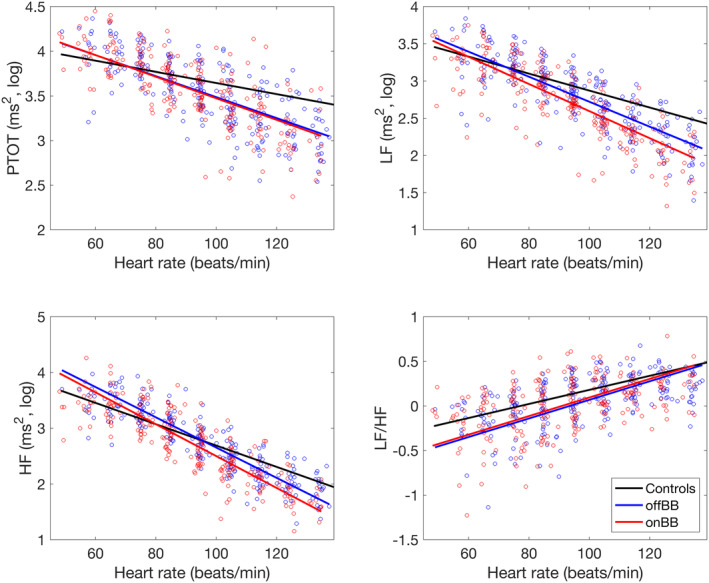 Figure 1
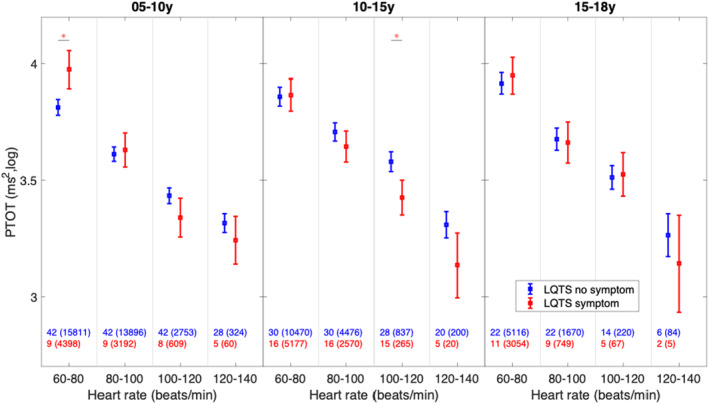 Figure 2
 Figure 3
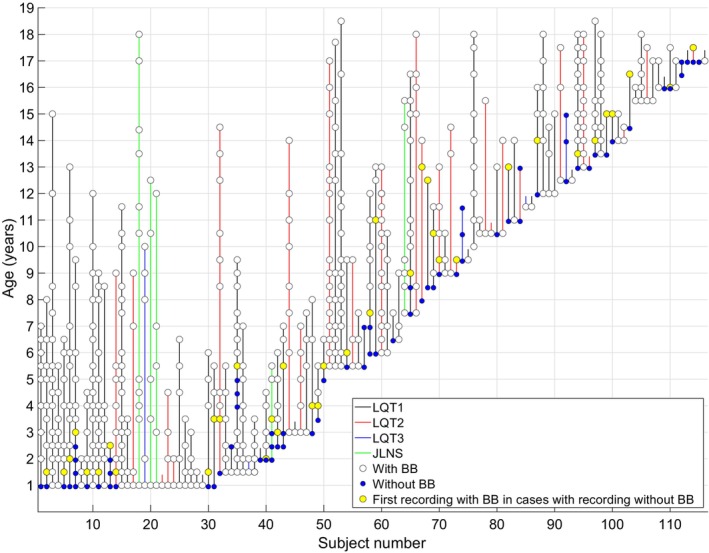 Figure 4
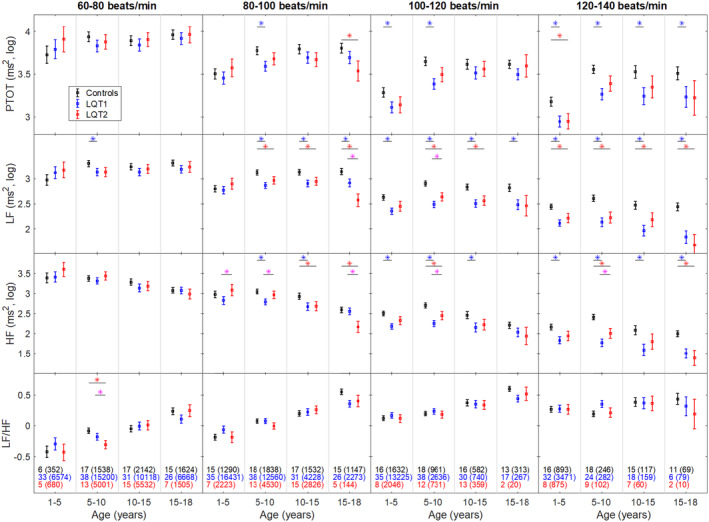 Figure 5
Peer Reviews
No public reviews on file for this paper yet. If you reviewed it on a platform where reviews are public (OpenReview, ICLR, NeurIPS, ICML), you can paste yours below so the community can read it here.
Videos
No videos yet. Explain this paper in a talk, walkthrough, or lecture? Add one.
Taxonomy
TopicsCardiac electrophysiology and arrhythmias · Heart Rate Variability and Autonomic Control · ECG Monitoring and Analysis