B‐lymphoblastic leukemia/lymphoma with DUX4 rearrangement
Wing Kit Lam, Ching Ching Alice Wong

Abstract
Genes, proteins, chemicals, diseases, species, mutations and cell lines named across the full text — each resolved to its canonical identifier and authoritative record.
Click any figure to enlarge with its caption.
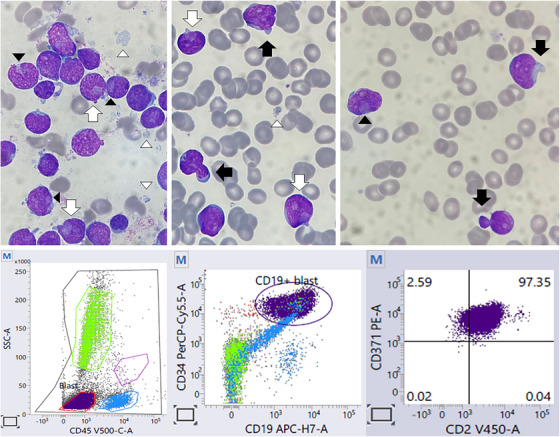 FIGURE 1
Peer Reviews
No public reviews on file for this paper yet. If you reviewed it on a platform where reviews are public (OpenReview, ICLR, NeurIPS, ICML), you can paste yours below so the community can read it here.
Videos
No videos yet. Explain this paper in a talk, walkthrough, or lecture? Add one.
Taxonomy
TopicsAcute Myeloid Leukemia Research · Acute Lymphoblastic Leukemia research · Chronic Lymphocytic Leukemia Research
1
A 35‐year‐old man presented with dizziness, exertional dyspnea, and palpitations for 1 month without fever. Complete blood count showed anemia (hemoglobin, 40 g/L), leucopenia (3.70 × 10^9^/L), and neutropenia (1.60 × 10^9^/L) with occasional circulating blasts on the peripheral blood smear. Bone marrow aspirate (May‐Grünwald‐Giemsa stain, ×1000; Figure 1, upper panels) showed 91% medium‐sized blasts with around half of them showing “cup‐like” nuclei (black arrowheads) and around a third of them showing cytoplasmic and/or nuclear blebs (black arrows). Some of the blasts showed both features (white arrows). Some leukemic cytoplasmic fragments were noted in the background (white arrowheads). Flow cytometry showed B‐lymphoblasts which demonstrate co‐expression of CD2 and CD371 (Figure 1, lower panel). Karyotype was normal. Next‐generation sequencing showed IKZF1 partial deletion (exons 4–7), PTPN11, and multiple NRAS mutations. Targeted RNA sequencing showed the presence of IGH::DUX4 fusion, confirming the diagnosis. The patient was given pediatric‐inspired intensive chemotherapy and achieved complete remission. He was planned to have allogeneic hematopoietic stem cell transplantation.
The morphological findings (upper panels) and the flow cytometry findings (lower panel) of the bone marrow aspirate of the patient.
B‐lymphoblastic leukemia/lymphoma (B‐ALL) with DUX4 rearrangement is a new provisional entity in the 5th edition of the World Health Organization Classification of Hematolymphoid Tumors which is more common in children, adolescents, and young adults and is associated with good prognosis. DUX4 rearrangements in B‐ALL are usually cytogenetically cryptic. Co‐expression of CD2 and CD371 in B‐ALL is strongly associated with DUX4 rearrangement. Yet, morphological description of this entity is scarce. “Cup‐like” nuclei in blasts are known to be associated with acute myeloid leukemia with NPM1 and/or FLT3‐ITD mutations but are less recognized in B‐ALL. Moreover, cytoplasmic and nuclear blebs are hitherto not described as distinctive features in any specific subtype of B‐ALL. Further study on the link between the morphological and molecular features of B‐ALL with DUX4 rearrangement cases would be of value.
AUTHOR CONTRIBUTIONS
Wing Kit Lam analyzed the data, wrote the paper, and produced the figures. Ching Ching Alice Wong analyzed the data and wrote the paper.
CONFLICT OF INTEREST STATEMENT
The authors declare no conflict of interest.
FUNDING INFORMATION
No funding source was declared.
ETHICS STATEMENT
The authors have confirmed ethical approval statement is not needed for this submission.
PATIENT CONSENT STATEMENT
Written informed consent from the patient was obtained.
CLINICAL TRIAL REGISTRATION
The authors have confirmed clinical trial registration is not needed for this submission.