Synthesis and optical properties of bis- and tris-alkynyl-2-trifluoromethylquinolines
Stefan Jopp, Franziska Spruner von Mertz, Peter Ehlers, Alexander Villinger, Peter Langer

TL;DR
This paper reports the synthesis of alkynylated quinolines and their optical properties, showing how substitution patterns affect their behavior.
Contribution
The novel contribution is the synthesis of bis- and tris-alkynyl-2-trifluoromethylquinolines and their optical property analysis.
Findings
Bis- and tris-alkynyl-2-trifluoromethylquinolines were synthesized in good to excellent yields.
Optical properties were studied using absorption and fluorescence spectroscopy.
Substitution patterns and substituent types significantly influence optical behavior.
Abstract
Three bis- or tris-brominated 2-trifluoromethylquinolines have been successfully applied in palladium-catalysed Sonogashira reactions, leading to several examples of alkynylated quinolines in good to excellent yields. Optical properties of selected products have been studied by steady state absorption and fluorescence spectroscopy which give insights of the influence of the substitution pattern and of the type of substituents on the optical properties.
Genes, proteins, chemicals, diseases, species, mutations and cell lines named across the full text — each resolved to its canonical identifier and authoritative record.
Click any figure to enlarge with its caption.
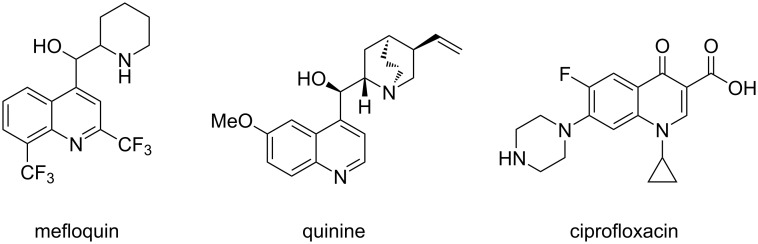 Figure 1
 Scheme 1
 Scheme 2
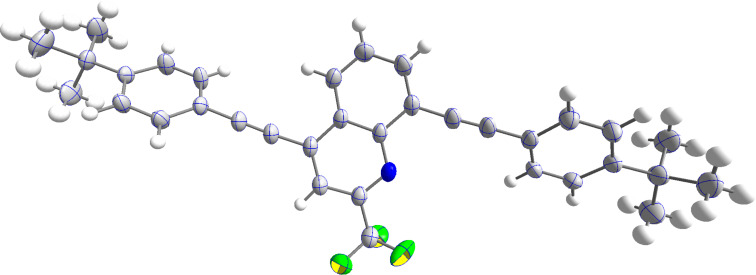 Figure 2
 Scheme 3
 Scheme 4
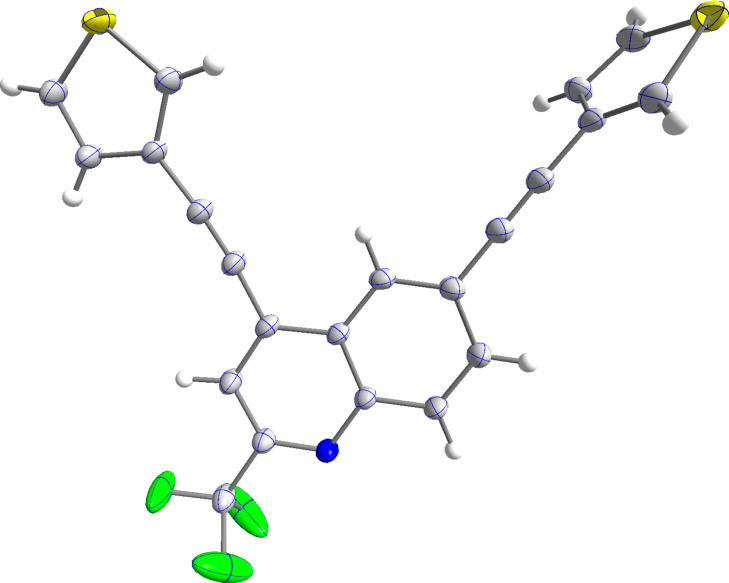 Figure 3
 Scheme 5
 Scheme 6
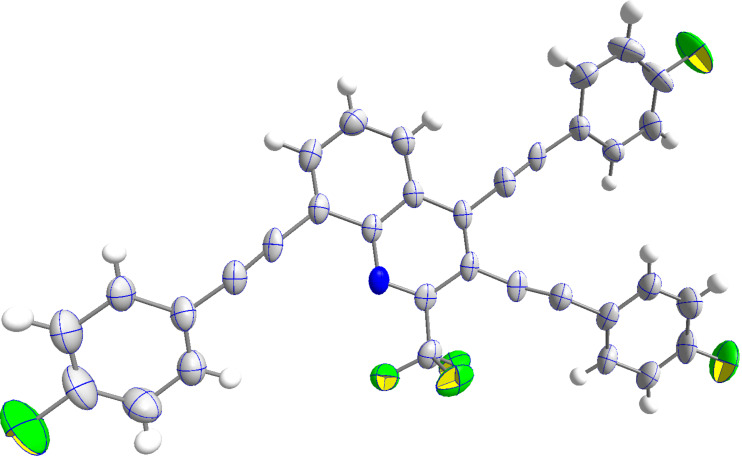 Figure 4
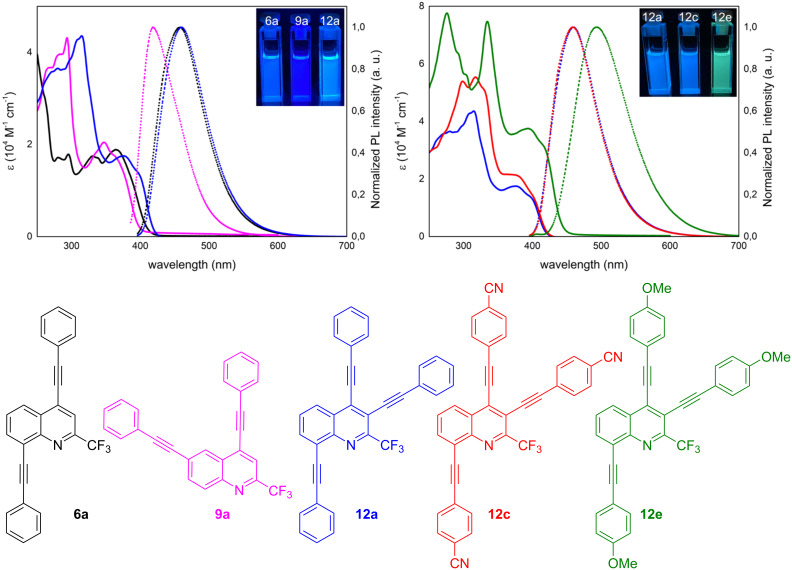 Figure 5
|
| |||
|
| |||
| Pd-catalyst | Ligand | Cu-catalyst | Yield |
|
| |||
| Pd(OAc)2 (5) | XPhos (10) | CuI (10) | 99 |
| Pd(OAc)2 (2.5) | XPhos (5) | CuI (5) | 99 |
| Pd(PPh3)4 (5) | – | CuI (10) | 99 |
| Pd(PPh3)4 (2.5) | – | CuI (5) | 99 |
| Pd(PPh3)4 (1.75) | – | CuI (3.5) | 93 |
| Pd(PPh3)4 (1) | – | CuI (2) | 90 |
|
|
|
|
|
| |
|
| |||||
| λ1,abs (nm) | 280 | 267 | 279 | 298 | 276 |
| ελ1 (M−1cm−1) | 17200 | 36600 | 36600 | 53900 | 77600 |
| λ2,abs (nm) | 295 | 282 | 308 | 318 | 292a |
| ελ2 (M−1cm−1) | 17900 | 39600 | 42700 | 55400 | 64000 |
| λ3,abs (nm) | 331 | 293 | 315 | 330 | 303 |
| ελ3 (M−1cm−1) | 17400 | 43200 | 43600 | 51100 | 56100 |
| λ4,abs (nm) | 337 | 347 | 377 | 378 | 335 |
| ελ4 (M−1cm−1) | 17100 | 20500 | 17500 | 21100 | 75700 |
| λ5,abs (nm) | 365 | 362a | 395a | 397a | 395 |
| ελ5 (M−1cm−1) | 18800 | 17500 | 14300 | 15800 | 37400 |
| λ6,abs (nm) | 416a | ||||
| ελ6 (M−1cm−1) | 32089 | ||||
| λ1,em380 (nm) | 457 | 419 | 459 | 458 | 494 |
| Φb | 0.66 | 0.63 | 0.54 | 0.56 | 0.59 |
- —Ministerium für Bildung, Wissenschaft und Kultur Mecklenburg-Vorpommernhttp://dx.doi.org/10.13039/501100014848
Peer Reviews
No public reviews on file for this paper yet. If you reviewed it on a platform where reviews are public (OpenReview, ICLR, NeurIPS, ICML), you can paste yours below so the community can read it here.
Videos
No videos yet. Explain this paper in a talk, walkthrough, or lecture? Add one.
Taxonomy
TopicsFluorine in Organic Chemistry · Synthesis and Biological Evaluation · Catalytic Cross-Coupling Reactions
Introduction
Quinoline is a well-known core structure which can be found in several natural and synthetic products and many of them show interesting pharmacological properties [1–3]. Quinine, for example, is a widely known natural product which was first isolated from the cinchona tree besides many other quinoline-containing cinchona alkaloids [4]. It is applied as antimalarial agent and furthermore as a bitter flavour component. Mefloquin [5] and ciprofloxacin [6], on the other hand, are synthetic compounds containing a fluorinated quinoline and quinolone core structure and are used as antimalarial and antibacterial agents, respectively (Figure 1). Fluorine-containing quinolines and quinolinones are of particular interest, since fluorine atoms are known to enhance the pharmacological properties of organic molecules [7–15]. Fluorine atoms act as bioisosteres of hydrogen atoms, while CF_3_ groups are bioisosteres of hydroxy and methyl groups and are known to protect from metabolic oxidation [16]. Fluorine-containing arenes are metabolically more stable as compared to non-fluorinated arenes and they show a higher lipophilicity.
Natural and synthetic compounds containing a quinoline or quinolone core-structure.
Known synthetic approaches towards 2-trifluoromethylquinolines include the cyclisation of anilines with trifluoroacetoacetate [17], the synthesis from enaminoketones [18] and the gold-catalysed cyclisation of propargylanilines [19].
Aside from its pharmaceutical significance quinoline compounds have been reported as strongly fluorescent with applications as electroluminescence materials [20–23], dyes, preservatives and as ligands in complex chemistry [24–27].
In the context of our interest in the application of cross-coupling reactions to polyhalogenated heterocycles [28–31], we studied Sonogashira reactions of brominated 2-trifluoromethylquinolines. The optical properties of selected products, bis- and tris-alkynylated quinolines, were studied to gain insights into how the substitution pattern at different positions may alter the optical properties.
Results and Discussion
The starting material, 4,8-dibromo-2-(trifluoromethyl)quinoline (4), was synthesized from 2-bromoaniline (1a) and ethyl trifluoroacetoacetate (2), adapting a known procedure from Schlosser and Marull (Scheme 1) [17]. The cyclization of 1a with 2a chemoselectively afforded 8-bromo-2-trifluoromethyl-4-quinolone (3) rather than 8-bromo-4-trifluoromethyl-2-quinolone. Bromination of 3 with phosphoryl bromide gave 4.
Synthesis of 4. Reaction conditions: i: polyphosphoric acid, 150 °C, 2 h; ii: POBr3 (1.1 equiv), 150 °C, 2 h.
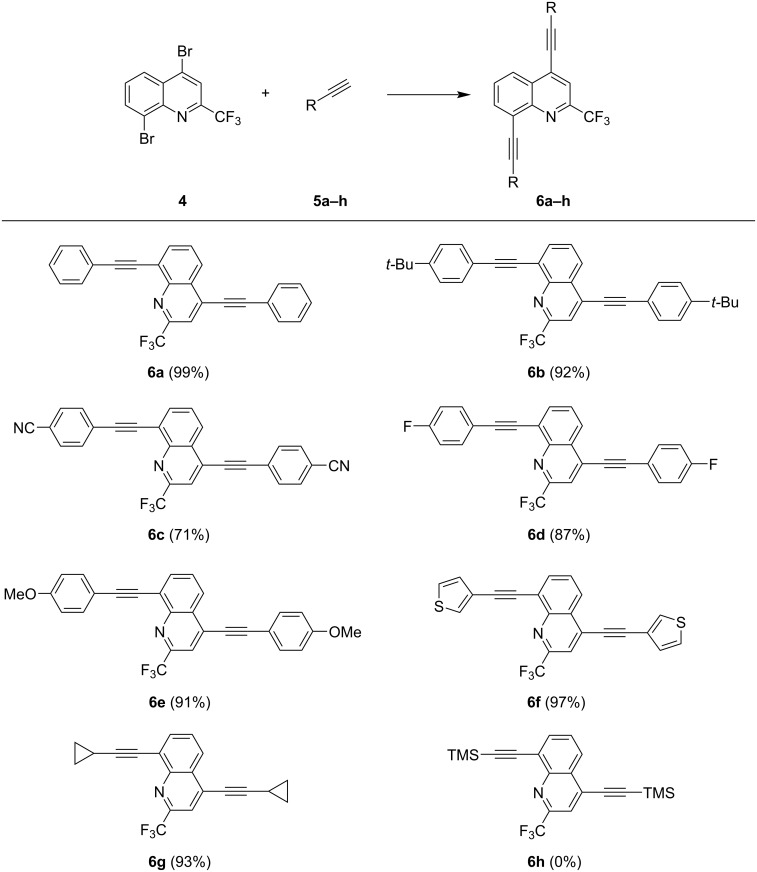
With quinoline 4 in hand, we studied palladium-catalysed Sonogashira reactions with phenylacetylene (5a). Gratifyingly, our initial test reaction, using Pd(OAc)2 as catalyst with XPhos as ligand, gave bis-alkynylated product 6a in quantitative yield. Reducing the catalyst loading from 5 to 2.5 mol % or switching to more simple Pd(PPh_3_)4 still achieved quantitative yields. Less catalyst led to a reduced yield (Table 1). Consequently, we chose 2.5 mol % Pd(PPh_3_)4 for all further reactions.
As a next step, we analysed the scope of our methodology (Scheme 2). The optimized conditions allow cross-coupling reactions of various acetylenes containing electron-rich and electron-withdrawing functional groups, like methoxy or cyano, as well as thienyl and cyclopropyl groups. In general, all products were achieved in very good yields, ranging from 71 to 99%. Only product 6h, containing a TMS group, could not be isolated at all, since the reaction resulted in an inseparable mixture of several products.
Synthesis of compounds 6a–h. Reaction conditions: Pd(PPh3)4 (2.5 mol %), CuI (5 mol %), acetylene (3.0 equiv), dioxane, NEt3, 100 °C, 6 h; isolated yields.
The structure of 6b could be independently confirmed by X-ray crystallography (Figure 2). Both phenyl rings are found to be twisted in an angle of approximately 45° from the quinoline core.
ORTEP of 6b (CCDC 2322985).
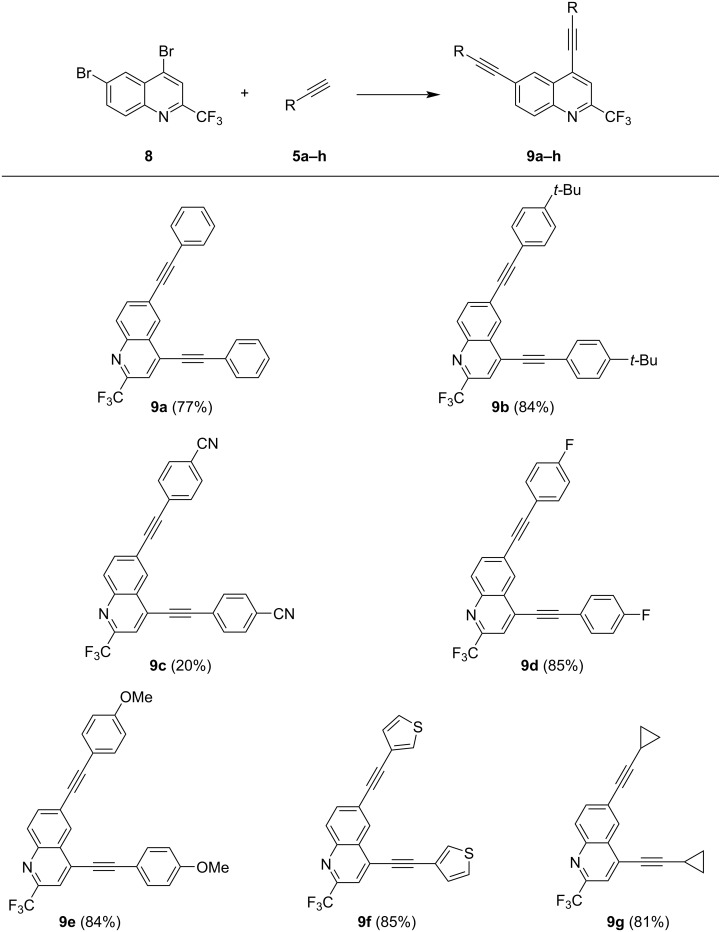
As a next step of our synthetic studies, we synthesized 4,6-dibromo-2-trifluoromethylquinoline (8) [32], an isomer of 4, using 4-bromoaniline (1b) instead of 1a (Scheme 3). Afterwards, we studied the scope of the twofold Sonogashira reaction, using the same reaction conditions as before (Scheme 4).
Synthesis of 8. Reaction conditions: i: polyphosphoric acid, 150 °C, 2 h [33]; ii: POBr3 (1.1 equiv), 150 °C, 2 h.
Synthesis of compounds 9a–g: Reaction conditions: Pd(PPh3)4 (2.5 mol %), CuI (5 mol %), acetylene (3.0 equiv), dioxane, NEt3, 100 °C, 6 h, isolated yields.
All 2,6-bis-alkynylated quinolines 9 were obtained in good yields of 77–85%, except for 9c containing a cyano group (20%), most likely due to its low solubility. The yields are generally lower as compared to isomeric 2,8-bis-alkynylated products 6a–g, which might be due to a slightly lower reactivity of the 6-position in comparison to the 8-position.
The structure of product 9f was confirmed by X-ray crystallography (Figure 3). The thiophene ring in 4-position is in plane with the quinoline core, while the other ring is twisted in an angle of approximately 85°. This might be explained by an electronic push–pull interaction of the thiophene and the quinoline moieties via the alkyne.
ORTEP of 9f (CCDC 2322983).
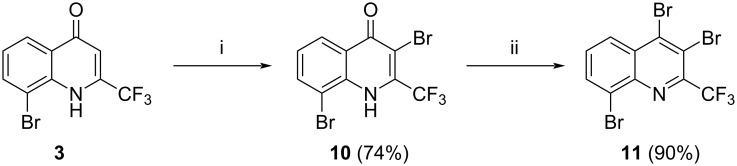
Finally, we focussed on the synthesis of tris-alkynylated quinolines starting from 3,4,8-tribromo-2-(trifluoromethyl)quinoline (11). Starting material 11 was synthesized in very good yield from quinolone 3 by bromination in position 3, followed by treatment of brominated intermediate 10 with phosphoryl bromide (Scheme 5) [34].
Synthesis of starting material 11. Reaction conditions: i: AcOH, Br2 (1.1 equiv), reflux, 24 h; ii: POBr3 (1.1 equiv), 150 °C, 2 h.
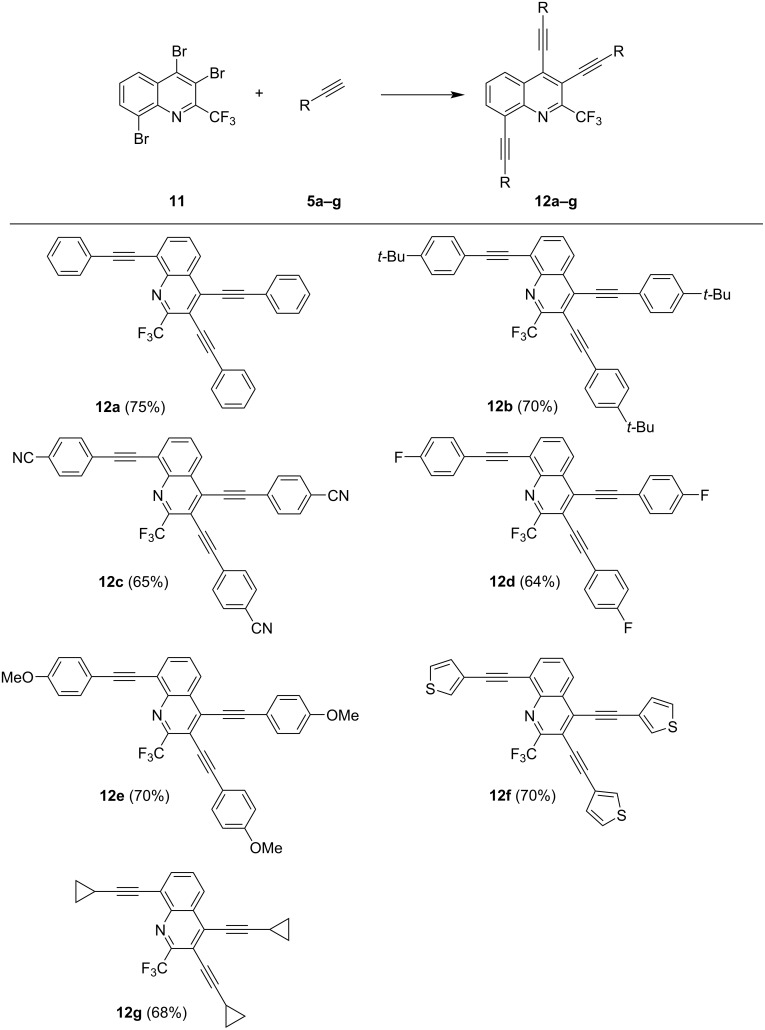
To our delight, the optimized conditions for the synthesis of alkynylated quinolines 6 could be applied also to the three-fold Sonogashira reaction of 11. However, the reaction time had to be prolonged from 6 to 24 h and the amount of acetylene was increased. Thus, tris-alkynylated quinolines 12a–g were prepared in good 64–75% yields (Scheme 6). The yields of products 12a–g were lower as compared to bis-alkynylated products 6a–g which were, in fact, found as major side-products, due to dehalogenation at position 3. In particular, the side-product 6b was isolated in 25% yield during the purification of 12b. The structure of product 12d was proven by X-ray crystallography (Figure 4). All three phenyl rings are found to be nearly in plane with the quinoline core, showing only a slight twist of 5–10°.
Synthesis of compounds 12a–g. Reaction conditions: Pd(PPh3)4 (2.5 mol %), CuI (5 mol %), acetylene (4.0 equiv), dioxane, NEt3, 100 °C, 24 h; isolated yields.
ORTEP of 12d (CCDC 2322984).
Optical properties
Steady-state absorption and fluorescence measurements were carried out. Compounds 6a, 9a, and 12a were selected to study the impact of the position of the alkynyl group on the optical properties. Comparison of the absorption and emission features of 12a, 12b and 12c gives first insights on how the optical properties can be fine-tuned by the substitution pattern of the arylalkyne. The key optical properties are summarized in Table 2.
All molecules display relatively high quantum yields (QYs) with the highest being 0.66 for 6a and the lowest 0.54 for 12a. This is in accordance with similar poly-alkynylated molecules from the literature [31,36]. Differences in the absorption and photoluminescence spectra of 6a, 9a and 12a can be explained by the different positions of the alkyne moieties (Figure 5). All absorption spectra exhibit a broad first absorption band with different fine structures. However, TD-DFT calculations using the long-range correlated CAM-B3LYP/6-311G(d,p) level of theory reveal that the lowest energy band for all three derivatives 6a, 9a and 12a originate mainly from a HOMO→LUMO transition with some admixture of HOMO−1→LUMO+1 and HOMO−1→LUMO, respectively. A bathochromic shift is observed from 9a over 6a to 12a in the first absorption maximum with a total of 0.29 eV. This trend can be observed in the emission spectrum as well. All three emission spectra are characterized by a single broad emission peak which is almost identical for 6a and 12a and is redshifted by 0.26 eV compared to 9a. Thus, the position of the substituent at the quinoline core has a significant impact on the optical properties of the molecules. An alkynyl group located at the 8-position seems to have a greater impact on the properties than one at the 3-position, since 6a and 12a are almost identical in their emission.
UV–vis and emission spectra of 6a, 9a and 12a (left) and 12a, 12c, and 12e (right, λex = 380 nm) in DCM (c = 10−5 M) at 20 °C.
The influence of the type of substituent located at the alkyne moieties of 12a, 12c, and 12e was also studied. The intensity increases from 12a to 12e and a bathochromic shift of the absorption maxima can be observed. Interestingly, the emission spectra of 12a and 12c are identical which suggests that the strong acceptor groups of 12c do not have an impact on the emission. On the other hand, the strong donor groups of 12e cause a redshift of 0.20 eV as compared to the simple phenyl-substituted molecule. Electron-acceptor groups usually have a slighter impact on the emission than electron-donating groups [36]. These findings show that by varying the position and the substituents of the alkynyl groups the properties of the products can be tuned effectively.
Conclusion
Three different brominated 2-trifluoromethylquinolines have been synthesized and applied to palladium-catalysed Sonogashira reactions. Optimised reaction conditions allow the synthesis of various bis- or tris-alkynylated products in one step. Products were generally obtained in high yields and intensive fluorescence. The photophysical properties of selected compounds were investigated via steady-state absorption and fluorescence spectroscopy and gives first insights into the structure–optical property relationship of polyalkynylated quinolines. In particular, high fluorescence quantum yields have been determined for all studied compounds. Variation of the substitution pattern on the quinoline scaffold and on the arylalkyne moiety permits the fine tuning of the optical properties.
Supporting Information
File 1Experimental part.
The reference list from the paper itself. Each links out to its DOI / PubMed record.
- 1Cannon J G J Med Chem 1997404165416610.1021/jm 9706123 · doi ↗
- 2Michael J P Nat Prod Rep 20082516618710.1039/b 612168 n 18250901 · doi ↗ · pubmed ↗
- 3Taylor J B Triggle D J Comprehensive medicinal chemistry II 2007 Amsterdam, Netherlands Elsevier
- 4Willcox M Bodeker G Rasoanaivo P Traditional Medicinal Plants and Malaria 2004 Boca Raton, FL, USACRC Press 10.1201/9780203502327 · doi ↗
- 5Ohnmacht C J Patel A R Lutz R E J Med Chem 19711492692810.1021/jm 00292 a 0085115690 · doi ↗ · pubmed ↗
- 6Grohe K Zeiler H-J Metzger K 1-Cyclopropyl-6-fluor-1,4-dihydro-4-oxo-7-piperazino-chinolin-3-carbonsäuren, Verfahren zu ihrer Herstellung Ger. Pat. Appl.DE 3142854 A 119811029
- 7Baraznenok I L Nenajdenko V G Balenkova E S Eur J Org Chem 1999493794110.1002/(sici)1099-0690(199904)1999:4<937::aid-ejoc 937>3.0.co;2-311672241 · doi ↗ · pubmed ↗
- 8Crousse B BéguéJ-P Bonnet-Delpon D J Org Chem 200065165009501310.1021/jo 991880710956485 · doi ↗ · pubmed ↗