EMG phenomena of myogenic hyperexcitability
Andreas Posa, Malte Kornhuber

TL;DR
This paper discusses how muscle spontaneous activity patterns help diagnose neuromuscular diseases, focusing on myogenic conditions.
Contribution
The study highlights distinct patterns of pathological spontaneous activity in myogenic disorders.
Findings
Pathological spontaneous activity in myogenic diseases shows distinct distribution patterns.
These patterns correlate with the location of neuromuscular lesions.
EMG findings are typically detectable 2 to 4 weeks after lesion onset in axonal injuries.
Abstract
Art, Verteilungsmuster und der zeitliche Verlauf muskulärer Spontanaktivität sind für die Diagnostik neuromuskulärer Krankheiten im klinischen Alltag bedeutsam. Bei neurogenen Läsionen mit motorisch axonaler Beteiligung ist pathologische Spontanaktivität (PSA) meist 2 bis 4 Wochen nach Läsionsbeginn mittels Nadelelektromyographie sicher fassbar. Das Verteilungsmuster korreliert dabei mit dem Läsionsort. Schwerpunkt der vorliegenden Arbeit liegt in der Darstellung der unterschiedlichen PSA-Verteilungsmuster bei myogenen Erkrankungen.
Genes, proteins, chemicals, diseases, species, mutations and cell lines named across the full text — each resolved to its canonical identifier and authoritative record.
Click any figure to enlarge with its caption.
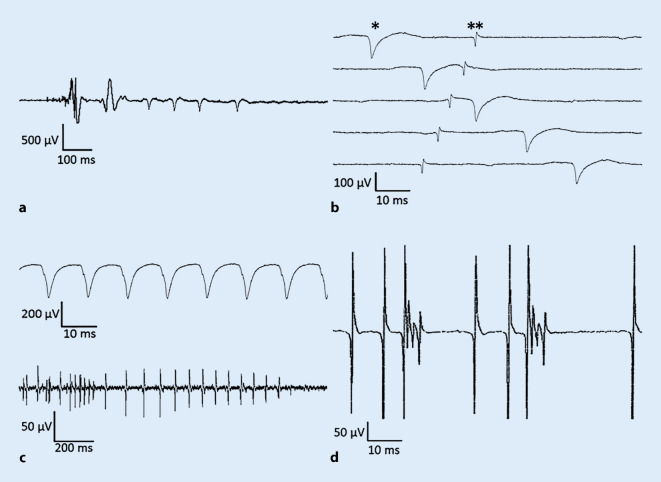 Figure 1
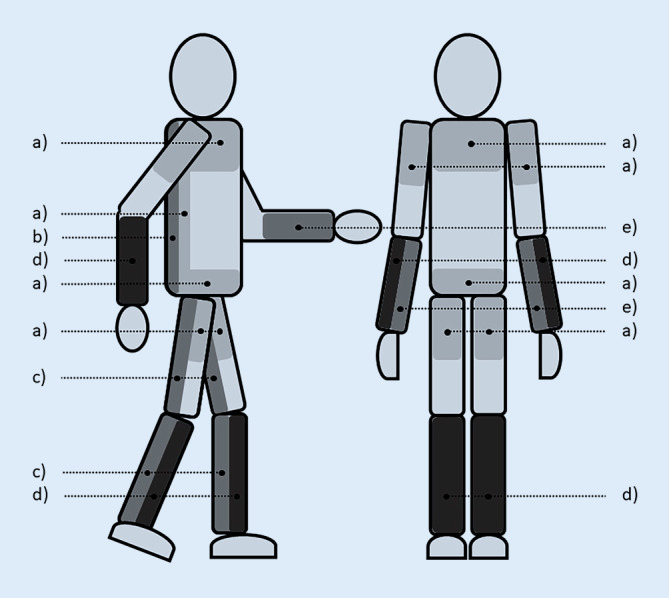 Figure 2
 Figure 3
Peer Reviews
No public reviews on file for this paper yet. If you reviewed it on a platform where reviews are public (OpenReview, ICLR, NeurIPS, ICML), you can paste yours below so the community can read it here.
Videos
No videos yet. Explain this paper in a talk, walkthrough, or lecture? Add one.
Taxonomy
TopicsNeurogenetic and Muscular Disorders Research · Hereditary Neurological Disorders · Myasthenia Gravis and Thymoma