A Novel Thermo-Alkaline Stable GDSL/SGNH Esterase with Broad Substrate Specificity from a Deep-Sea Pseudomonas sp
José Luis Rodríguez-Mejía, Itzel Anahí Hidalgo-Manzano, Luis Felipe Muriel-Millán, Nancy Rivera-Gomez, Diana X. Sahonero-Canavesi, Edmundo Castillo, Liliana Pardo-López

TL;DR
A new esterase from a deep-sea Pseudomonas sp. shows stability in harsh conditions and could be useful for industrial applications.
Contribution
Discovery of a novel thermo-alkaline stable esterase from a deep-sea Pseudomonas sp. with broad substrate specificity.
Findings
EstGoM is a new esterase from a deep-sea Pseudomonas sp. with high activity at pH 9 and 60°C.
EstGoM retains over 50% activity across pH 7–11 and temperatures 10–75°C, and is tolerant to high salt and detergents.
EstGoM belongs to a new subgroup of lipolytic family II esterases and has broad substrate specificity.
Abstract
Marine environments harbor a plethora of microorganisms that represent a valuable source of new biomolecules of biotechnological interest. In particular, enzymes from marine bacteria exhibit unique properties due to their high catalytic activity under various stressful and fluctuating conditions, such as temperature, pH, and salinity, fluctuations which are common during several industrial processes. In this study, we report a new esterase (EstGoM) from a marine Pseudomonas sp. isolated at a depth of 1000 m in the Gulf of Mexico. Bioinformatic analyses revealed that EstGoM is an autotransporter esterase (type Va) and belongs to the lipolytic family II, forming a new subgroup. The purified recombinant EstGoM, with a molecular mass of 67.4 kDa, showed the highest hydrolytic activity with p-nitrophenyl octanoate (p-NP C8), although it was also active against p-NP C4, C5, C10, and C12. The…
Genes, proteins, chemicals, diseases, species, mutations and cell lines named across the full text — each resolved to its canonical identifier and authoritative record.
Click any figure to enlarge with its caption.
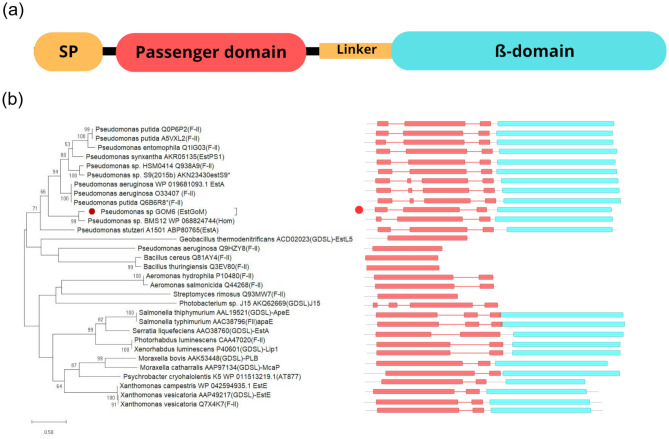 Figure 1
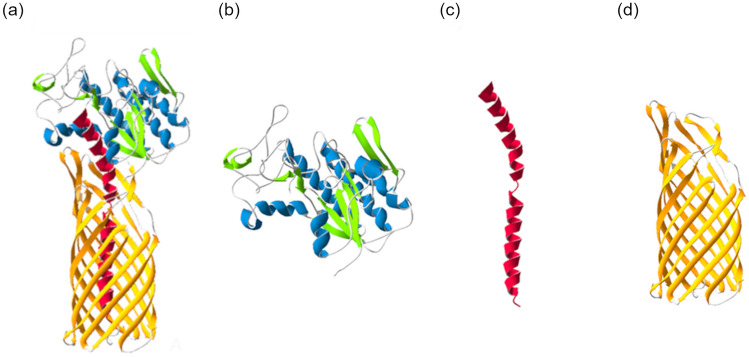 Figure 2
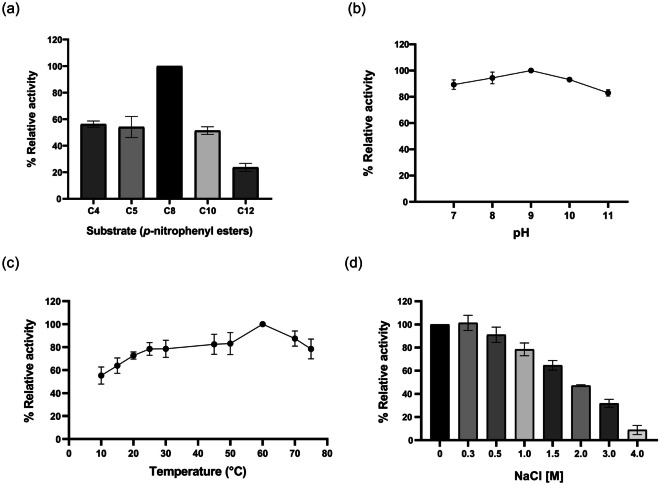 Figure 3
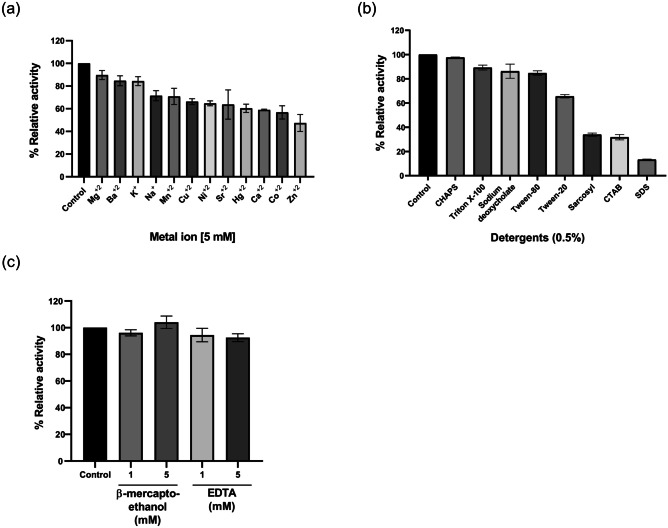 Figure 4
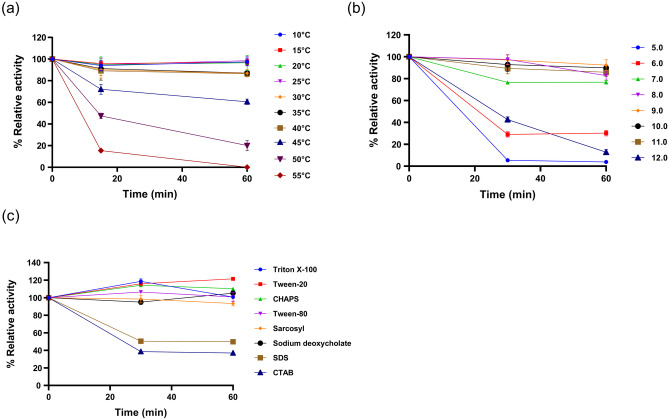 Figure 5
Peer Reviews
No public reviews on file for this paper yet. If you reviewed it on a platform where reviews are public (OpenReview, ICLR, NeurIPS, ICML), you can paste yours below so the community can read it here.
Videos
No videos yet. Explain this paper in a talk, walkthrough, or lecture? Add one.
Taxonomy
TopicsEnzyme Catalysis and Immobilization · Microbial Metabolic Engineering and Bioproduction · Enzyme Structure and Function