Establishment of a laboratory colony of Pressatia choti (Diptera: Psychodidae), a suspected vector of Leishmania braziliensis
Joanna Alexandre, Débora Elienai de Oliveira Miranda, Fernando José da Silva, Filipe Dantas-Torres, Sinval Pinto Brandão-Filho

TL;DR
Researchers successfully created a lab colony of Pressatia choti sand flies, which may help study their role in spreading Leishmania braziliensis.
Contribution
The first successful establishment of a laboratory colony of Pressatia choti for potential use in leishmaniasis research.
Findings
A laboratory colony of Pressatia choti was successfully established.
The life cycle of Pr. choti ranged from 31 to 56 days under controlled conditions.
Biological parameters of Pr. choti are comparable to other neotropical sand flies.
Abstract
Pressatia choti is a common sand fly found in the Atlantic Forest of Brazil, which is suspected to be involved in the transmission of Leishmania braziliensis. Herein, we aimed to establish a Pr. choti laboratory colony. Wild-caught female sand flies were blood fed on hamsters and maintained under controlled conditions (temperature: 26 °C; relative humidity: 70%). Of the 301 collected female sandflies, 288 were identified as Pr. choti. The life cycle duration ranged from 31 to 56 days. We successfully established a Pr. choti colony, whose biological parameters were similar to those of other neotropical sand flies.
Genes, proteins, chemicals, diseases, species, mutations and cell lines named across the full text — each resolved to its canonical identifier and authoritative record.
Click any figure to enlarge with its caption.
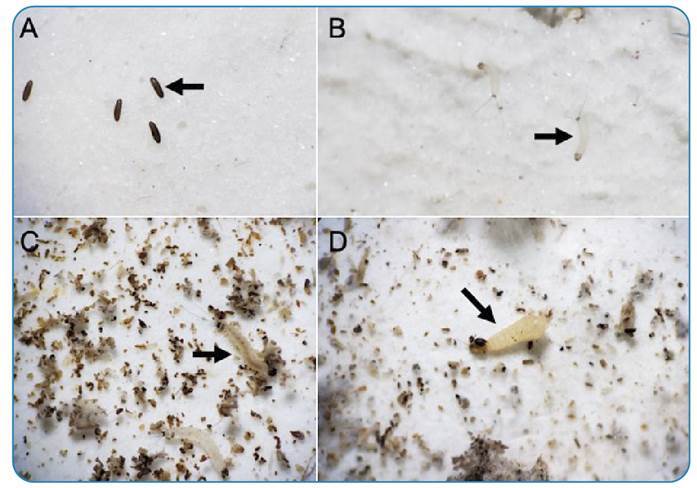 Figure 1
Peer Reviews
No public reviews on file for this paper yet. If you reviewed it on a platform where reviews are public (OpenReview, ICLR, NeurIPS, ICML), you can paste yours below so the community can read it here.
Videos
No videos yet. Explain this paper in a talk, walkthrough, or lecture? Add one.
Taxonomy
TopicsResearch on Leishmaniasis Studies · Trypanosoma species research and implications · Parasites and Host Interactions