Novel Approach to Exploring Protease Activity and Targets in HIV-associated Obstructive Lung Disease using Combined Proteomic-Peptidomic Analysis
Sarah Samorodnitsky, Monica Kruk, Eric F. Lock, Ken M. Kunisaki, Alison Morris, Janice M. Leung, Danielle Weise, Subina Mehta, Laurie L. Parker, Pratik D. Jagtap, Timothy J. Griffin, Chris H. Wendt

TL;DR
This study explores how proteases contribute to lung disease in people with HIV by combining proteomic and peptidomic analyses to identify key proteases and their targets.
Contribution
The novel integration of proteomic and peptidomic data provides new insights into protease activity and targets in HIV-associated obstructive lung disease.
Findings
101 proteases were identified, with 22 showing significant correlation with lung function.
31 cleaved proteins were found to associate with lung function, linked to SUMOylation pathways.
Proteases like neutrophil elastase and cathepsin D are implicated in degrading proteins critical for cell cycle and stability.
Abstract
Obstructive lung disease (OLD) is increasingly prevalent among persons living with HIV (PLWH). However, the role of proteases in HIV-associated OLD remains unclear. We combined proteomics and peptidomics to comprehensively characterize protease activities. We combined mass spectrometry (MS) analysis on bronchoalveolar lavage fluid (BALF) peptides and proteins from PLWH with OLD (n=25) and without OLD (n=26) with a targeted Somascan aptamer-based proteomic approach to quantify individual proteases and assess their correlation with lung function. Endogenous peptidomics mapped peptides to native proteins to identify substrates of protease activity. Using the MEROPS database, we identified candidate proteases linked to peptide generation based on binding site affinities which were assessed via z-scores. We used t-tests to compare average forced expiratory volume in 1 second per predicted…
Genes, proteins, chemicals, diseases, species, mutations and cell lines named across the full text — each resolved to its canonical identifier and authoritative record.
Click any figure to enlarge with its caption.
 Figure 1
 Figure 2
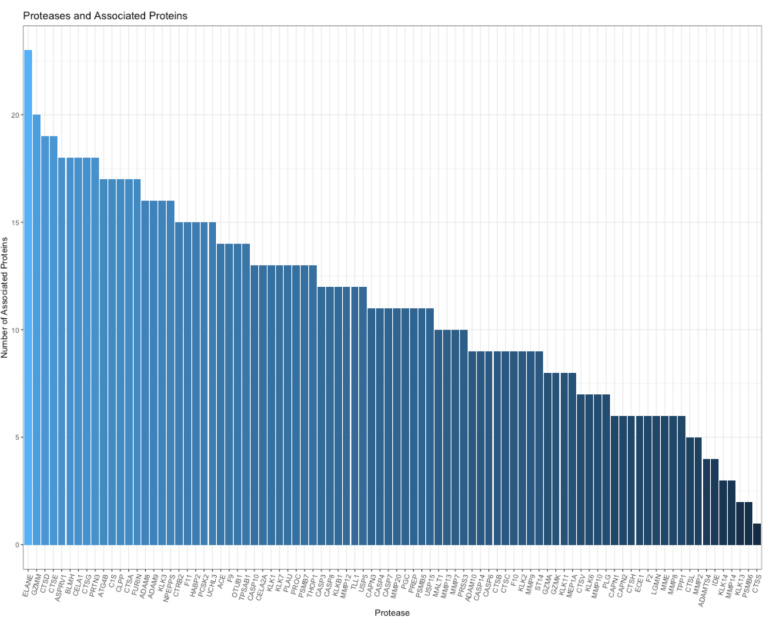 Figure 3
Peer Reviews
No public reviews on file for this paper yet. If you reviewed it on a platform where reviews are public (OpenReview, ICLR, NeurIPS, ICML), you can paste yours below so the community can read it here.
Videos
No videos yet. Explain this paper in a talk, walkthrough, or lecture? Add one.
Taxonomy
TopicsPeptidase Inhibition and Analysis · Pneumocystis jirovecii pneumonia detection and treatment · Studies on Chitinases and Chitosanases