Incidence of side effects of antituberculosis drugs and their related factors in northern Iran: a retrospective cohort study
Motahareh Kheradmand, Mahdi Afshari, Mohsen Aarabi, Siavosh Abedi, Mohammadreza Parsaee, Asghar Nezammahalleh, Mahmood Moosazadeh

TL;DR
This study examines the side effects of tuberculosis drugs in northern Iran and finds that older patients are more likely to experience adverse reactions.
Contribution
The study identifies age over 59 as a risk factor for adverse drug reactions in TB patients.
Findings
136 out of 3903 TB patients experienced major adverse drug reactions (3.5%).
Patients over 59 years old had a higher chance of ADR compared to those under 29 (OR=2.63).
No significant differences in ADR rates were found between genders or treatment history groups.
Abstract
Antituberculosis drugs may cause mild, moderate or severe adverse drug reactions (ADR) leading to poor compliance. Description of the pattern of ADR and their related factors can help tuberculosis (TB) control program as part of the WHO programs. This study aims to investigate the incidence of ADR and associated factors among TB patients in northern Iran. This is a retrospective cohort study. The required information, including year of diagnosis, age, gender, residence area, nationality, HIV co-morbidity, history of anti TB treatment and ADR, was obtained from the Deputy of Health, Mazandaran University of Medical Sciences, Iran. All data were analyzed using SPSS version 21 software. Out of 3903 TB patients, 136 (3.5%) experienced major ADR. The incidence of ADR for men and women as well as for those with and without previous treatment history were 3.9% vs. 3.3% and 5.3% vs. 3.4%,…
Genes, proteins, chemicals, diseases, species, mutations and cell lines named across the full text — each resolved to its canonical identifier and authoritative record.
Click any figure to enlarge with its caption.
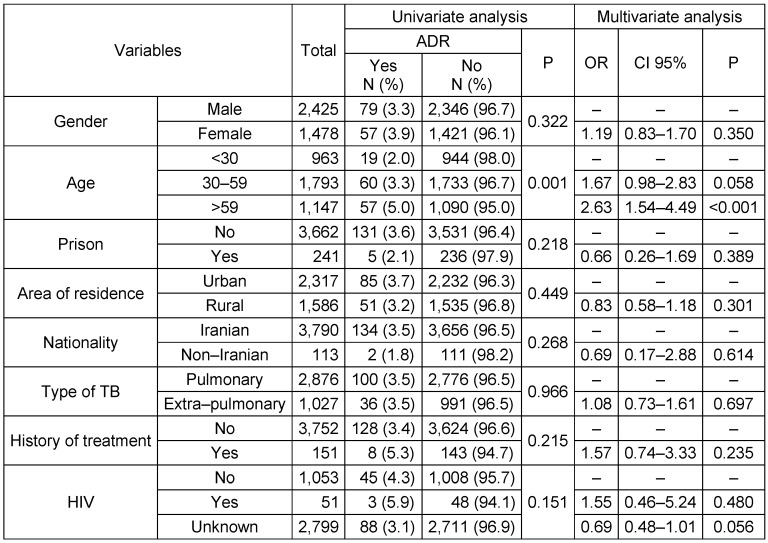 Figure 1
Peer Reviews
No public reviews on file for this paper yet. If you reviewed it on a platform where reviews are public (OpenReview, ICLR, NeurIPS, ICML), you can paste yours below so the community can read it here.
Videos
No videos yet. Explain this paper in a talk, walkthrough, or lecture? Add one.
Taxonomy
TopicsTuberculosis Research and Epidemiology · Pharmacological Effects of Natural Compounds · Leprosy Research and Treatment
Background
Despite the reduction in tuberculosis (TB) incidence, its morbidity and mortality is still one of the main global public-health concerns. The annual incidence and the mortality of TB has been estimated to be 9.6 million and 1.5 million, respectively [1], [2]. The first line anti-TB drugs (Rifampin, Isoniazid, Pyrazinamide) have an efficacy exceeding 95% [3].
Anti-TB drugs may cause some adverse drug reactions (ADR), varying from mild to severe forms. Just 2%–8% of TB patients may experience severe ADR, such as exanthema, vertigo, psychosis and hepatotoxicity, leading to a termination of or change in treatment regimen. Conversely, mild to moderate ADR, including gastroenteric problems, nausea/vomiting, arteritis, peripheral neuropathy, drug allergy, rash/itching, headache and behavioral problems (insomnia, anxiety, hypolibido), do not require emergent change in treatment regimen. Such complications may challenge the TB control program [4], [5], [6], [7], [8]. Hepatotoxicity, one of the most severe drug reactions, occurs in the first month of treatment and can be fatal if diagnosed late [2]. The ADR incidence is also affected by dosage and time of drug prescription. Age, nutritional status, co-morbidities such as liver or renal dysfunction as well as HIV infection and alcoholism are other determinants for TB ADR [6].
In addition to high burdens associated with ADR for patients and communities, diagnosis and treatment of such complications cause high economic costs, including hospitalization, provision of drugs and food supplements, and a negative impact on the work force [4]. Describing the pattern of ADR onset along with investigating the factors associated with such adverse reactions can help policymakers to control and manage the relevant costs [9]. In this study, we aimed to determine the incidence of ADR and relevant risk factors among TB patients in Mazandaran University of Medical Sciences.
Methods
The retrospective cohort study was conducted among 3,903 patients with TB treated with anti-TB drugs from 2005 to 2017. All of them were recruited by census method. Inclusion criteria were: all TB patients who registered and were followed-up from treatment initiation until the end of the second month of treatment. Exclusion criteria include:
- Subjects who were diagnosed and registered as TB patients but later on TB diagnosis was ruled out.
- Patients who were diagnosed in another center and referred to the TB registry system of Mazandaran University of Medical Sciences, but their history of adverse-reaction experience was not available.
The required information was provided from the TB registry system by the Health Deputy of Mazandaran University of Medical Sciences, Sari, Iran, in excel format. This information included year of diagnosis, age, gender, area of residence, nationality, HIV co-morbidity, history of anti TB treatment and ADR. The following adverse reactions were assessed: peripheral neuropathy (burning of the extremities), nausea, vomiting, abdominal pain, edema, mucosal ulcers, shock, hearing loss or deafness, vertigo, nystagmus, icterus, visual impairment, acute liver failure, thrombocytopenia, acute renal failure, feverless skin rashes and skin rashes with fever.
Adverse reactions were evaluated and approved by a general practitioner who was in charge of the treatment of TB patients. According to the WHO Tuberculosis Control Program, we defined the presence of ADR as at least one of the above-mentioned side effects in patients receiving tuberculosis treatment. In the case of any missing data, the research team was referred to the peripheral city districts and collected the required data from the patients and their files.
The collected data were transferred to SPSS version 21 after refinement. The incidence of ADR and different types of the reactions were described by percent frequency. Univariate and multivariate logistic regression models (adjusting for potential confounders) were used to test for the association between ADR onset and different factors. A p-value less 0.05 was considered statistically significant.
This study was approved by the ethics committee of Mazandaran University of Medical Sciences (IR.MAZUMS.REC.1398.36). Written informed consent was obtained from all participants.
Results
During the study period, 4,033 TB patients were registered, 130 of whom were excluded (86 patients due to wrong diagnosis and 44 cases were transferred from other regions). Of the 3,903 remaining patients, 136 (3.5%) had experienced adverse drug reactions during treatment. The type of drug reaction was identified and reported in 107 patients. Of these, 92 had one ADR, 13 patients reported two types, and 2 patients had three types of ADR. Renal adverse reaction, vertigo, vomiting, icter, feverless skin rashes and also skin rashes with fever were observed in 9, 4, 23, 77, 6, and 5 patients, respectively.
Univariate analyses showed that ADR frequency was higher among women than men (3.9% vs. 3.3% respectively), urban residents than rural residents (3.7% vs. 3.2% respectively), patients with previous treatment history vs. those without (5.3% vs. 3.4% respectively), HIV-positive TB patients vs. HIV-negative TB patients (5.9% vs. 4.3% respectively). None of these associations were statistically significant (p>0.05). The frequency of ADR among patients aged >59 was significantly higher than that among patients aged <30 (5% vs. 2% respectively, p=0.001). Using a multivariate logistic regression model and controlling for possible confounders, only age >59 significantly increased the odds of developing ADR (OR=2.633, 95% CI: 1.54–4.49) (Table 1 (Tab. 1)). It should be noted that there were no differences between the effect size of multivariate logistic regression and the univariate model. Moreover, there was no potential confounder.
Discussion
The results showed that 3.5% of TB patients in northern Iran experienced adverse drug reactions during anti-TB treatment. Although these reactions were higher among women and re-treatment cases, the associations were not statistically significant. Multivariate logistic regression models showed that out of the investigated factors, only age over 59 compared with age under 30 was significantly associated with ADR.
The rate of ADR in the present study was lower than those reported in studies performed in India [10], China [1], Brazil [11] and the Markazi province in Iran [12]. It should be noted that demographic characteristics and methods of data registry were different in these other study regions. In addition, different surveillance systems, ethnicities, study designs and various definitions of ADR were other factors responsible for these heterogeneities [13].
Some of the previous studies reported higher ADR incidences among men [10], while others reported that women were more affected than men [1], [11], [12]. Although the present study reported that ADR was more common among women, the difference was non-significant. Higher adverse reactions among women might be due to hormonal fluctuations during different periods of their lives. Moreover, interactions between oral contraceptives and anti-TB drugs might be another reason for such an association [14].
In the current study, icterus was the most common adverse reaction, while digestive complications and hyperuricemia were reported in some other studies [1], [10], [11]. Hepatic and digestive problems were reported in the study conducted among Chinese patients [15].
Our study revealed that age is related to adverse drug reactions during anti-TB treatment, which is in keeping with the results of several other studies [1], [10], [12]. However, results of a meta-analysis did not report this factor as a risk factor for ADR [16].
Limitations
One of the limitations of the current study is using registry data of a medical university, which is not collected according to research purposes and is prone to some defects and biases. Therefore, it was not possible to assess the role of some factors such as weight and diabetes co-morbidity in developing ADR. Further studies are recommended to prospectively investigate the association between all relevant factors with ADR onset. The high possibility of underreporting adverse reactions was another limitation of the present study.
Conclusions
This study shows that age >59 can be considered as a risk factor for ADR to anti-TB drugs.
Notes
Competing interests
The authors declare that they have no competing interests.
Acknowledgments
The authors thank Mazandaran University of Medical Sciences for the kind financial support and also the Health Deputy of this University for providing the necessary data.
Funding
This study was carried out with the financial support of Mazandaran University of Medical Sciences (grant No. 1398.36).
Authors’ ORCIDs
- Kheradmand M: 0000-0002-4843-302X
- Afshari M: 0000-0002-3159-8741
- Aarabi M: 0000-0003-3811-8306
- Abedi S: 0000-0003-4453-3661
- Moosazadeh M: 0000-0002-5452-514X
The reference list from the paper itself. Each links out to its DOI / PubMed record.
- 1Han XQ Pang Y Ma Y Liu YH Guo R Shu W Huang XR Ge QPDUJ Gao WW Prevalence and Risk Factors Associated with Adverse Drug Reactions among Previously Treated Tuberculosis Patients in China Biomed Environ Sci Feb 201730213914210.3967/bes 2017.01828292352 · doi ↗ · pubmed ↗
- 2Woimo TT Yimer WK Bati T Gesesew HA The prevalence and factors associated for anti-tuberculosis treatment non-adherence among pulmonary tuberculosis patients in public health care facilities in South Ethiopia: a cross-sectional study BMC Public Health Mar 201717126910.1186/s 12889-017-4188-928320351 PMC 5359861 · doi ↗ · pubmed ↗
- 3Resende LS Santos-Neto ET Risk factors associated with adverse reactions to antituberculosis drugs J Bras Pneumol 2015411778910.1590/S 1806-3713201500010001025750677 PMC 4350828 · doi ↗ · pubmed ↗
- 4Xia YY Hu DY Liu FY Wang XM Yuan YL Tu DH Chen YX Zhou L Zhu LZ Gao WW Wang HY Chen da F Yang L He PP Li XT He YJ Sun F Zhan SY Design of the anti-tuberculosis drugs induced adverse reactions in China National Tuberculosis Prevention and Control Scheme Study (ADACS)BMC Public Health May 20101026710.1186/1471-2458-10-26720492672 PMC 2893093 · doi ↗ · pubmed ↗
- 5Marra F Marra CA Bruchet N Richardson K Moadebi S Elwood RK Fitzgerald JM Adverse drug reactions associated with first-line anti-tuberculosis drug regimens Int J Tuberc Lung Dis Aug 200711886887517705952 · pubmed ↗
- 6Arbex MA Varella Mde C Siqueira HR Mello FA Antituberculosis drugs: drug interactions, adverse effects, and use in special situations. Part 1: first-line drugs J Bras Pneumol 201036562664010.1590/s 1806-3713201000050001621085830 · doi ↗ · pubmed ↗
- 7Castro AT Mendes M Freitas S Roxo PC Incidence and risk factors of major toxicity associated to first-line antituberculosis drugs for latent and active tuberculosis during a period of 10 years Rev Port Pneumol (2006)201521314415010.1016/j.rppnen.2014.08.00425926250 · doi ↗ · pubmed ↗
- 8World Health Organization Global tuberculosis control: surveillance, planning, financing: WHO report 20082008 Geneva Who 304