Mild Iron-Catalyzed Oxidative Cross-Coupling of Quinoxalinones with Indoles
Hangcheng Ni, Hui Mao, Ying Huang, Yi Lu, Zhenxiang Liu

TL;DR
A new iron-catalyzed method efficiently couples quinoxalinones and indoles to form useful derivatives under mild conditions.
Contribution
A mild, scalable, and cost-effective iron-catalyzed oxidative cross-coupling method for synthesizing 3-(indol-3-yl)quinoxalin-2-one derivatives.
Findings
The method allows incorporation of diverse functional groups into the final products.
The reaction can be scaled up to gram-scale with high yields.
Iron chloride facilitates key intermediates that undergo oxidation to form the products.
Abstract
Utilizing iron chloride as a Lewis acid catalyst, we developed a straightforward and mild oxidative cross-coupling reaction between quinoxalinones and indoles, yielding a series of versatile 3-(indol-3-yl)quinoxalin-2-one derivatives. This approach allows for the incorporation of a wide array of functional groups into the final products, demonstrating its synthetic versatility. Notably, the method was successfully scaled up to gram-scale reactions while maintaining high yields. Our mechanistic investigation indicates that iron chloride serves as a catalyst to facilitate the formation of key intermediates which subsequently undergo oxidation to afford the desired products. The merits of this protocol include its cost effectiveness, operational simplicity, and the ease of product isolation via filtration.
Genes, proteins, chemicals, diseases, species, mutations and cell lines named across the full text — each resolved to its canonical identifier and authoritative record.
Click any figure to enlarge with its caption.
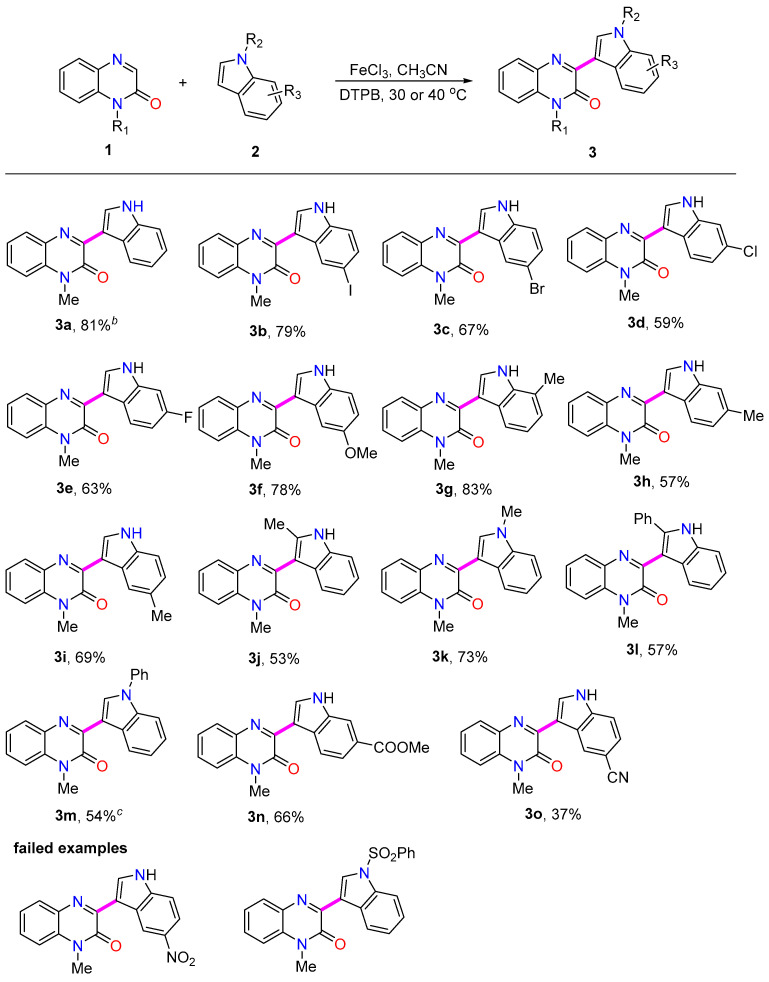 Figure 1
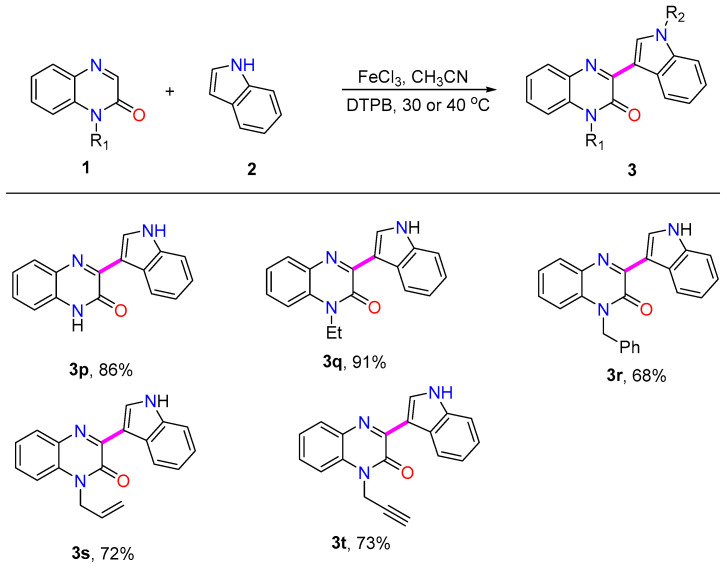 Figure 2
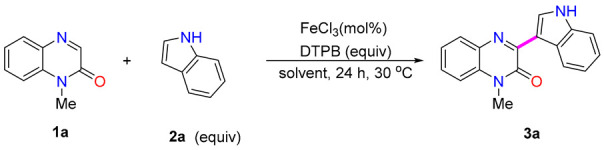 Figure 3
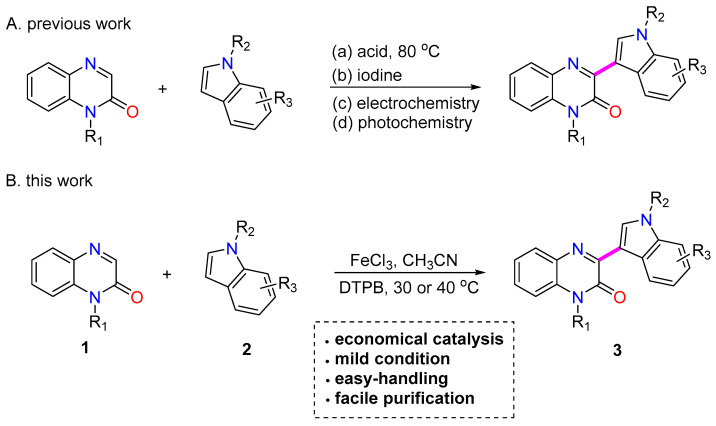 Figure 4
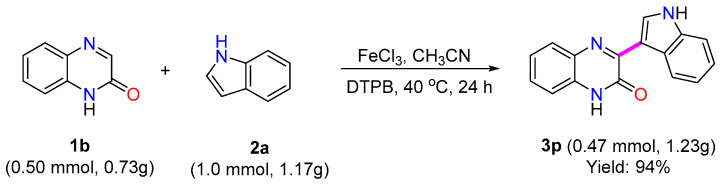 Figure 5
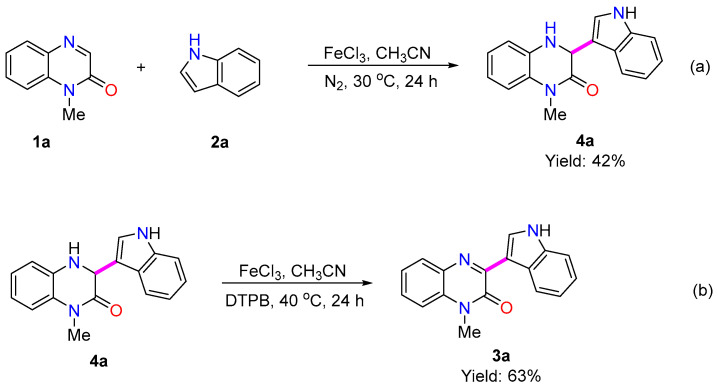 Figure 6
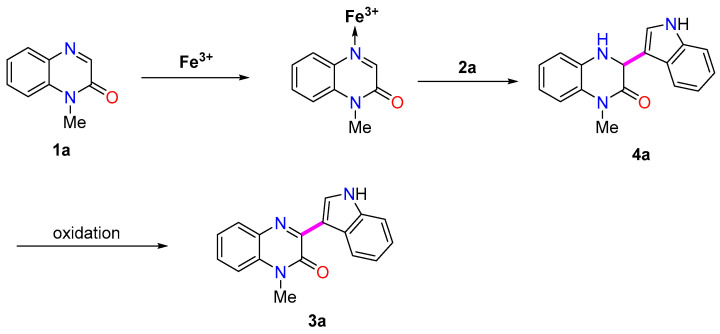 Figure 7
- —Jinhua Science and Technology Bureau
- —Open Research Fund of Key Laboratory of the Ministry of Education for Advanced Catalysis Materials and Zhejiang Key Laboratory for Reactive Chemistry on Solid Surface, Zhejiang Normal University
Peer Reviews
No public reviews on file for this paper yet. If you reviewed it on a platform where reviews are public (OpenReview, ICLR, NeurIPS, ICML), you can paste yours below so the community can read it here.
Videos
No videos yet. Explain this paper in a talk, walkthrough, or lecture? Add one.
Taxonomy
TopicsSynthesis and Biological Evaluation · Catalytic C–H Functionalization Methods · Oxidative Organic Chemistry Reactions
1. Introduction
Iron, an abundant, economical, and low-toxicity metal, plays a pivotal role in organic synthesis. Over the past decade, iron-catalyzed reactions have been successfully applied to a spectrum of organic transformations, including substitution, addition, elimination, oxidation, and reduction [1,2,3]. The utility of iron complexes extends to asymmetric catalysis, a more complex and challenging domain [4]. More recently, the potential of iron complexes has been harnessed in green photocatalytic processes, where intramolecular or intermolecular charge transfer facilitates the generation of reactive radical species [5].
Quinoxalinones are a significant class of heterocyclic compounds with widespread applications in medicinal chemistry and advanced functional materials [6,7,8,9,10]. Notably, the subclass of 3-(indol-3-yl)quinoxalin-2-one derivatives, which features both a quinoxalinone framework and an indole moiety, has shown remarkable biological activities. These include potent antibacterial properties, inhibition of platelet aggregation, and a significant suppression of human tumor cell proliferation [11,12,13]. Historically, Brønsted acids have been employed as catalysts for the cross-coupling of quinoxalinones with indoles under high-temperature conditions [14]. Molecular iodine has also proven effective for this reaction [15]. With the advent of electrochemistry and photochemistry, these innovative methodologies have been integrated into the reaction system [16,17,18]. For instance, Tang’s group has reported a visible light-promoted cross-coupling of quinoxalinones with indole derivatives, utilizing B(C_6_F_5_)3·H_2_O as a Lewis acid catalyst (Scheme 1A) [17].
In this work, we introduce an iron-catalyzed cross-coupling method for the synthesis of 3-(indol-3-yl)quinoxalin-2-one derivatives (Scheme 1B). This approach offers the advantages of a cost-effective catalyst, mild reaction conditions, and straightforward product isolation. Notably, the process allows for the direct filtration and isolation of pure products, eliminating the need for additional purification steps.
2. Results and Discussion
As depicted in Table 1, the reaction of quinoxalinone (1a) with indole (2a, 1.5 equivalents) at 30 °C, catalyzed by 10% FeCl_3_ and using 2.0 equivalents of di-tert-butyl peroxide (DTBP), yielded the desired product (3a) with an 81% yield (Entry 1). Utilizing 2.0 equivalents of indole resulted in a higher yield compared to lower amounts, and increasing the indole further did not improve the yield (Entries 2–4). Catalyst optimization demonstrated that a loading of 10% FeCl_3_ was optimal for achieving the highest yield (Entries 5–7). The quantity of DTBP was also screened, confirming that 2.0 equivalents were necessary for the maximum yield (Entries 8–9). Solvent screening revealed that acetonitrile (CH_3_CN) was the most effective medium, with other solvents such as dichloromethane (DCM) yielding product 3a in moderate yields (Entries 10–11). Additionally, reactions conducted at shorter time resulted in lower yields of 3a, indicating 24 h was essential for this reaction (Entry 12).
Under the optimal reaction condition, we explored the substrate scope of the oxidative coupling between quinoxalinone (1a) and a series of indoles (2), with the results summarized in Figure 1. Indoles bearing various functional groups, including alkyl, methoxy, halide and cyanide, were all found to be compatible with our protocol, affording the corresponding products in moderate to good yields (3a–3o). Halogenated indoles, known for their reactivity in cross-coupling reactions, were smoothly converted into the desired products with good yields (3b–3e). The position of the substituents on the indole ring had a significant impact on the reaction efficiency (3f–3k), suggesting that the electronic properties of the three-position of the indoles are crucial for the reaction outcome. More sterically hindered indoles, such as 2-methyl indole and 2-phenyl indole, also successfully underwent the coupling reaction, albeit with moderate yields. Notably, electron-deficient indoles, including methyl 1H-indole-6-carboxylate and 1H-indole-5-carbonitrile, were viable substrates, yielding the desired products (3n and 3o) with somewhat lower yields. However, when more electron-deficient indoles were used as substrates, the reaction resulted in only trace amounts of the product, with the starting material 1a remaining unreacted.
The substrate scope concerning N-substituted quinoxalinones (1) was then investigated, as detailed in Figure 2. N-substituted quinoxalinones (1b–1f) featuring a range of important and potentially reactive functional groups, including alkenyl and alkynyl moieties, were found to be well-tolerated under the reaction conditions. Elevated temperature was required for the full conversion of reaction intermediate. It is noteworthy that the commercially available starting material, quinoxalin-2(1H)-one (1b), could be efficiently converted to the desired product with an 86% yield upon increasing the temperature to ensure complete conversion of the intermediate to the final product. Interestingly, N-substituted quinoxalinones with the less stable alkenyl and alkynyl groups also successfully yielded products 3s and 3t in relatively good yields.
To demonstrate the practicality of the iron salt-catalyzed oxidative coupling reaction, a gram-scale synthesis was conducted under the standard condition. Gratifyingly, the reaction, employing commercially available quinoxalin-2(1H)-one (1b) and indole (2a) as substrates, was readily scalable to the gram scale, yielding the desired product 3p with an exceptional isolated yield of 94%. It is particularly noteworthy that the product could be directly isolated via simple filtration of the reaction mixture, thereby eliminating the need for additional purification steps. This straightforward approach offers a cost-effective and convenient method for the large-scale synthesis of 3-(1H-indol-3-yl)quinoxalin-2(1H)-one derivatives, as illustrated in Scheme 2.
To elucidate the reaction mechanism, a series of control experiments were performed, as depicted in Scheme 3. When the reaction was carried out under a nitrogen atmosphere (Scheme 3a), the intermediate 4a was identified as the predominant product, which was isolated in a 42% yield by filtration of the reaction mixture. The structure of intermediate 4a was confirmed through ^1^H NMR and high-resolution mass spectrometry (HRMS) analyses. Notably, 4a could be further oxidized to the desired product 3a in a 63% yield upon continuation of the reaction under the standard condition. This observation implies that a Lewis acid-catalyzed Friedel–Crafts-type reaction is likely the initial step, leading to the formation of intermediate 4a [14,17]. Furthermore, the observed lower efficiency with electron-deficient indoles (Figure 1, entries featuring 5-nitro-1H-indole and 1H-indole-5- carbonitrile) provides additional support for the proposed iron salt-catalyzed Friedel–Crafts-type electrophilic substitution reaction mechanism.
Based on the aforementioned findings and the relevant literature [14,17], we propose a plausible mechanism for the transformation of quinoxalinones (1) with indoles (2) to afford a variety of 3-(indol-3-yl)quinoxalinones (3), as illustrated in Scheme 4. Initially, quinoxalinone (1a) is coordinated to the Lewis acid (FeCl_3_), resulting in the formation of a cationic intermediate. Subsequently, this cationic intermediate undergoes an electrophilic Friedel–Crafts-type reaction with an electron-rich indole (2a), leading to the generation of intermediate 4a. The final step involves the further oxidation of intermediate 4a by di-tert-butyl peroxide (DTBP), ultimately yielding the desired product 3a.
In conclusion, we developed a straightforward and mild oxidative cross-coupling method for the synthesis of versatile 3-(indol-3-yl)quinoxalinone derivatives, utilizing iron chloride as a Lewis acid catalyst. This approach allows for the incorporation of various functional groups into the products through the use of a diverse range of indoles and quinoxalin-2(1H)-one derivatives. Our mechanistic studies indicate that iron chloride serves as an effective Lewis acid catalyst, facilitating the reaction process. The protocol is distinguished by its cost effectiveness and ease of operation, with product isolation achievable through simple filtration. Furthermore, the method is successfully scaled up to gram-scale reactions with high yields, employing commercially available starting materials. This scalability provides a simple, economical and convenient route for the large-scale synthesis of a variety of 3-(indol-3-yl)quinoxalinone derivatives.
3. Materials and Methods
3.1. General Information
^1^H NMR and ^13^C NMR spectra were recorded on a Bruker AVANCE NEO 400 MHZ (Karlsruhe, Germany). Spectra were calibrated relative to resonances of the deuterated solvents for proton and carbon chemical shifts: DMSO (δ = 2.50 for ^1^H NMR and δ = 39.50 for ^13^C NMR), CDCl_3_ (δ = 7.26 for ^1^H NMR and δ = 77.16 for ^13^C NMR). Data are reported as follows: chemical shift δ/ppm, integration (1H only), multiplicity (s = singlet, d = doublet, t =triplet, dd = doublet of doublets, m = multiplet; ^13^C signals are singlets unless otherwise stated), coupling constants J in Hz. HRMS spectra were obtained on a waters G2-XS Qtof (Milford, MA, USA). High-performance liquid Chromatographic (HPLC) was carried out on a Shimadzu LC-20ADxr (Kyoto, Japan). The melting point was recorded on Shanghai INESA Physico-Optical Instrument INESA SGM X-4A (Shanghai, China). Compounds 1a and 1c–1f were prepared using literature methods [19,20]. All other chemicals were purchased from Chemical Co. (Shanghai Titan Scientific Co., Ltd., Shanghai, China, Anhui Zesheng Technology Co., Ltd., Anqing, China, etc.) and used as received unless otherwise specified.
3.2. General Procedure for the Synthesis of Starting Materials (1a and 1c–1f) [19,20]
A typical procedure is as follows: To a stirred solution of quinoxalin-2(1H)-ones (3 mmol) in DMF (10 mL), the corresponding halide (1.6 equiv) and potassium carbonate (1.2 equiv) were added at room temperature; the mixture was stirred overnight. Then, the resulting mixture was supplemented with water (50 mL) and extracted with ethyl acetate (50 mL) for three times. The combined organic layers were dried over Na_2_SO_4_, filtered and evaporated under reduced pressure. The residue was purified by column chromatography on silica gel to produce the desired product 1. See Supporting Information for more details including the chemical structural formulae and ^1^H NMR and ^13^C NMR spectra of the products.
3.3. General Procedure for the Synthesis of Product (3a–3t)
A Schlenk tube equipped with a magnetic stir bar was charged with 1 (0.5 mmol) and 2 (1.0 mmol, 2.0 equiv). FeCl_3_ solution (0.01 mmol/mL in CH_3_CN, 5 mL) and di-tert-butyl peroxide (DTBP, 1.0 mmol, 2.0 equiv) were added. Then, the reaction mixture was stirred at 30 or 40 °C for 24 h. After that, the resulting mixture was analyzed by HPLC and handled in two ways: (1) For the reaction with the precipitant, the mixture was filtered to produce product 3, which was washed with a small amount of acetonitrile. The solution was further condensed to precipitate the product, and the mixture was filtered. (2) For the reaction without the precipitant, the reaction solution was removed under reduced pressure with a rotary evaporator. The crude residue was purified by silica gel column chromatography with ethyl acetate and petrol ether (1:4) as eluent to produce pure product 3.
3.4. Characterization Data of Products
The chemical structural formulae and ^1^H NMR and ^13^C NMR spectra of products 3a–3t can be seen in Supporting Information.
3-(1H-indol-3-yl)-1-methylquinoxalin-2(1H)-one (3a):Isolated through filtration to produce yellow solid. Yield: 81%. ^1^H NMR (400 MHz, DMSO-d6) δ 11.79 (s, 1H), 9.03–8.85 (m, 2H), 7.92 (d, J = 7.9 Hz, 1H), 7.61–7.48 (m, 3H), 7.46–7.33 (m, 1H), 7.33–7.18 (m, 2H), 3.74 (s, 3H). ^13^C NMR (101 MHz, DMSO-d6) δ 153.66, 150.62, 136.29, 133.18, 132.96, 131.49, 128.36, 128.25, 126.31, 123.42, 123.02, 122.53, 120.98, 114.42, 111.88, 111.41, 29.09. This is a known structure. These data are similar to the reported ones [14].3-(5-iodo-1H-indol-3-yl)-1-methylquinoxalin-2(1H)-one (3b):Isolated through filtration to produce yellow solid. M.P.: >300 °C. Yield: 79%. ^1^H NMR (400 MHz, DMSO-d6) δ 11.93 (s, 1H), 9.23 (s, 1H), 8.89 (s, 1H), 7.85 (d, J = 7.9 Hz, 1H), 7.60–7.47 (m, 3H), 7.47–7.32 (m, 2H), 3.71 (s, 3H). ^13^C NMR (101 MHz, DMSO-d6) δ 153.54, 150.22, 135.39, 133.80, 132.72, 131.55, 131.26, 130.51, 128.75, 128.54, 128.34, 123.53, 114.50, 114.36, 110.57, 85.43, 29.10. HRMS (ESI): m/z calcd for C_17_H_12_N_3_OI [M + Na]^+^: 423.9923. Found: 423.9923.3-(5-bromo-1H-indol-3-yl)-1-methylquinoxalin-2(1H)-one (3c):Isolated through filtration to produce yellow solid. Yield: 67%. ^1^H NMR (400 MHz, DMSO-d6) δ 11.96 (s, 1H), 9.01 (s, 1H), 8.93 (s, 1H), 7.87 (d, J = 7.9 Hz, 1H), 7.72–6.40 (m, 5H), 3.71 (s, 3H). ^13^C NMR (101 MHz, DMSO-d6) δ 153.55, 150.23, 135.04, 134.27, 132.73, 131.56, 128.57, 128.40, 127.99, 125.05, 125.00, 123.53, 114.51, 113.94, 113.78, 110.90, 29.11. This is a known structure. These data are similar to the reported ones [14].3-(5-chloro-1H-indol-3-yl)-1-methylquinoxalin-2(1H)-one (3d):Isolated through filtration to produce yellow solid. Yield: 59%. ^1^H NMR (400 MHz, DMSO-d6) δ 11.86 (s, 1H), 8.92 (s, 1H), 8.85 (s, 1H), 7.89 (s, 1H), 7.53 (m, 3H), 7.37 (s, 1H), 7.23 (s, 1H), 3.71 (s, 3H). ^13^C NMR (101 MHz, DMSO-d6) δ 153.53, 150.23, 136.80, 133.96, 132.78, 131.58, 128.52, 128.45, 127.09, 125.06, 124.26, 123.43, 121.11, 114.44, 111.58, 111.45, 29.08. This is a known structure. These data are similar to the reported ones [14].3-(6-fluro-1H-indol-3-yl)-1-methylquinoxalin-2(1H)-one (3e):Isolated through filtration to produce yellow solid. M.P.: 261.0–263.0 °C. Yield: 63%. ^1^H NMR (400 MHz, DMSO-d6) δ 11.81 (s, 1H), 8.97–8.82 (m, 2H), 7.89 (d, J = 7.9 Hz, 1H), 7.52 (t, J = 2.8 Hz, 2H), 7.37 (s, 1H), 7.30 (d, J = 9.7 Hz, 1H), 7.07 (t, J = 9.3 Hz, 1H), 3.71 (d, J = 2.0 Hz, 3H). ^13^C NMR (101 MHz, DMSO-d6) δ 159.25 (d, J = 236.4 Hz), 153.55, 150.30, 136.40 (d, J = 12.5 Hz), 133.73 (d, J = 2.6 Hz), 132.82, 131.58, 128.43, 128.42, 124.14 (d, J = 9.6 Hz), 123.42, 123.01, 114.43, 111.45, 109.07 (d, J = 23.4 Hz), 98.06 (d, J = 25.7 Hz), 29.08. HRMS (ESI): m/z calcd for C_17_H_12_N_3_OF [M + H]^+^: 294.1043. Found: 294.1046.3-(5-methoxy-1H-indol-3-yl)-1-methylquinoxalin-2(1H)-one (3f):Isolated through filtration to produce yellow solid. Yield: 78%. ^1^H NMR (400 MHz, DMSO-d6) δ 11.68 (s, 1H), 8.88 (s, 1H), 8.47 (s, 1H), 7.90 (d, J = 7.9 Hz, 1H), 7.53 (s, 2H), 7.47–7.33 (m, 2H), 6.89 (d, J = 8.7 Hz, 1H), 3.88 (s, 3H), 3.72 (s, 3H). ^13^C NMR (101 MHz, DMSO-d6) δ 154.87, 153.67, 150.68, 133.52, 132.94, 131.42, 131.17, 128.31, 128.14, 126.99, 123.45, 114.44, 112.48, 112.08, 111.13, 105.06, 55.24, 29.09. This is a known structure. These data are similar to the reported ones [14].3-(7-methyl-1H-indol-3-yl)-1-methylquinoxalin-2(1H)-one (3g):Isolated through filtration to produce yellow solid. M.P.: 289.0–291.0 °C. Yield: 83%. ^1^H NMR (400 MHz, DMSO-d6) δ 11.78 (s, 1H), 8.92 (s, 1H), 8.73 (d, J = 8.0 Hz, 1H), 7.91 (d, J = 7.9 Hz, 1H), 7.53 (d, J = 3.9 Hz, 2H), 7.46–7.34 (m, 1H), 7.14 (t, J = 7.6 Hz, 1H), 7.04 (d, J = 7.1 Hz, 1H), 3.73 (s, 3H), 2.53 (s, 3H). ^13^C NMR (101 MHz, DMSO-d6) δ 153.70, 150.61, 135.71, 132.96, 132.86, 131.47, 128.36, 128.23, 126.08, 123.41, 123.17, 121.19, 120.93, 120.65, 114.41, 111.81, 29.08, 16.76. HRMS (ESI): m/z calcd for C_18_H_15_N_3_O [M + H]^+^: 290.1293. Found: 290.1298.3-(6-methyl-1H-indol-3-yl)-1-methylquinoxalin-2(1H)-one (3h):Isolated through filtration to produce yellow solid. Yield: 57%. ^1^H NMR (400 MHz, DMSO-d6) δ 11.65 (s, 1H), 8.85 (d, J = 2.9 Hz, 1H), 8.74 (d, J = 8.1 Hz, 1H), 7.90 (d, J = 7.9 Hz, 1H), 7.53 (s, 1H), 7.50 (d, J = 9.1 Hz, 1H), 7.42–7.34 (m, 1H), 7.30 (s, 1H), 7.06 (d, J = 8.2 Hz, 1H), 3.72 (s, 3H), 2.44 (s, 3H). ^13^C NMR (101 MHz, DMSO-d6) δ 153.64, 150.60, 136.71, 132.99, 132.73, 131.68, 131.46, 128.32, 128.15, 124.18, 123.39, 122.72, 122.63, 114.40, 111.70, 111.40, 29.07, 21.36. This is a known structure. These data are similar to the reported ones [14].3-(5-methyl-1H-indol-3-yl)-1-methylquinoxalin-2(1H)-one (3i):Isolated through filtration to produce yellow solid. M.P.: >300 °C. Yield: 69%. ^1^H NMR (400 MHz, DMSO-d6) δ 11.67 (s, 1H), 8.88 (d, J = 2.6 Hz, 1H), 8.71 (s, 1H), 7.93 (d, J = 7.9 Hz, 1H), 7.54 (d, J = 2.2 Hz, 2H), 7.39 (d, J = 6.0 Hz, 2H), 7.07 (d, J = 8.2 Hz, 1H), 3.73 (s, 3H). ^13^C NMR (101 MHz, DMSO-d6) δ 153.67, 150.67, 134.60, 133.22, 132.99, 131.43, 129.63, 128.35, 128.12, 126.57, 123.97, 123.38, 122.80, 114.40, 111.51, 111.02, 29.06, 21.66. HRMS (ESI): m/z calcd for C_18_H_15_N_3_O [M + H]^+^: 290.1293. Found: 290.1295.3-(2-methyl-1H-indol-3-yl)-1-methylquinoxalin-2(1H)-one (3j):Isolated through silica gel column chromatography with ethyl acetate and petrol ether (1:4) to produce yellow solid. The yellow solid was washed with petrol ether. Yield: 69%. ^1^H NMR (400 MHz, DMSO-d6) δ 11.49 (s, 1H), 7.80 (d, J = 8.0 Hz, 1H), 7.75 (d, J = 7.9 Hz, 1H), 7.62–7.52 (m, 2H), 7.41–7.31 (m, 2H), 7.07 (t, J = 7.8 Hz, 1H), 7.03–6.97 (m, 1H), 3.71 (s, 3H), 2.55 (s, 3H). ^13^C NMR (101 MHz, DMSO-d6) δ 154.01, 153.14, 139.29, 135.08, 132.81, 132.53, 129.02, 128.65, 127.96, 123.30, 120.83, 120.80, 119.49, 114.42, 110.59, 109.48, 29.28, 14.24. This is a known structure. These data are similar to the reported ones [14].3-(1-methyl-1H-indol-3-yl)-1-methylquinoxalin-2(1H)-one (3k):Isolated through filtration to produce yellow solid. Yield: 73%. ^1^H NMR (400 MHz, DMSO-d6) δ 8.95–8.88 (m, 2H), 7.92 (d, J = 7.4 Hz, 1H), 7.56 (d, J = 7.2 Hz, 3H), 7.44–7.36 (m, 1H), 7.35–7.25 (m, 2H), 3.93 (s, 3H), 3.75 (s, 3H). ^13^C NMR (101 MHz, DMSO-d6) δ 153.60, 150.32, 136.98, 136.87, 132.97, 131.49, 128.37, 128.31, 126.78, 123.48, 123.14, 122.63, 121.31, 114.48, 110.36, 110.25, 33.07, 29.11. This is a known structure. These data are similar to the reported ones [14].3-(2-phenyl-1H-indol-3-yl)-1-methylquinoxalin-2(1H)-one (3l):Isolated through silica gel column chromatography with ethyl acetate and petrol ether (1:4) to produce yellow solid. Yield: 57%. ^1^H NMR (400 MHz, DMSO-d6) δ 11.84 (s, 1H), 7.78 (d, J = 7.9 Hz, 1H), 7.70–7.44 (m, 6H), 7.42–7.28 (m, 4H), 7.18 (t, J = 7.2 Hz, 1H), 7.07 (t, J = 7.5 Hz, 1H), 3.59 (s, 3H). ^13^C NMR (101 MHz, DMSO-d6) δ 153.72, 153.56, 139.19, 135.96, 133.14, 133.05, 132.71, 129.74, 129.02, 128.57, 128.40, 127.86, 127.81, 123.35, 122.08, 120.33, 119.99, 114.61, 111.45, 109.13, 29.28. This is a known structure. These data are similar to the reported ones [14].3-(1-phenyl-1H-indol-3-yl)-1-methylquinoxalin-2(1H)-one (3m):Isolated through filtration to produce yellow solid. Yield: 54%. ^1^H NMR (400 MHz, DMSO-d6) δ 9.09 (s, 1H), 9.03 (d, J = 7.4 Hz, 1H), 8.00 (d, J = 7.9 Hz, 1H), 7.73–7.57 (m, 7H), 7.56–7.48 (m, 1H), 7.42–7.31 (m, 2H), 3.76 (s, 3H). ^13^C NMR (101 MHz, DMSO-d6) δ 153.68, 144.99, 138.26, 135.79, 134.97, 132.84, 131.72, 130.14, 129.01, 128.76, 127.67, 127.40, 124.52, 123.76, 123.65, 122.25, 114.66, 112.78, 110.74, 29.24. This is a known structure. These data are similar to the reported ones [18].methyl 3-(4-methyl-3-oxo-3,4-dihydroquinoxalin-2-yl)-1H-indole-6-carboxylate (3n):Isolated through filtration to produce yellow solid. Yield: 66%. ^1^H NMR (400 MHz, DMSO-d6) δ 12.10 (s, 1H), 9.09 (s, 1H), 8.94 (d, J = 8.4 Hz, 1H), 8.15 (s, 1H), 7.94 (d, J = 7.9 Hz, 1H), 7.83 (d, J = 8.5 Hz, 1H), 7.56 (s, 2H), 7.41 (d, J = 5.0 Hz, 1H), 3.89 (s, 3H), 3.74 (s, 3H). ^13^C NMR (101 MHz, DMSO-d6) δ 166.97, 153.55, 150.16, 135.99, 135.65, 132.76, 131.60, 129.88, 128.59, 128.52, 123.43, 122.68, 121.46, 114.43, 113.64, 111.67, 51.93, 29.08. This is a known structure. These data are similar to the reported ones [18].3-(4-methyl-3-oxo-3,4-dihydroquinoxalin-2-yl)-1H-indole-5-carbonitrile (3o):Isolated through filtration to produce yellow solid. M.P.: >300 °C. Yield: 37%. ^1^H NMR (400 MHz, DMSO-d6) δ 12.20 (s, 1H), 9.15 (s, 1H), 8.98 (s, 1H), 7.92 (d, J = 7.9 Hz, 1H), 7.64 (d, J = 8.4 Hz, 1H), 7.61–7.44 (m, 3H), 7.37 (t, J = 7.4 Hz, 1H), 3.66 (s, 3H). ^13^C NMR (101 MHz, DMSO-d6) δ 153.44, 149.85, 138.14, 135.00, 132.62, 131.64, 128.91, 128.76, 127.98, 125.95, 125.39, 123.52, 120.73, 114.48, 113.31, 111.77, 103.06, 29.11. HRMS (ESI): m/z calcd for C_18_H_12_N_4_O [M + Na]^+^: 323.0909. Found: 323.0909.3-(1H-indol-3-yl)-1-methylquinoxalin-2(1H)-one (3p):Isolated through filtration to produce yellow solid. Yield: 86%. ^1^H NMR (400 MHz, DMSO-d6) δ 12.41 (s, 1H), 11.78 (s, 1H), 8.94 (s, 1H), 8.91–8.85 (m, 1H), 7.86 (d, J = 7.9 Hz, 1H), 7.54–7.47 (m, 1H), 7.43 (t, J = 7.6 Hz, 1H), 7.32 (d, J = 7.8 Hz, 2H), 7.27–7.20 (m, 2H). ^13^C NMR (101 MHz, DMSO-d6) δ 154.41, 151.98, 136.28, 133.09, 132.65, 130.18, 127.99, 127.61, 126.20, 123.24, 122.99, 122.56, 121.00, 114.94, 111.90, 111.32. This is a known structure. These data are similar to the reported ones [17].1-ethyl-3-(1H-indol-3-yl)quinoxalin-2(1H)-one (3q):Isolated through silica gel column chromatography with ethyl acetate and petrol ether (1:4) to produce red solid. M.P.: 175.0–176.5 °C. Yield: 91%. ^1^H NMR (400 MHz, DMSO-d6) δ 11.80 (s, 1H), 8.96–8.87 (m, 2H), 7.93 (d, J = 7.9 Hz, 1H), 7.63–7.49 (m, 3H), 7.38 (t, J = 7.5 Hz, 1H), 7.27–7.21 (m, 2H), 4.38 (q, J = 6.7, 2H), 1.30 (t, J = 6.9 Hz, 3H). ^13^C NMR (101 MHz, DMSO-d6) δ 153.17, 150.65, 136.29, 133.26, 133.21, 130.24, 128.73, 128.40, 126.33, 123.36, 123.01, 122.54, 121.00, 114.13, 111.89, 111.34, 36.89, 12.45. HRMS (ESI): m/z calcd for C_18_H_15_N_3_O [M + H]^+^: 290.1293. Found: 290.1295.1-benzyl-3-(1H-indol-3-yl)quinoxalin-2(1H)-one (3r):Isolated through silica gel column chromatography with ethyl acetate and petrol ether (1:4) to produce orange solid. Yield: 68%. ^1^H NMR (400 MHz, DMSO-d6) δ 11.85 (s, 1H), 8.98–8.90 (m, 2H), 7.95 (d, J = 7.8 Hz, 1H), 7.56–7.50 (m, 1H), 7.43 (d, J = 3.2 Hz, 2H), 7.38–7.29 (m, 5H), 7.29–7.23 (m, 3H), 5.63 (s, 2H). ^13^C NMR (101 MHz, DMSO-d6) δ 153.84, 150.77, 136.33, 136.19, 133.39, 133.29, 130.61, 128.73, 128.64, 128.27, 127.26, 126.76, 126.33, 123.62, 123.02, 122.62, 121.10, 114.80, 111.94, 111.40, 44.98. This is a known structure. These data are similar to the reported ones [17].1-allyl-3-(1H-indol-3-yl)quinoxalin-2(1H)-one (3s):Isolated through silica gel column chromatography with ethyl acetate and petrol ether (1:4) to produce orange solid. Yield: 72%. ^1^H NMR (400 MHz, DMSO-d6) δ 11.82 (s, 1H), 8.95–8.87 (m, 2H), 7.94 (d, J = 7.9 Hz, 1H), 7.55–7.44 (m, 3H), 7.38 (m, 1H), 7.28–7.21 (m, 2H), 6.08–5.94 (m, 1H), 5.20 (d, J = 10.5 Hz, 1H), 5.10 (d, J = 16.9 Hz, 1H), 5.01 (d, J = 2.4 Hz, 2H). ^13^C NMR (101 MHz, DMSO-d6) δ 153.41, 150.75, 136.40, 133.36, 133.26, 131.94, 130.63, 128.69, 128.42, 126.39, 123.69, 123.10, 122.75, 121.21, 117.06, 114.90, 112.05, 111.45, 44.05. This is a known structure. These data are similar to the reported ones [17].3-(1H-indol-3-yl)-1-(prop-2-yn-1-yl)quinoxalin-2(1H)-one (3t):Isolated through silica gel column chromatography with ethyl acetate and petrol ether (1:4) to produce yellow solid. Yield: 73%. ^1^H NMR (400 MHz, DMSO-d6) δ 11.85 (s, 1H), 8.93–8.85 (m, 2H), 7.95 (d, J = 7.7 Hz, 1H), 7.60 (t, J = 9.0 Hz, 2H), 7.52 (d, J = 5.2 Hz, 1H), 7.43 (t, J = 7.5 Hz, 1H), 7.28–7.22 (m, 2H), 5.21 (s, 2H), 3.35 (s, 1H). ^13^C NMR (101 MHz, DMSO-d6) δ 152.78, 150.47, 136.32, 133.34, 133.19, 129.84, 128.60, 128.37, 126.22, 123.92, 122.97, 122.67, 121.14, 114.69, 111.96, 111.20, 78.37, 75.07, 31.34. This is a known structure. These data are similar to the reported ones [17].
3.5. Gram Scale Reaction
A 100 mL round bottle equipped with a magnetic stir bar was charged with 1 (5.0 mmol) and 2 (10.0 mmol, 2.0 equiv). FeCl_3_ solution (0.01 mmol/mL in CH_3_CN, 50 mL) and di-tert-butyl peroxide (DTBP, 10.0 mmol, 2.0 equiv) were added. Then, the reaction mixture was stirred at 40 °C for 24 h to produce the suspension. The resulting mixture was analyzed by HPLC. The mixture was filtered to produce pure yellow product 3p in a 94% yield.
4. Patents
The application of a Chinese patent related to the structure and bioactivity of compound 3e is pending.
The reference list from the paper itself. Each links out to its DOI / PubMed record.
- 1Bauer I. Knölker H.-J. Iron catalysis in organic synthesis Chem. Rev.20151153170338710.1021/cr 500425 u 25751710 · doi ↗ · pubmed ↗
- 2Guðmundsson A. Bäckvall J.E. On the use of iron in organic chemistry Molecules 202025134910.3390/molecules 2506134932188092 PMC 7144124 · doi ↗ · pubmed ↗
- 3Rana S. Biswas J.P. Paul S. Paul S. Paik A. Maiti D. Organic synthesis with the most abundant transition metal–iron: From rust to multitasking catalysts Chem. Soc. Rev.20215024347210.1039/D 0CS 00688 B 33399140 · doi ↗ · pubmed ↗
- 4Casnati A. Lanzi M. Cera G. Recent advances in asymmetric iron catalysis Molecules 202025388910.3390/molecules 2517388932858925 PMC 7503417 · doi ↗ · pubmed ↗
- 5de Groot L.H.M. Ilic A. Schwarz J. Wärnmark K. Iron photoredox catalysis–past, present, and future J. Am. Chem. Soc.20231459369938810.1021/jacs.3c 0100037079887 PMC 10161236 · doi ↗ · pubmed ↗
- 6Carta A. Piras S. Loriga G. Paglietti G. Chemistry, biological properties and SAR analysis of quinoxalinones Mini-Rev. Med. Chem.200661179120010.2174/13895570677874271317100630 · doi ↗ · pubmed ↗
- 7Liu R. Huang Z.-H. Murray M.-G. Guo X.-Y. Liu G. Quinoxalin-2(1H)-one derivatives as inhibitors against hepatitis C virus J. Med. Chem.2011545747576810.1021/jm 200394 x 21761853 · doi ↗ · pubmed ↗
- 8El-Hawash S.A.M. Habib N.S. Kassem M.A. Synthesis of some new quinoxalines and 1,2,4-triazolo [4,3-a]-quinoxalines for evaluation of in vitro antitumor and antimicrobial activities Arch. Pharm.200633956457110.1002/ardp.20060006117009301 · doi ↗ · pubmed ↗