Phosphine-Catalyzed γ′-Carbon 1,6-Conjugate Addition of α-Succinimide Substituted Allenoates with Para-Quinone Methides: Synthesis of 4-Diarylmethylated 3,4-Disubstituted Maleimides
Zhenzhen Gao, Xiaoming Zhou, Dandan Liu, Baoshen Nie, Hanchong Lu, Xiaotong Chen, Jiahui Wu, Lei Li, Xuekun Wang

TL;DR
This paper presents a new phosphine-catalyzed reaction to create maleimides with high efficiency and diverse substrates.
Contribution
A novel γ′-carbon 1,6-conjugate addition method for synthesizing maleimides using phosphine catalysis is introduced.
Findings
A wide range of substrates can be used to produce 4-diarylmethylated maleimides with good yields.
A plausible reaction mechanism was proposed to explain the catalytic process.
Abstract
In this paper, an interesting γ′-carbon 1,6-conjugate addition for phosphine-catalyzed α-succinimide substituted allenoates has been disclosed. A wide array of substrates was found to participate in the reaction, resulting in the production of diverse 4-diarylmethylated 3,4-disubstituted maleimides with satisfactory to outstanding yields. Furthermore, a plausible mechanism for the reaction was proposed by the investigators.
Genes, proteins, chemicals, diseases, species, mutations and cell lines named across the full text — each resolved to its canonical identifier and authoritative record.
Click any figure to enlarge with its caption.
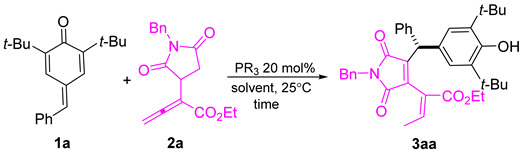 Figure 1
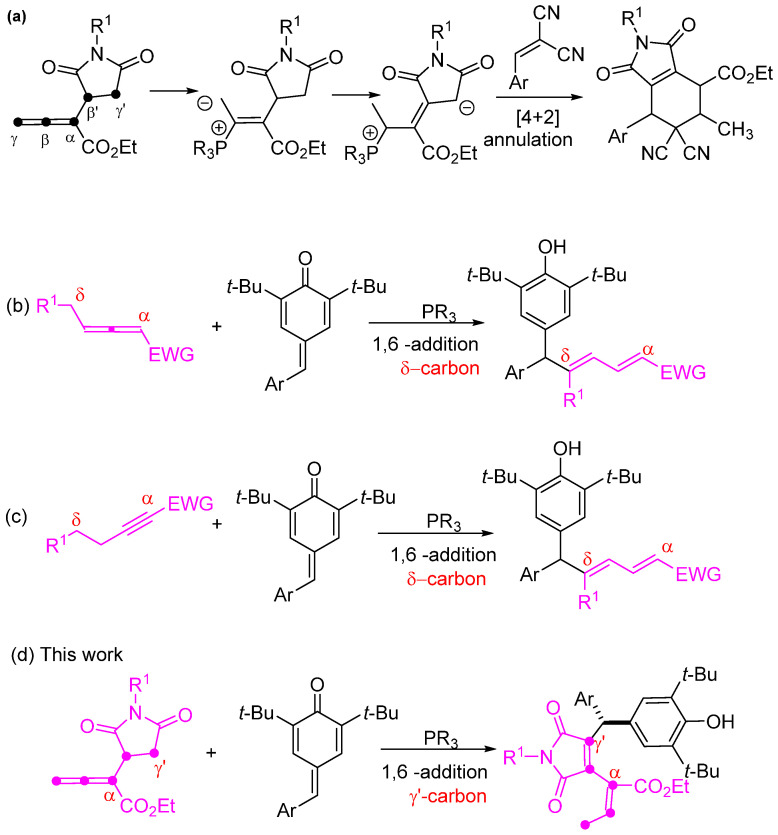 Figure 2
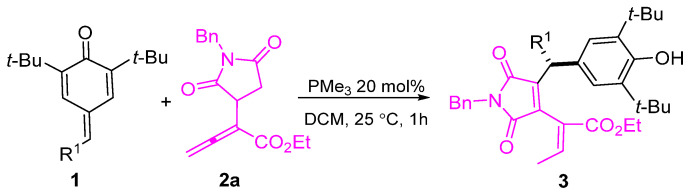 Figure 3
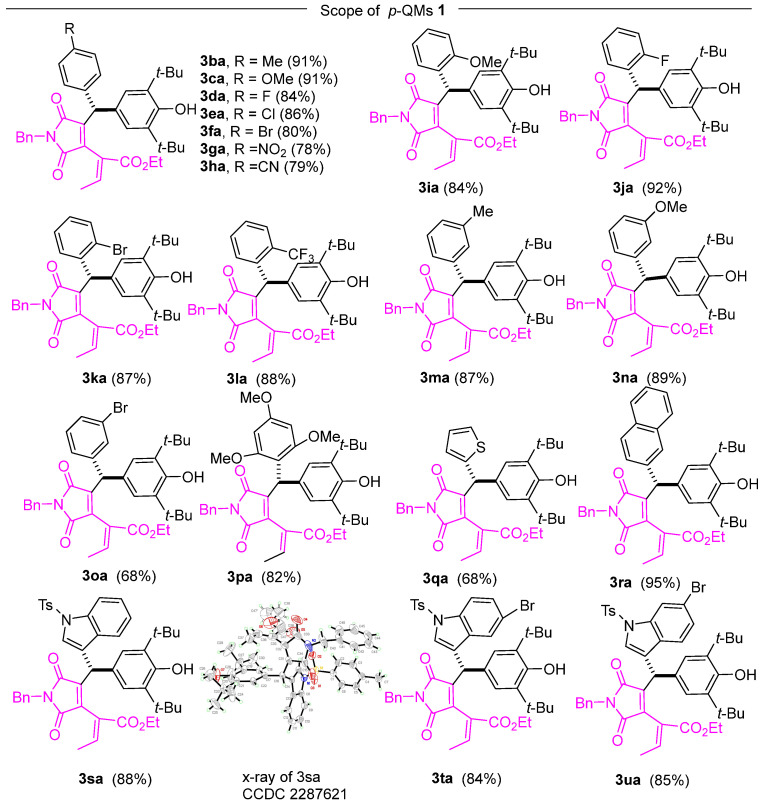 Figure 4
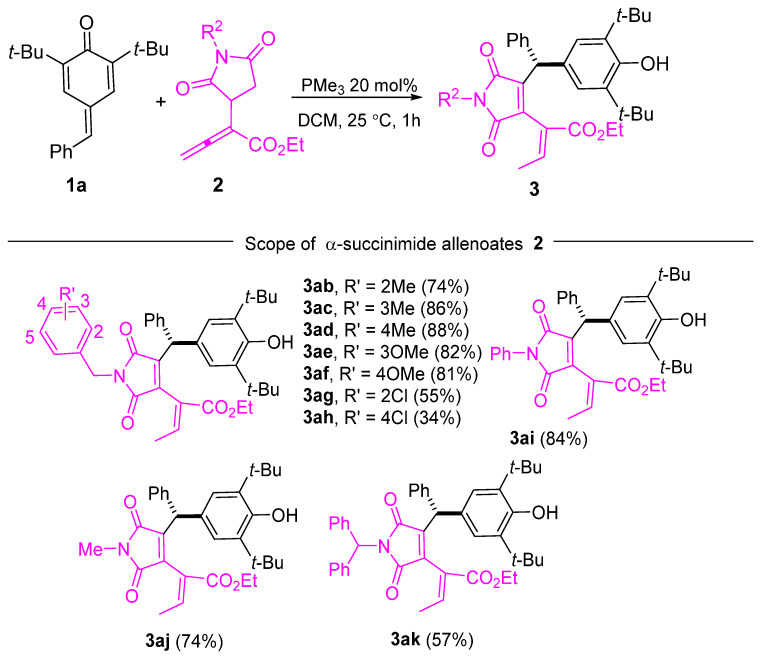 Figure 5
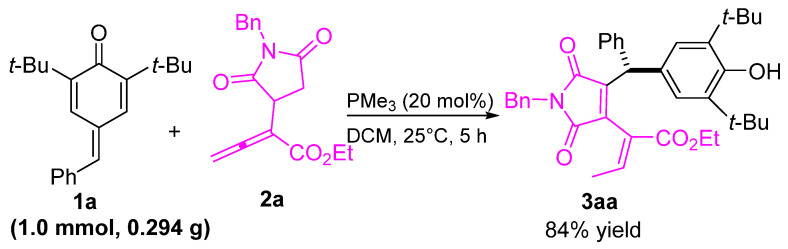 Figure 6
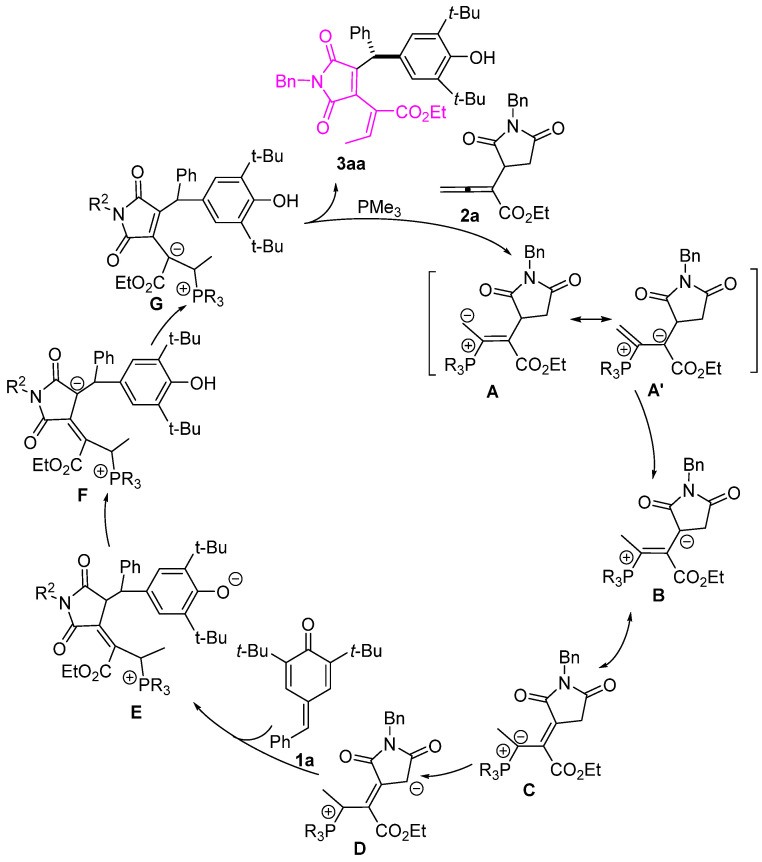 Figure 7
- —Natural Science Foundation of Shandong Province
- —National Natural Science Foundation of China
- —Support Plan on Science and Technology for Youth Innovation of Universities in Shandong Province
- —Innovation and Entrepreneurship Training Program Liaocheng University
- —Special Construction Project Fund for Shandong Province Taishan Scholars
Peer Reviews
No public reviews on file for this paper yet. If you reviewed it on a platform where reviews are public (OpenReview, ICLR, NeurIPS, ICML), you can paste yours below so the community can read it here.
Videos
No videos yet. Explain this paper in a talk, walkthrough, or lecture? Add one.
Taxonomy
TopicsSynthesis of Indole Derivatives · Multicomponent Synthesis of Heterocycles · Axial and Atropisomeric Chirality Synthesis
1. Introduction
Over the past two decades, there has been a notable growth in phosphine catalysis within organic synthesis. This expansion is attributed to the versatile nature of phosphine, attracting attention from numerous research groups [1,2,3,4,5,6,7,8,9,10,11,12]. Since the pioneering work of Kwon’s group in 2003, where they introduced α-substituted allenoates for phosphine-catalyzed [4 + 2] annulation [13], the potential of these allenoates in phosphine catalysis has been extensively explored. While various electrophilic partners have been employed in phosphine-catalyzed nucleophilic additions or annulations with α-substituted allenoates [14,15,16,17,18,19,20,21,22,23,24,25,26,27,28,29,30,31,32,33], there remains value in investigating novel α-substituted allenoates with diverse structures. Such research endeavors hold promise for revealing new reaction pathways and enriching synthetic routes for a wide array of functional molecules. Very recently, our group was the first to report a series of new α-succinimide substituted allenoates, which can undergo a [4 + 2] annulation reaction with 1,1-dicyanoalkenes under phosphine catalysis, involving the γ′-carbon of the allenoates (Scheme 1a) [34]. But there have been very few works related to the γ′-carbon addition of allenoates under phosphine catalysis [35,36]. Therefore, the potential of α-succinimide substituted allenoates in nucleophilic phosphine catalysis remains underexplored. Therefore, continuous exploration of the addition reactions involving this allenoate is highly recommended.
In recent years, para-quinone methides have emerged as versatile building blocks for 1,6-conjugate addition reactions, facilitating the synthesis of functionalized diarylmethane derivatives [37,38,39,40,41,42,43,44,45,46,47]. Catalytic reactions play an important role in many transformations of para-quinone methides, and some have been established through the use of catalysts such as Lewis acids, Brønsted acids, bases, transition metals, and N-heterocyclic carbenes [38,48]. In a recent investigation, these 1,6-addition reactions to para-quinone methides taking place under phosphine catalysis were already reported, achieving the phosphine-catalyzed direct dienylation with para-quinone methides. Xu et al. documented a chiral phosphine-catalyzed allenoate isomerization/1,6-conjugate addition cascade reaction with para-quinone methides. The reaction exclusively proceeds via the δ-carbon under phosphine catalysis (Scheme 1b) [49]. Another study by Wang et al. in 2021 revealed a phosphine-catalyzed protocol for the 1,6-conjugate addition of an alkynoate via the δ-carbon with para-quinone methides (Scheme 1c) [50]. To the best of our knowledge, γ′-carbon 1,6-conjugate addition with para-quinone methides catalyzed by phosphine has never been reported before.
Heterocyclic diarylmethane molecules have exhibited a wide range of biological applications [51,52,53,54,55,56,57,58,59]. As part of our ongoing efforts to develop new methodologies for synthesizing functionalized organic compounds under phosphine catalysis, we introduce an innovative and highly regioselective synthesis of 4-diarylmethylated 3,4-disubstituted maleimides. Herein, we report the first example of a phosphine catalyzed γ′-carbon 1,6-addition of α-succinimide substituted allenoates to para-quinone methides (Scheme 1d).
2. Results and Discussion
This investigation commenced by examining the reaction between α-succinimide allenoate 2a and para-quinone methide (p-QM) 1a. A catalyst, MePPh_2_, was employed at 20 mol % with DCM as the solvent. The desired product 3aa was obtained with a yield of 34% (Table 1, entry 1). Various phosphines were also tested for the cascade remote 1, 6-addition reactions. However, no enhancement in reactivity was observed with the phosphines EtPPh_2_ and PrPPh_2_ (Table 1, entries 2, 3). Fortunately, when the reaction was attempted with Me_2_PPh and PMe_3_, smooth conversion was achieved, yielding the 1,6-conjugate addition product 3aa with yields of 67% and 92%, respectively (Table 1, entries 4, 5). It is noteworthy that the presence of PCy_3_ or PBu_3_, with their bulky substitution groups, resulted in decreased yields (Table 1, entries 6, 7). Considering the optimal catalyst, PMe_3_, we further optimized the reactions, using different solvents. Solvent screening revealed that DCE yielded similar results to DCM (Table 1, entry 8), while toluene, THF, and EtOAc exhibited low reactivity as solvents (Table 1, entries 9–11). Conversely, CH_3_CN and CH_3_OH resulted in inferior outcomes (Table 1, entries 12, 13). By reducing the loading of PMe_3_ to 10 mol % and 5 mol %, the yields of 3aa decreased to 85% and 75%, respectively (Table 1, entries 14, 15). Therefore, the optimal reaction conditions were determined to be DCM as the solvent, room temperature, and 20 mol% of PMe_3_ as the catalyst.
Following the determination of optimal conditions for 1,6-conjugate addition, we investigated the substrate scope of this reaction. In Scheme 1, we explored the influence of various functional groups on the benzene ring of p-QMs. Under the optimized conditions, it was observed that the p-QMs carrying various electronically diverse functional groups at the para-position of the phenyl ring facilitated the formation of conjugate adducts with yields ranging from good to excellent. Smooth conjugate addition was achieved with electron-rich methyl- and methoxy-substituted aryl quinone methides, resulting in excellent yields of the adducts (Scheme 2, 3ba, 3ca). Similarly, the reactions effectively yielded the corresponding products in good yields (Scheme 2, 3da–3ha) when employing arenes containing electron-deficient functional groups such as halogens, nitro groups, and cyano groups. Additionally, satisfactory performance was demonstrated in the reaction with p-QMs containing an ortho-substituted aryl moiety (Scheme 2, 3ia–3la). The applicability of the reaction was expanded to include meta-substituted aryl quinone methides (Scheme 2, 3ma–3oa). Furthermore, trisubstituted aryl quinone methides were investigated, and the conjugate addition yielded the desired in good yields (Scheme 2, 3pa). Moreover, the reaction was employed with p-QMs derived from β-naphthaldehyde, resulting in enhanced product yields (Scheme 2, 3ra). The reaction also showed success with the p-QM substrates generated from thiophene-2-carboxaldehyde and indole-3-carboxaldehyde (Scheme 2, 3qa, 3sa–3ua). The structure of 3sa was confirmed via X-ray analysis (CCDC 2287621) [60]. These data are accessible free of charge from the Cambridge Crystallographic Data Centre via http://www.ccdc.cam.ac.uk/data_request/cif. 9 August 2023. (DOI: 10.5517/ccdc.csd.cc2gsg7z). For further details regarding the crystal structure of 3sa, please refer to the Supplementary Materials.
In addition to p-QMs, we explored the substrate scope of α-succinimide allenoates with various R^2^ groups using 1a as the coupling partner (Scheme 3). We were pleased to observe that the reactivity of the substrates remained unaffected when electron-donating substituents were introduced into the benzyl phenyl ring, resulting in yields of 74–81% (Scheme 3, 3ab–3af). However, the yields slightly decreased to 55% and 34% for 3ag and 3ah, respectively, when R’ groups with electron-withdrawing properties were employed. Encouragingly, the reaction displayed good tolerance toward the phenyl group, as evidenced by the successful formation of the corresponding products in 84% yield (Scheme 3, 3ai). Additionally, when R^2^ was a methyl group or a diphenyl-substituted methyl group, the products were obtained with respective yields of 74% (Scheme 2, 3aj) and 57% (Scheme 3, 3ak).
To demonstrate the applicability of our method, we conducted a scale-up reaction. As depicted in Scheme 4, the reaction between 1a and allenoate 2a proceeded smoothly under optimal conditions, yielding desired product 3aa at the gram scale without any noticeable loss in yield.
A plausible reaction mechanism is proposed in Scheme 5. This addition reaction begins with the nucleophilic addition of a phosphine to the allenoates 2a, forming zwitterionic intermediates (A⟷A′). Subsequent proton transfer leads to intermediate B, followed by the formation of intermediate D through isomerization and proton transfer. Intermediate D then attacks p-QM 1a, forming intermediate E. Subsequently, intermediate E undergoes a series of H-transfers to form intermediate G. The elimination of PR_3_ from G produces product 3aa, which regenerates PR_3_ to complete the catalytic cycle.
3. Materials and Methods
All chemical reactions were carried out under an argon atmosphere using oven-dried glassware. This setup included magnetic stirring to ensure proper mixing of reagents. Unless otherwise stated, all chemicals were purchased from commercial suppliers and used as received without any additional purification. However, all solvents used in the reactions were purified and dried prior to use, according to standard laboratory procedures. The progress of the chemical reactions was monitored by thin-layer chromatography (TLC) on glass plates precoated with silica gel, and fluorescence quenching with UV light at a wavelength of 254 nm was used to visualize the chromatograms. Any necessary purification of the products was carried out by flash column chromatography using the Qingdao Haiyang flash silica gel (Qingdao, China) with a particle size range of 100–200 mesh. Nuclear magnetic resonance (NMR) spectra, both proton (^1^H) and carbon (^13^C), were recorded in deuterated CDCl_3_ or DMSO-d6 using the 500 MHz NMR spectrometer. The melting points of the compounds were determined using an X-4 digital micro-melting point apparatus from Shanghai Jingke (Shanghai, China) to ensure accuracy. An Agilent instrument using electrospray ionization mass spectrometry (ESI-MS) (Campus Drive Stanford, CA, USA) was used to obtain accurate mass measurements. In addition, X-ray crystallographic data were collected using a Bruker D8 VENTURE instrument (Billerica, Germany) to provide detailed structural information on the synthesized compounds. Characterization data of compounds, NMR spectra of compounds and crystallographic data for product 3sa, See Supplementary Materials.
3.1. General Procedure for the Synthesis of Para-Quinone Methides 1
Aldehyde (10 mmol) was added to a solution of the phenol (10 mmol) in toluene (40 mL). The reaction mixture was heated in a Dean–Stark apparatus to reflux. Piperidine (20 mmol) was added dropwise over 1 h, and heating continued until all the starting material had been consumed. After the mixture had cooled just below the boiling point of toluene (100 °C), acetic anhydride (20 mmol) was added. The solution was stirred for 15 min. The residue was extracted three times with dichloromethane. The combined organic layers were sequentially washed with water and brine, dried over magnesium sulfate, filtered, and concentrated. The crude product was purified by flash column chromatography on silica gel to afford the corresponding product 1.
3.2. General Procedure for the Synthesis of α-Succinimide Substituted Allenoates 2
Maleimide (0.15 mmol), allene (0.30 mmol), DABCO (0.030 mmol), and 1,4-dioxane (1.0 mL) were added to a Schlenk tube. The reaction mixture was stirred at room temperature for 3 h, the solvent was then removed under reduced pressure, and the residue was purified by flash column chromatography (PE/EA = 4/1~2/1) to afford products 2.
3.3. General Procedure for the Phosphine-Catalyzed Direct 1,6-Conjugate Addition
Under argon atmosphere, 1 mL of DCM was added to a mixture of para-quinone methide 1 (0.10 mmol), α-succinimide substituted allenoate 2 (0.12 mmol) and catalyst PMe_3_ (20 mol%, 0.02 mmol) in a Schlenk tube at room temperature. The resulting mixture was stirred until the starting material was completely consumed (monitored by TLC) and then concentrated to dryness. The residue was purified through flash column chromatography (PE/EtOAc = 8:1) to afford corresponding cycloaddition products 3.
4. Conclusions
In conclusion, we have introduced a novel method for synthesizing functionalized 4-diarylmethylated 3,4-disubstituted maleimides in satisfactory yields. This method involves a phosphine-catalyzed 1,6-conjugated addition reaction between α-succinimide substituted allenoates and p-QMs. Considering the extensive research on the biological activity of natural products and industrially useful compounds containing the 3,4-disubstituted maleimide moiety, our methodology presents a new and efficient protocol for their synthesis.
The reference list from the paper itself. Each links out to its DOI / PubMed record.
- 1Wang Z. Xu X. Kwon O. Phosphine Catalysis of Allenes with Electrophiles Chem. Soc. Rev.2014432927294010.1039/C 4CS 00054 D 24663290 PMC 4059616 · doi ↗ · pubmed ↗
- 2Xiao Y. Sun Z. Guo H. Kwon O. Chiral Phosphines in Nucleophilic Organocatalysis Beilstein J. Org. Chem.2014102089212110.3762/bjoc.10.21825246969 PMC 4168899 · doi ↗ · pubmed ↗
- 3Li W. Zhang J. Recent Developments in the Synthesis and Utilization of Chiral β-Aminophosphine Derivatives as Catalysts or Ligands Chem. Soc. Rev.2016451657167710.1039/C 5CS 00469 A 26776280 · doi ↗ · pubmed ↗
- 4Xiao Y. Guo H. Kwon O. Nucleophilic Chiral Phosphines: Powerful and Versatile Catalysts for Asymmetric Annulations Aldrichim. Acta 201649341 PMC 522234128077882 · pubmed ↗
- 5Wang T. Han X. Zhong F. Yao W. Lu Y. Amino Acid Derived Bifunctional Phosphines for Enantioselective Transformations Acc. Chem. Res.2016491369137810.1021/acs.accounts.6b 0016327310293 · doi ↗ · pubmed ↗
- 6Zhou L. Guo H. Acidic Hydrogen-Tethered Electron-Deficient Acceptors for Phosphine-Catalyzed Annulations Synlett 20243510.1055/a-2242-0543 · doi ↗
- 7Wei Y. Shi M. Lu’s [3 + 2] Cycloaddition of Allenes with Electrophiles: Discovery, Development and Synthetic Application Org. Chem. Front.201741876189010.1039/C 7QO 00285 H · doi ↗
- 8Ni H. Chan W.L. Lu Y. Phosphine-Catalyzed Asymmetric Organic Reactions Chem. Rev.20181189344941110.1021/acs.chemrev.8b 0026130204423 · doi ↗ · pubmed ↗