The complete mitochondrial genome of Zaomma eriococci (hymenoptera: encyrtidae)
Zi-Cong Li, Arong Luo, Qing-Song Zhou, Zhulidezi Aishan

TL;DR
This paper reports the first complete mitochondrial genome of Zaomma eriococci, a species in the Encyrtidae family, providing a valuable resource for genetic studies.
Contribution
The study presents the first complete mitochondrial genome of the genus Zaomma, offering new insights into its genetic structure and phylogenetic relationships.
Findings
The mitochondrial genome is 15,648 bp long and contains 37 classical eukaryotic mitochondrial genes.
Phylogenetic analysis shows Z. eriococci is closely related to Tassonia gloriae.
The genome includes 22 tRNA genes and an A + T rich region.
Abstract
The complete mitochondrial genome of the Zaomma eriococci (Ferrière, 1955) (Hymenoptera: Encyrtidae) was obtained through next-generation sequencing, making the first reported complete mitochondrial genome of the genus Zaomma. The mitochondrial genome is 15,648 bp in length and includes 37 classical eukaryotic mitochondrial genes along with an A + T rich region. All 13 protein-coding genes (PCGs) initiate with typical ATN codons. Of these, 10 PCG genes terminate with TAA, while three terminate with TAG. Additionally, there are 22 tRNA genes, ranging in size from 62 to 70 bp. The maximum likelihood phylogenetic tree was constructed based on 13 PCGs, indicates that Z. eriococci is closely related to Tassonia gloriae. This mitochondrial genome will serve as a valuable molecular resource for species identification, genetic analysis, and comparative genomic studies of Z. eriococci,…
Genes, proteins, chemicals, diseases, species, mutations and cell lines named across the full text — each resolved to its canonical identifier and authoritative record.
Click any figure to enlarge with its caption.
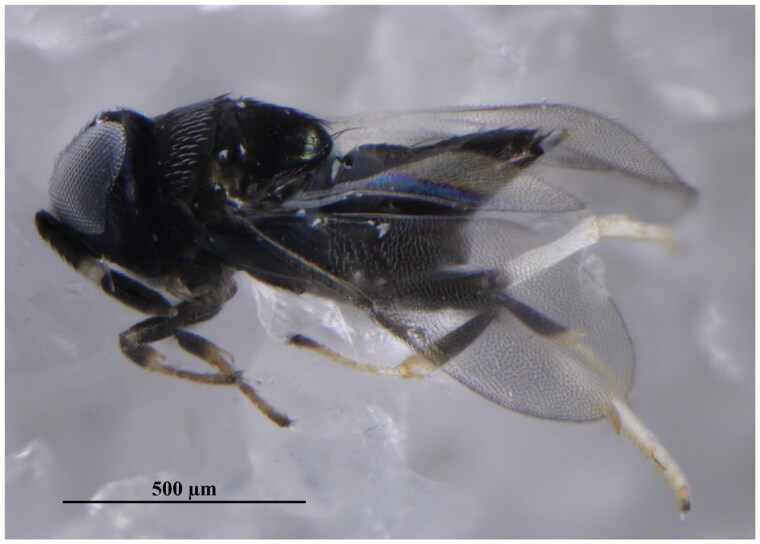 Figure 1
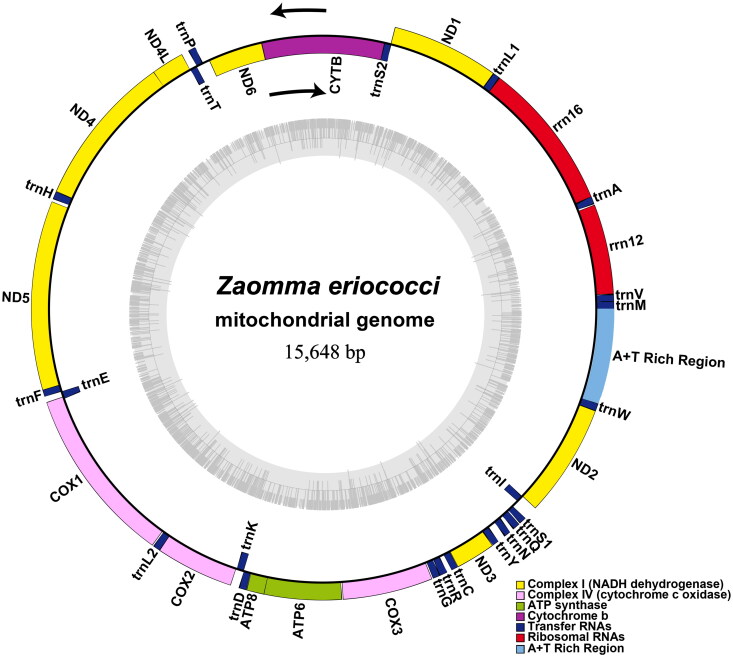 Figure 2
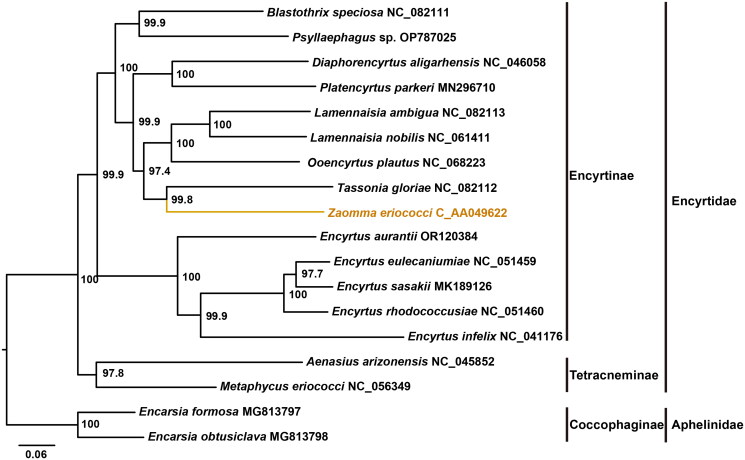 Figure 3
- —National Natural Science Foundation of China10.13039/501100001809
Peer Reviews
No public reviews on file for this paper yet. If you reviewed it on a platform where reviews are public (OpenReview, ICLR, NeurIPS, ICML), you can paste yours below so the community can read it here.
Videos
No videos yet. Explain this paper in a talk, walkthrough, or lecture? Add one.
Taxonomy
TopicsInsect-Plant Interactions and Control · Research on scale insects · Insect Resistance and Genetics
Introduction
The family Encyrtidae (Hymenoptera: Chalcidoidea) is one of the most diverse groups of parasitoids, with approximately 5,000 described species (Noyes 2018). The genus Zaomma was initially characterized by Ashmead in 1900 due to its very large rounded eyes and short antennae (Ashmead 1900), and presently encompasses 17 described species (Noyes 2018). Zaomma eriococci (Ferrière, 1955) is widely distributed in Europe and Asia, where it acts as a parasitoid for 13 scale insect species, most of which belong to the family Eriococcidae (Noyes 2018). Additionally, Z eriococci has been reported as a hyperparasitoid of two encyrtid species (Xu et al. 1996).
Recently, Z. eriococci was reported as one member of the parasitoid communities associated with Crapemyrtle Bark Scale Acanthococcus lagerstroemiae in China and Korea (Zhang et al. 2018; Suh 2019). However, only partial COI gene data are available for the molecular information of Z. eriococci (Zhang et al. 2018). The absence of complete mitochondrial genome information hinders our comprehensive understanding of this species and the phylogenetic relationships within the genus Zaomma, which belongs to the family Encyrtidae. In this study, we present the complete mitochondrial genome of Z. eriococci.
Materials and methods
Sampling and identification
Specimens of Z. eriococci (Figure 1) were reared from A. lagerstroemiae (Hemiptera: Eriococcidae) collected in August 2023 in Jincheng City, Shanxi Province, China (112.91367E, 35.62242 N). The species was identified based on morphological characters as described (Suh 2019) and later confirmed by comparing the DNA barcodes with the GenBank database. Voucher specimens were preserved in 100% ethanol at −20 °C and deposited at the Institute of Zoology, Chinese Academy of Sciences (IZCAS) under voucher number J23094_TXF. For further information, please contact Qing-Song Zhou via email at [email protected].
The lateral view of Zaomma eriococci (Ferrière, 1955). (Photo by Jin-Ling Wang). The specimen was rared from Acanthococcus lagerstroemiae at Jincheng City, Shanxi Province, China (112.91367E, 35.62242 N).
Mitochondrial genome assembly and annotation
The complete mitochondrial genome of Z. eriococci was obtained through next-generation sequencing. Genomic DNA was extracted from a mixture of fresh samples from five individuals using a modified CTAB procedure in liquid nitrogen (Doyle 1986). Subsequently, DNA quality was assessed using PicoGreen and quantified by the ND-2,000 (NanoDrop Technologies). DNA integrity was confirmed by agarose gel electrophoresis. A DNA library was created using the Illumina TruSeq^®^ DNA PCR-Free HT Kit and sequenced on the Illumina HiSeq platform (150 bp paired-end). The minimum and maximum reads mapping depths for assembled mitochondrial genome were 870× and 7995×, respectively (Supplementary Figure S1). The mitochondrial genome of Z. eriococci were assembled from Illumina short reads using MitoFlex (Li et al. 2021) and NOVOPlasty (Dierckxsens et al. 2017). The assembled linear contigs were manually curated in BioEdit (Hall et al. 2011) and the identical sequence overlap in the control region was deleted to ensure the circularization of the mitochondrial genome.
The mitochondrial genome was annotated using the Mitos webserver (http://mitos2.bioinf.uni-leipzig.de/index.py) (Bernt et al. 2013) following the invertebrate mitochondrial code. Transfer RNA (tRNA) genes were confirmed using the online tool ARWEN (http://130.235.46.10/ARWEN/) (Laslett and Canbäck 2008). Subsequently, the position and direction of each gene were manually checked with reference mitochondrial genomes from closely related species to Z. eriococci. The circular map of the mitochondrial genomes was generated using OrganellarGenomeDRAW (OGDRAW, https://chlorobox.mpimp-golm.mpg.de/OGDraw.html) (Lohse et al. 2007).
Phylogenetic analysis
A total of 16 species from the family Encyrtidae were selected as ingroups, with two species from Aphelinidae chosen as outgroups (Supplementary Table S1). The mitochondrial sequences were processed using PhyloSuite (Zhang et al. 2020). Protein coding sequences alignment were performed using MACSE v2 (Ranwez et al. 2018). Gaps and ambiguous sites were removed using Gblocks (Talavera and Castresana 2007). The phylogenetic tree was inferred using IQ-Tree v1.6.9 (Nguyen et al. 2015) under maximum-likelihood (ML) method with 1,000 ultrafast bootstraps (Hoang et al. 2018) and 1,000 SH-aLRT replicates (Guindon et al. 2010), the best-fit partitioning schemes and substitution models were determined using ModeFinder (Kalyaanamoorthy et al. 2017).
Results
The complete mitochondrial genome of Z. eriococci is a typical circular DNA molecule of 15,648 bp in length, with the nucleotide base composition as follows: A: 34.94%, T: 44.93, G: 13.43, C: 6.70%. It comprises 13 protein-coding genes (PCGs), 22 transfer RNAs (tRNAs), two ribosomal RNAs (rRNAs) and a putative control region (CR) (Figure 2). The mitochondrial genome of Z. eriococci exhibits a novel gene rearrangement in encyrtids species (Xing et al. 2022), a total of 29 genes, including eight PCGs, nineteen tRNAs, and two rRNAs were rearranged compared to the putative ancestral insect mitochondrial genome (Cameron 2014). The combined length of all 13 protein-coding genes accounts for 70.6% of the entire mitochondrial genome. The ND5 domain, spanning 1,662 bp, was the longest gene, while the ATP8 domain, covering 159 bp, was the shortest. All 13 PCGs initiate with typical ATN codons (six ATT, four ATG, two ATA, and one ATC). Regarding termination codons, COX2, ND1, and ND3 concluded with TAG, while the others conclude with TAA. The control region is 822 bp in length and contains seven types of repeats ranging from 10 to 144 bp. Two novel lncRNAs along with multiple copy number variations in short tandem repeats were found in other animal mitochondrial genomes (Gao et al. 2018; Chen et al. 2020), however, they were not taken into consideration in this study due to the limitations of NGS sequencing (Tørresen et al. 2019).
Circular map of the Z. eriococci mitochondrial genome. Different colors indicate different types of genes and regions.
The ModelFinder analysis shown that the GTR + F + I + G4 model was the best-fit model. The maximum-likelihood phylogenetic tree based on the concatenation alignment of 13 PCGs, supported the sister relationship between Encyrtinae and Tetracneminae (Zhou et al. 2021; Xing et al. 2022) with high support values (>97%). The phylogeny also confirmed the placement of Z. eriococci within the subfamily Encyrtinae, indicating its close relationship to Tassonia gloriae (Figure 3).
The maximum-likelihood (ML) phylogenetic tree of encyrtidae based on concatenated 13 mitochondrial protein coding genes. All species involved in the tree have scientific names with accession number on right side.
Discussion and conclusion
Approximately 5,000 species have been described in the family Encyrtidae (Noyes 2018). However, fewer than 50 complete mitochondrial genomes have been deposited in the GenBank database. In this study, we assembled and annotated the entire mitochondrial genome of Z. eriococci which it is the first for genus Zaomma. We described the structural features of the mitochondrial genome and its phylogenetic position within the Encyrtidae. The complete mitochondrial genome was 15,648 bp in length, with an AT content of 97.87%. The mitochondrial genome of Z. eriococci exhibits a novel gene rearrangement. Phylogenetic analysis supported the placement of Z. eriococci in the subfamily Encyrtinae, closely related to T. gloriae. These results will contribute to enhancing the mitochondrial genomic data for the family Encyrtidae.
Supplementary Material
Supplemental Material
The reference list from the paper itself. Each links out to its DOI / PubMed record.
- 1Ashmead WH. 1900. On the genera of chalcid-flies belonging to the subfamily Encyrtinae. Proc United States National Museum. 22(1202):323–412. doi:10.5479/si.00963801.22-1202.323. · doi ↗
- 2Bernt M, Donath A, Jühling F, Externbrink F, Florentz C, Fritzsch G, Pütz J, Middendorf M, Stadler PF. 2013. MITOS: improved de novo metazoan mitochondrial genome annotation. Mol Phylogenet Evol. 69(2):313–319. doi:10.1016/j.ympev.2012.08.023.22982435 · doi ↗ · pubmed ↗
- 3Cameron SL. 2014. Insect mitochondrial genomics: implications for evolution and phylogeny. Annu Rev Entomol. 59(1):95–117. doi:10.1146/annurev-ento-011613-162007.24160435 · doi ↗ · pubmed ↗
- 4Chen Z, Xuan Y, Liang G, Yang X, Yu Z, Barker SC, Kelava S, Bu W, Liu J, Gao S. 2020. Precise annotation of tick mitochondrial genomes reveals multiple copy number variation of short tandem repeats and one transposon-like element. BMC Genomics. 21(1):488. doi:10.1186/s 12864-020-06906-2.32680454 PMC 7367389 · doi ↗ · pubmed ↗
- 5Dierckxsens N, Mardulyn P, Smits G. 2017. NOVO Plasty: de novo assembly of organelle genomes from whole genome data. Nucleic Acids Res. 45(4):e 18. doi:10.1093/nar/gkw 955.28204566 PMC 5389512 · doi ↗ · pubmed ↗
- 6Doyle J. 1986. A rapid DNA isolation procedure from small quantities of fresh leaf tissues. Phytochem Bull. 19:11–15.
- 7Ferrière C. 1955. Encyrtides nouveaux ou peu connus (Hym. Chalcidoidea). Mitteilungen Der Schweizerischen Entomologischen Gesellschaft 28:115–136.
- 8Gao S, Tian X, Chang H, Sun Y, Wu Z, Cheng Z, Dong P, Zhao Q, Ruan J, Bu W. 2018. Two novel lnc RN As discovered in human mitochondrial DNA using Pac Bio full-length transcriptome data. Mitochondrion. 38:41–47. doi:10.1016/j.mito.2017.08.002.28802668 · doi ↗ · pubmed ↗