A technique for preventing clip snagging during the use of a rotating function endoscopic clip
Koichiro Kawano, Mamoru Takenaka, Reiko Kawano, Tomonori Moriguchi, Koutaro Mine, Katsuhisa Nishi, Masatoshi Kudo

Abstract
Genes, proteins, chemicals, diseases, species, mutations and cell lines named across the full text — each resolved to its canonical identifier and authoritative record.
Click any figure to enlarge with its caption.
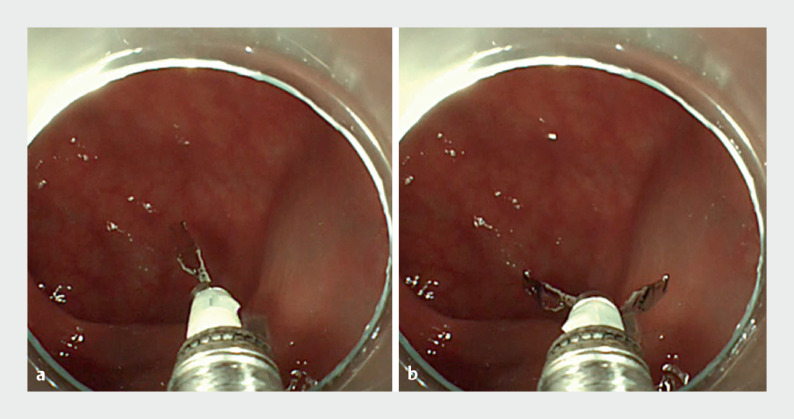 Fig. 1
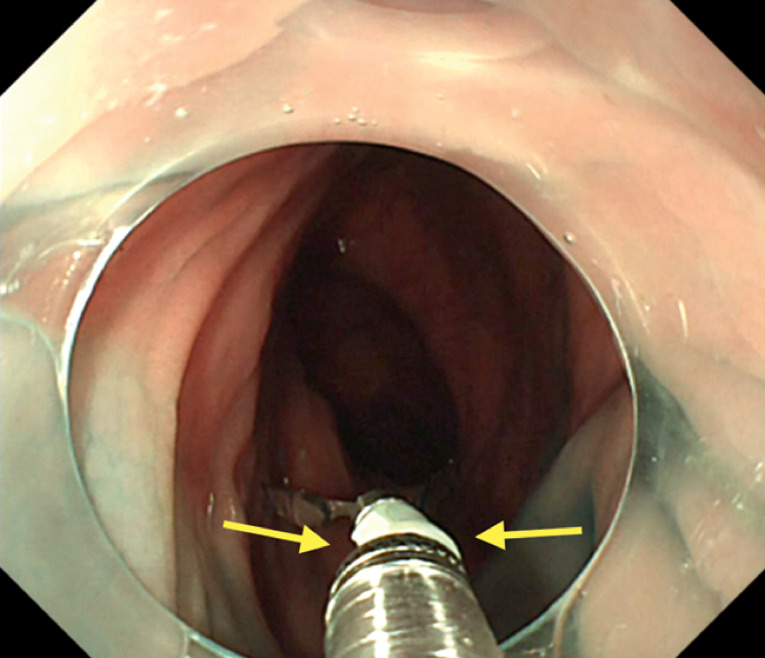 Fig. 2
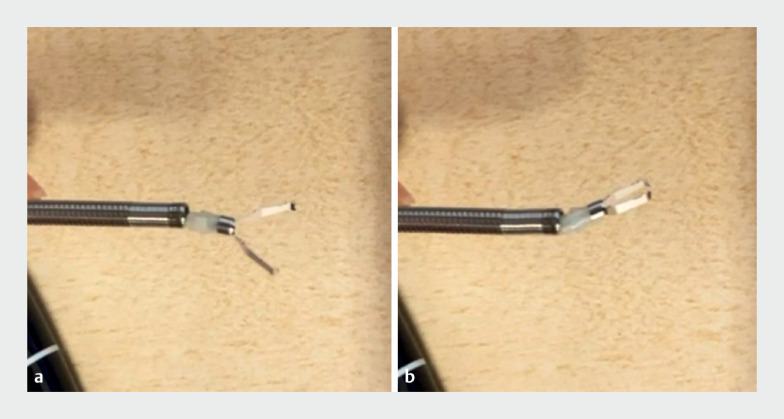 Fig. 3
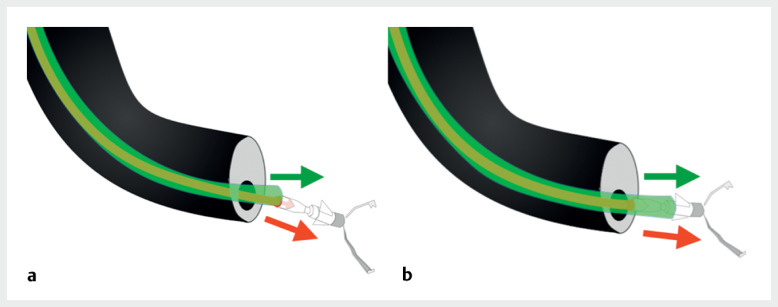 Fig. 4
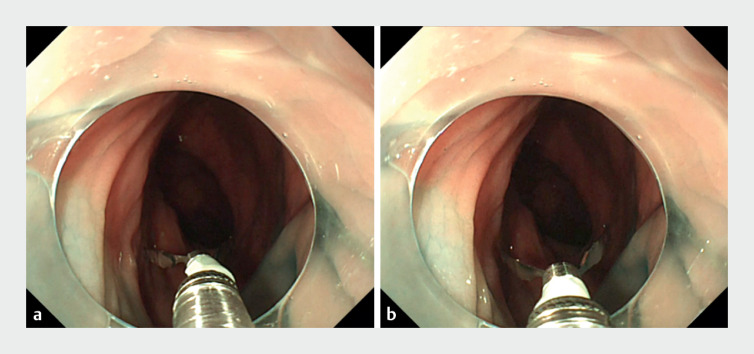 Fig. 5
Peer Reviews
No public reviews on file for this paper yet. If you reviewed it on a platform where reviews are public (OpenReview, ICLR, NeurIPS, ICML), you can paste yours below so the community can read it here.
Videos
No videos yet. Explain this paper in a talk, walkthrough, or lecture? Add one.
Taxonomy
TopicsGastrointestinal Bleeding Diagnosis and Treatment · Gastrointestinal disorders and treatments · Esophageal and GI Pathology
The EZ clip series (Olympus, Tokyo, Japan) is widely recognized as a useful endoscopic clip with a rotating function 1 2 3 . This highly effective rotation function allows the clip to be oriented correctly relative to the target ( Fig. 1 ). When employing this function, it is crucial to ensure that the coil sheath does not contact the end of the clip, as frictional resistance may impede proper rotation. Thus, separating the coil sheath from the clip is necessary before initiating rotation. The clip is then rotated to the proper angle and then retracted until the clip stopper contacts the coil sheath to allow for clipping. However, excessive bending of the endoscope during angle adjustment may cause the tip of the clip to collide with the coil sheath, leading to clip snagging ( Fig. 2 ) and, consequently, imprecise clipping ( Fig. 3 ).
The EZ clip series (Olympus, Tokyo, Japan) is widely recognized as a useful endoscopic clip with a rotating function. This highly effective rotation function allows the clip to be oriented correctly relative to the target.
The clip snagging phenomenon. Excessive bending of the endoscope during angle adjustment may cause the tip of the clip to collide with the coil sheath (yellow arrow), leading to clip snagging.
a , b The clip snagging phenomenon results in imprecise clipping.
Herein, we report a technique for preventing clip snagging during the use of a rotating function endoscopic clip.
The technique was applied to a 67-year-old man undergoing endoscopic submucosal dissection for a 0-IIa+IIc lesion in the sigmoid colon. The EZ clip was employed to suture the wound; however, strong bending of the endoscope tip resulted in clip snagging. To resolve this, the deployed clip and coil sheath were gently retracted into the scope channel while misaligned. The snagging was eliminated after several insertions and withdrawals in the scope channel, as the axis realigned with the coil sheath ( Fig. 4 ). This allowed for clipping without altering the clip’s position or the preset angle ( Fig. 5 , Video 1 ). The patient had a good postoperative course and was discharged on the fourth postoperative day.
a , b The deployed clip and coil sheath were gently retracted into the scope channel while misaligned, to resolve the clip snagging phenomenon. The snagging was eliminated after several insertions and withdrawals in the scope channel, as the axis realigned with the coil sheath.
a The clip snagging phenomenon. b The clip snagging phenomenon was resolved by axis correction.
Technique for preventing clip snagging during the use of a rotating function endoscopic clip for the successful closure of ulcers or effective hemostasis.Video 1
Despite its simplicity, this technique is instrumental in preventing clip snagging with a rotating function endoscopic clip, potentially leading to the successful closure of ulcers and effective hemostasis.
Endoscopy_UCTN_Code_TTT_1AO_2AO
The reference list from the paper itself. Each links out to its DOI / PubMed record.
- 1Shin DY Park S Kim A Compatibility of endoclips in the gastrointestinal tract with magnetic resonance imaging Sci Rep 2020101653733024206 10.1038/s 41598-020-73726-5PMC 7539000 · doi ↗ · pubmed ↗
- 2Peng YC Chen SY Tung CF Factors associated with failure of initial endoscopic hemoclip hemostasis for upper gastrointestinal bleeding J Clin Gastroenterol 200640252816340629 10.1097/01.mcg.0000190754.25750.c 0 · doi ↗ · pubmed ↗
- 3Olmez S Ozaslan E Avcioglu U Hemoclip retained for more than 2 years Endoscopy 201244 E 32332410.1055/s-0032-130985323012002 · doi ↗ · pubmed ↗