Synergistically Modulating Conductive Filaments in Ion‐Based Memristors for Enhanced Analog In‐Memory Computing
Jinyong Wang, Yujing Ren, Ze Yang, Qiaoya Lv, Yu Zhang, Mingyue Zhang, Tiancheng Zhao, Deen Gu, Fucai Liu, Baoshan Tang, Weifeng Yang, Zhiqun Lin

TL;DR
This paper introduces a memristor design that improves analog in-memory computing by better controlling ion movement and filament formation.
Contribution
A novel memristor using oxygen-rich SnO2 nanoflowers to synergistically modulate conductive filaments and reduce ion migration issues.
Findings
The memristor achieves a high on/off ratio of >10^6 and 10-year memory retention.
It demonstrates low switching variability (6.85%) and multiple synaptic functions for neuromorphic computing.
The device achieves ≥91.39% image recognition accuracy using symmetric analog weight updating.
Abstract
Memristors offer a promising solution to address the performance and energy challenges faced by conventional von Neumann computer systems. Yet, stochastic ion migration in conductive filament often leads to an undesired performance tradeoff between memory window, retention, and endurance. Herein, a robust memristor based on oxygen‐rich SnO2 nanoflowers switching medium, enabled by seed‐mediated wet chemistry, to overcome the ion migration issue for enhanced analog in‐memory computing is reported. Notably, the interplay between the oxygen vacancy (Vo) and Ag ions (Ag+) in the Ag/SnO2/p++‐Si memristor can efficiently modulate the formation and abruption of conductive filaments, thereby resulting in a high on/off ratio (>106), long memory retention (10‐year extrapolation), and low switching variability (SV = 6.85%). Multiple synaptic functions, such as paired‐pulse facilitation, long‐term…
Genes, proteins, chemicals, diseases, species, mutations and cell lines named across the full text — each resolved to its canonical identifier and authoritative record.
Click any figure to enlarge with its caption.
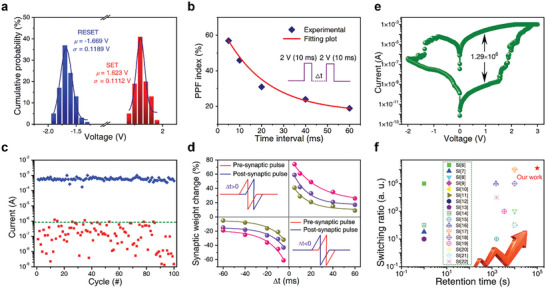 Figure 1
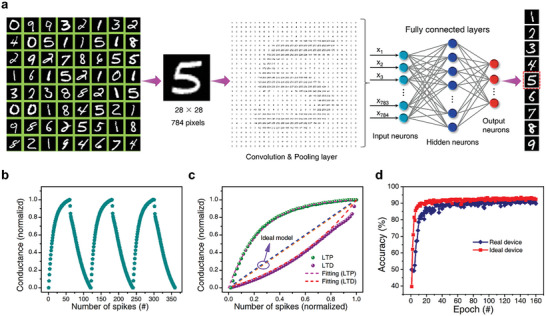 Figure 2
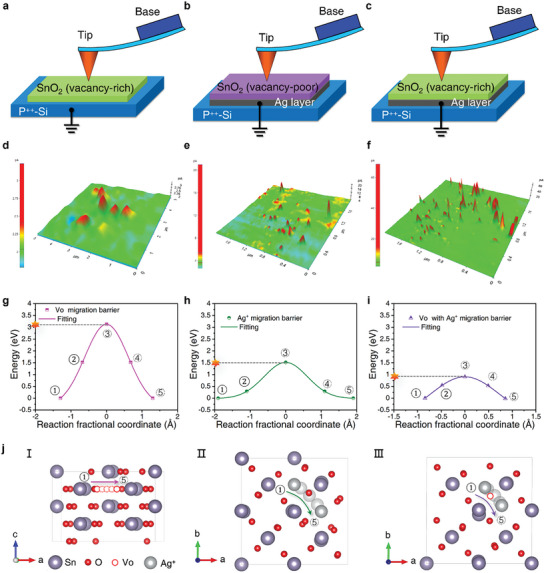 Figure 3
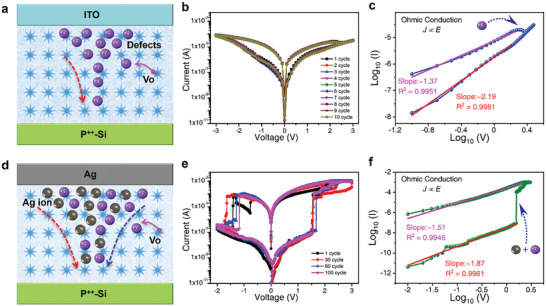 Figure 4
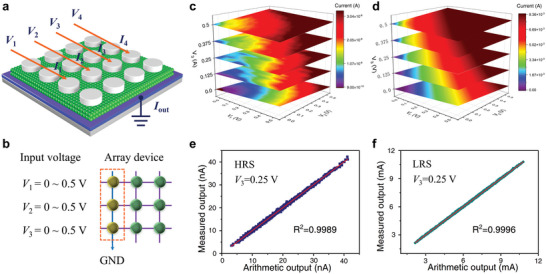 Figure 5
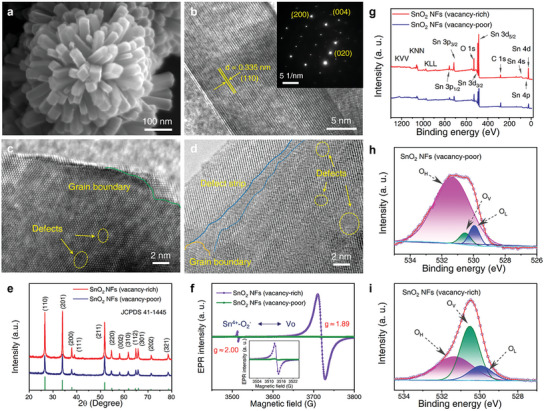 Figure 6
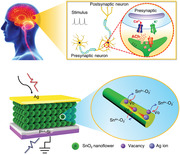 Figure 7
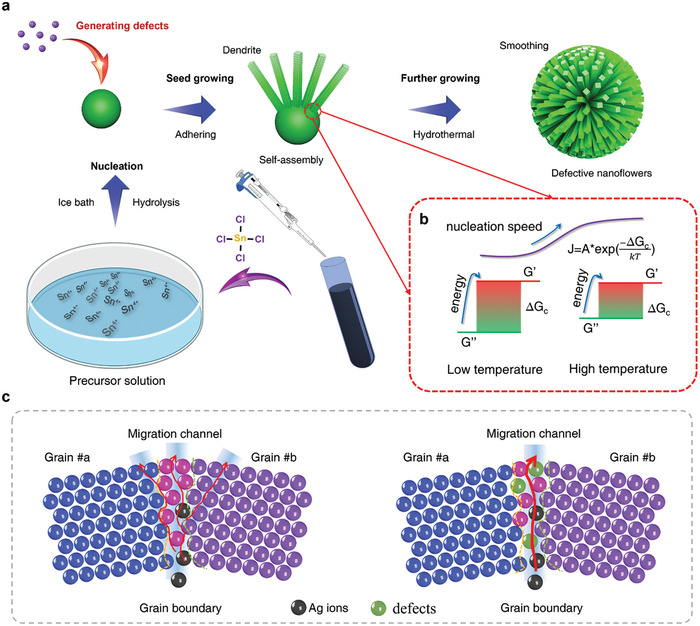 Figure 8
Peer Reviews
No public reviews on file for this paper yet. If you reviewed it on a platform where reviews are public (OpenReview, ICLR, NeurIPS, ICML), you can paste yours below so the community can read it here.
Videos
No videos yet. Explain this paper in a talk, walkthrough, or lecture? Add one.
Taxonomy
TopicsArchaeological and Historical Studies