Variable Clinical Presentations and Renal Outcome in Neonates With Autosomal Recessive Polycystic Kidney Disease
Ei Khin, Divya Ramdas

TL;DR
This paper discusses the varied symptoms and kidney outcomes in newborns with a genetic kidney disease called ARPKD.
Contribution
The study contributes three neonatal ARPKD cases, highlighting clinical variability and outcomes from a single center.
Findings
Neonates with ARPKD showed enlarged kidneys, cysts, and liver fibrosis.
Some cases resulted in respiratory issues due to lung underdevelopment.
Early-onset end-stage kidney disease was observed in some patients.
Abstract
Autosomal recessive polycystic kidney disease (ARPKD) is caused by a mutation in the polycystic kidney and hepatic disease-1 (PKHD1) gene and is an important inherited cause of chronic kidney disease in children. The most typical presentations in neonates are massively enlarged kidneys with variable echogenicity, multiple small cysts, and congenital hepatic fibrosis. Potter sequence with pulmonary hypoplasia can present due to oligohydramnios. Severe pulmonary hypoplasia can lead to respiratory insufficiency and perinatal death. Some affected children can develop end-stage renal disease in early childhood or adolescence. Here, we report the clinical presentations, management, and renal outcomes of three neonatal cases of ARPKD from our center.
Genes, proteins, chemicals, diseases, species, mutations and cell lines named across the full text — each resolved to its canonical identifier and authoritative record.
Click any figure to enlarge with its caption.
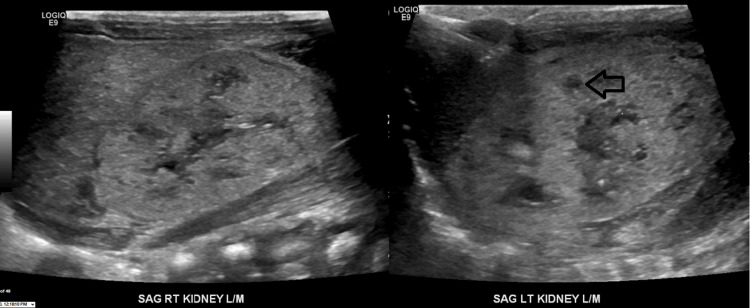 Figure 1
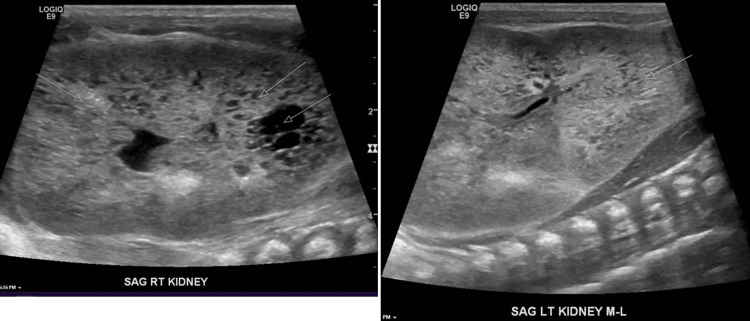 Figure 2
Peer Reviews
No public reviews on file for this paper yet. If you reviewed it on a platform where reviews are public (OpenReview, ICLR, NeurIPS, ICML), you can paste yours below so the community can read it here.
Videos
No videos yet. Explain this paper in a talk, walkthrough, or lecture? Add one.
Taxonomy
TopicsGenetic and Kidney Cyst Diseases · Renal and related cancers · Genetic Syndromes and Imprinting