Reflective environment heightens crayfish aggressive and fearful behaviors
Stephanie M Rocca, Danielle N Saldana, Merve Addemir, Julianna A Koenig, Bin Z He, Olga L Miakotina, Daniel F Eberl

TL;DR
Crayfish show more aggression and fear in a reflective environment, suggesting they recognize their reflection as another crayfish.
Contribution
This study demonstrates that crayfish treat their reflection as a conspecific, revealing new insights into their cognitive abilities.
Findings
Crayfish displayed increased aggression in a reflective environment.
Crayfish showed slight fear responses in the reflective environment.
Behavioral changes were minimal in the non-reflective control environment.
Abstract
Animals typically respond to their reflection as a conspecific and will respond as if the reflection were another animal that they could interact with, either fearfully or aggressively. We investigated how a modified reflective environment of a standard glass aquarium affects the aggressive and fearful behaviors of the crayfish Orconectes virilis , based on pre-determined behavior criteria. We found that the crayfish were both increasingly aggressive and slightly fearful in the reflective environment compared to minimal behavioral changes in the control non-reflective environment. Thus, our findings support that crayfish recognize their mirror image as a conspecific.
Genes, proteins, chemicals, diseases, species, mutations and cell lines named across the full text — each resolved to its canonical identifier and authoritative record.
Click any figure to enlarge with its caption.
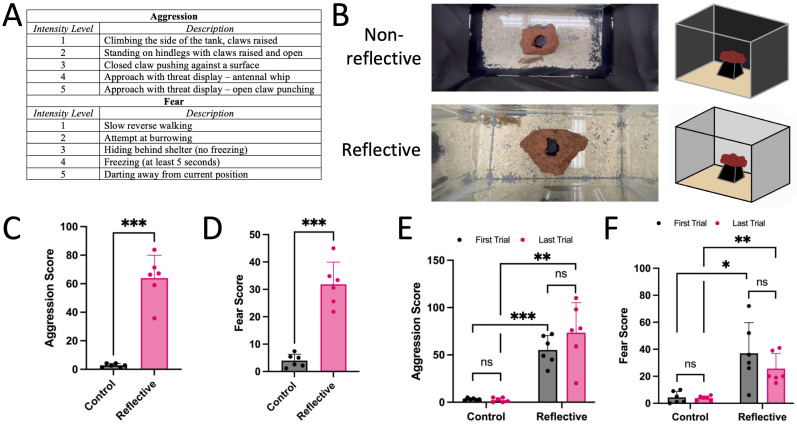 Figure 1
Peer Reviews
No public reviews on file for this paper yet. If you reviewed it on a platform where reviews are public (OpenReview, ICLR, NeurIPS, ICML), you can paste yours below so the community can read it here.
Videos
No videos yet. Explain this paper in a talk, walkthrough, or lecture? Add one.
Taxonomy
TopicsCrustacean biology and ecology