Investigating the impact of motion visual synchrony on self face recognition using real time morphing
Shunichi Kasahara, Nanako Kumasaki, Kye Shimizu

TL;DR
The study explores how facial movement affects self-face recognition, finding that motion narrows recognition boundaries but synchronization doesn't matter.
Contribution
A new methodology for real-time face morphing during movement to study self-face recognition dynamics.
Findings
Participants recognized a narrower self-face boundary with moving faces compared to static ones.
There was no significant difference in recognition between synchronous and asynchronous movements.
Morphing direction consistently biased the recognized self-face boundary.
Abstract
Face recognition is a crucial aspect of self-image and social interactions. Previous studies have focused on static images to explore the boundary of self-face recognition. Our research, however, investigates the dynamics of face recognition in contexts involving motor-visual synchrony. We first validated our morphing face metrics for self-face recognition. We then conducted an experiment using state-of-the-art video processing techniques for real-time face identity morphing during facial movement. We examined self-face recognition boundaries under three conditions: synchronous, asynchronous, and static facial movements. Our findings revealed that participants recognized a narrower self-face boundary with moving facial images compared to static ones, with no significant differences between synchronous and asynchronous movements. The direction of morphing consistently biased the…
Genes, proteins, chemicals, diseases, species, mutations and cell lines named across the full text — each resolved to its canonical identifier and authoritative record.
Click any figure to enlarge with its caption.
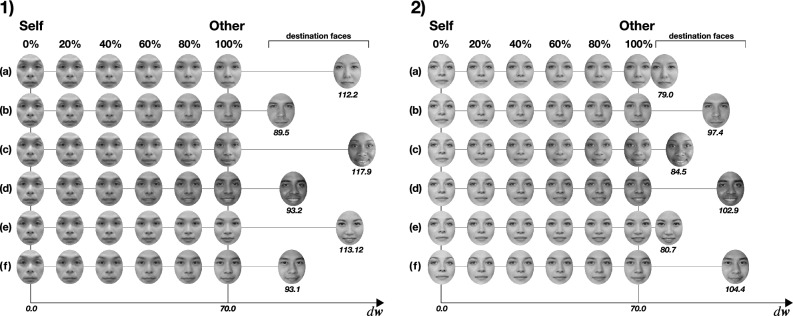 Figure 1
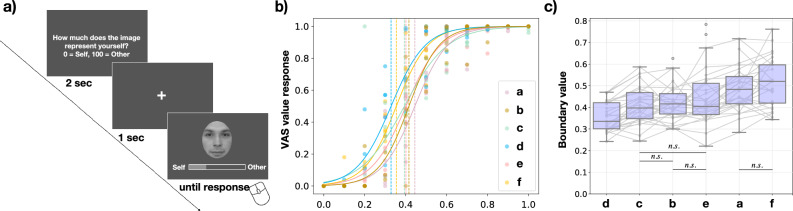 Figure 2
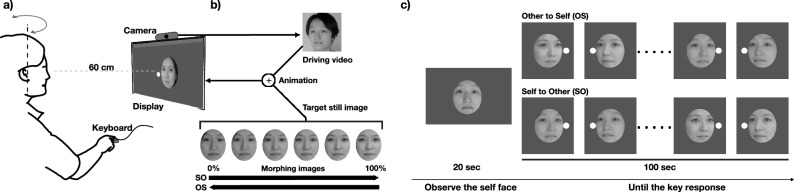 Figure 3
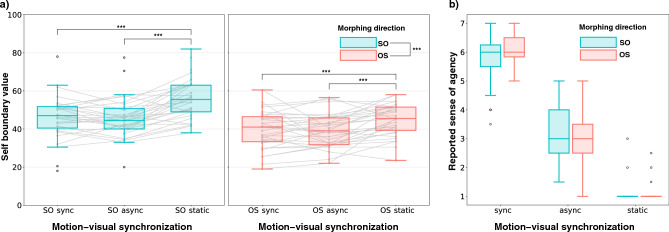 Figure 4
Peer Reviews
No public reviews on file for this paper yet. If you reviewed it on a platform where reviews are public (OpenReview, ICLR, NeurIPS, ICML), you can paste yours below so the community can read it here.
Videos
No videos yet. Explain this paper in a talk, walkthrough, or lecture? Add one.
Taxonomy
TopicsFace Recognition and Perception · Action Observation and Synchronization · Virtual Reality Applications and Impacts