Swimming in a school shelters fish from turbulence
Tyson L. Hedrick

TL;DR
Fish that swim in schools experience less energy expenditure in turbulent water due to the shelter provided by their group.
Contribution
The study experimentally demonstrates that schooling behavior significantly reduces the transport cost for fish in turbulent environments.
Findings
Schooling fish experience reduced energy costs in turbulent flow.
The study provides empirical evidence supporting the benefits of group movement in turbulent conditions.
Abstract
Much has been written about the energetic effects of animals moving in schools or flocks, but experimental results are few and often ambiguous. A new study in PLOS Biology shows that schooling greatly reduces the cost of transport for fish in turbulent flow. Much has been written about the energetic effects of animals moving in schools or flocks, but experimental results are few and often ambiguous. This Primer explores a new study in PLOS Biology which shows that schooling greatly reduces the cost of transport for fish in turbulent flow.
Genes, proteins, chemicals, diseases, species, mutations and cell lines named across the full text — each resolved to its canonical identifier and authoritative record.
Click any figure to enlarge with its caption.
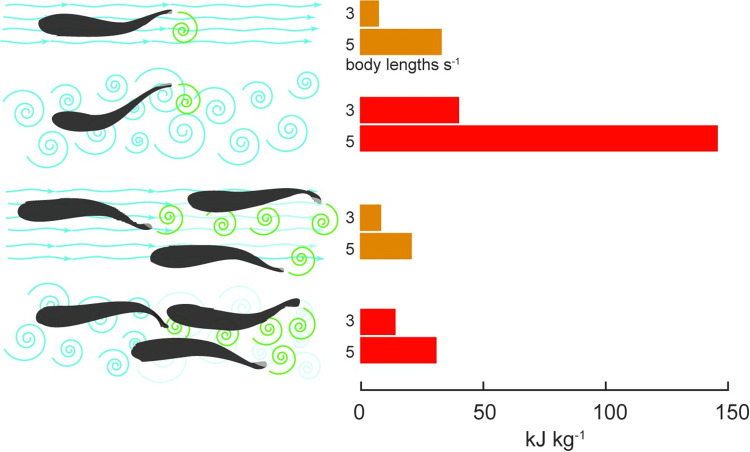 Figure 1
Peer Reviews
No public reviews on file for this paper yet. If you reviewed it on a platform where reviews are public (OpenReview, ICLR, NeurIPS, ICML), you can paste yours below so the community can read it here.
Videos
No videos yet. Explain this paper in a talk, walkthrough, or lecture? Add one.
Taxonomy
TopicsFish Ecology and Management Studies · Biomimetic flight and propulsion mechanisms · Distributed Control Multi-Agent Systems