The Prevalence and Association of Non-metric Dental Traits With Dentoskeletal Malocclusion and ABO Blood Groups in the Maharashtrian Population
Lalitkumar Gade, Priyanka P Kamble, Abdul Suban A Kanna, Kishor Patil, Ketan Saraf, Bhanu P Singh

TL;DR
This study examines non-metric dental traits in the Maharashtrian population and finds they are more common in females and linked to dental malocclusions and blood groups.
Contribution
The study provides new data on non-metric dental traits in the Maharashtrian population and their associations with malocclusion and ABO blood groups.
Findings
Non-metric dental traits were predominantly found in females with Class II dentoskeletal malocclusion and B blood group.
A statistically significant association was found between Cusp of Carabelli, dentoskeletal malocclusion, hypocone, and tricuspid lower second premolars.
Dentoskeletal malocclusion and sex were significant predictors of the hypocone trait.
Abstract
Introduction Non-metric dental traits (NMDTs) are a fundamental data source in forensic dentistry. Nevertheless, the insufficiency of data regarding the occurrence of these traits has instigated the present research endeavor aimed at ascertaining the prevalence, sexual dimorphism, and extent of inter-trait correlations within the Maharashtrian population of India. The secondary objective was to determine the correlations between NMDTs, dentoskeletal malocclusion, and ABO blood groups. Materials and methods This prospective, observational study included 528 individuals aged 18-30 years with dentoskeletal Class I, II, and III malocclusions. NMDTs such as the presence of Cusp of Carabelli (CoC) on the upper first molars, hypocone on the upper second molars, and tri- or bicuspid lower second premolars were observed on the dental casts of all individuals. The dental relationship was…
Genes, proteins, chemicals, diseases, species, mutations and cell lines named across the full text — each resolved to its canonical identifier and authoritative record.
Click any figure to enlarge with its caption.
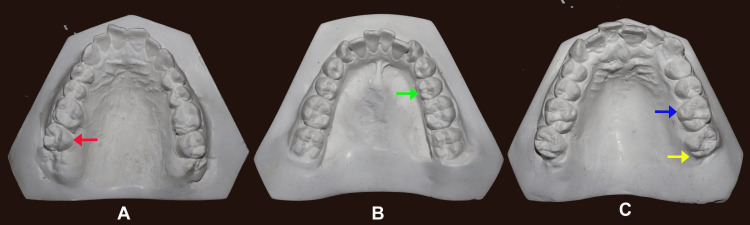 Figure 1
Peer Reviews
No public reviews on file for this paper yet. If you reviewed it on a platform where reviews are public (OpenReview, ICLR, NeurIPS, ICML), you can paste yours below so the community can read it here.
Videos
No videos yet. Explain this paper in a talk, walkthrough, or lecture? Add one.
Taxonomy
Topicsdental development and anomalies · Forensic Anthropology and Bioarchaeology Studies · HIV/AIDS oral health manifestations