Treatment Preferences for Acute Allergic Reactions: A Discrete Choice Experiment
Sofia Löfvendahl, Emelie Andersson, Sara Olofsson, Karin Wahlberg, Leif Bjermer, Göran Tornling, Jonas Hjelmgren

TL;DR
This study found that patients in Sweden are willing to pay more for a new fast-acting corticosteroid oral film compared to traditional tablets for treating acute allergic reactions.
Contribution
The study introduces a new method to assess patient preferences for corticosteroid administration modes using discrete choice experiments.
Findings
Patients were willing to pay 409 SEK more for the oral film over tablets in a forced choice model.
Subgroup analyses showed higher willingness to pay for those with swallowing difficulties or circulatory symptoms.
The economic benefit of the oral film remained significant even after accounting for current treatment value.
Abstract
Background: Timely treatment of acute allergic reactions (AARs) is important to minimize reaction severity. Corticosteroid tablets dissolved in water are commonly used in mainstay treatment. A new oral film that dissolves on the tongue provides a faster and less cumbersome alternative to tablets for corticosteroid administration during AARs. This study evaluated patients’ preferences for attributes related to administration mode of corticosteroids in AARs. Methods: A web-based survey was sent to a sample from the adult Swedish population (≥18 years) with experience of corticosteroid treatment for AAR. We assessed the willingness to pay (WTP) for attributes related to corticosteroid treatment by applying a discrete choice experiment (DCE) approach. DCE attributes were administration mode, time to symptom relief, and price. The WTP for each attribute was derived using the attribute’s…
Genes, proteins, chemicals, diseases, species, mutations and cell lines named across the full text — each resolved to its canonical identifier and authoritative record.
Click any figure to enlarge with its caption.
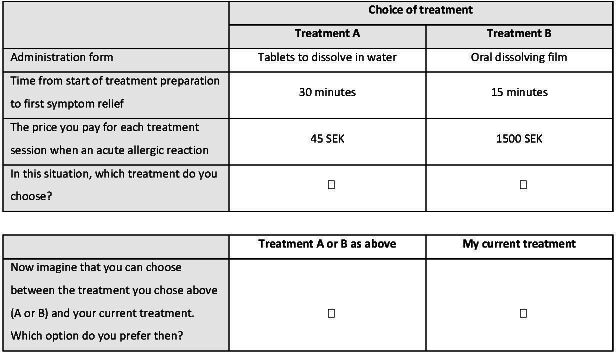 Figure 1
Peer Reviews
No public reviews on file for this paper yet. If you reviewed it on a platform where reviews are public (OpenReview, ICLR, NeurIPS, ICML), you can paste yours below so the community can read it here.
Videos
No videos yet. Explain this paper in a talk, walkthrough, or lecture? Add one.
Taxonomy
TopicsAllergic Rhinitis and Sensitization · Asthma and respiratory diseases · Dermatology and Skin Diseases