qPCR assay for detection of Woodchuck Hepatitis Virus Post-Transcriptional Regulatory Elements from CAR-T and TCR-T cells in fresh and formalin-fixed tissue
Shalini Pullarkat, Graeme Black, Marie Bleakley, Denise Buenrostro, Aude G. Chapuis, Alexandre V. Hirayama, Carla A. Jaeger-Ruckstuhl, Erik L. Kimble, Bo M. Lee, David G. Maloney, Jerald Radich, Brandon W. Seaton, Jennifer M. Specht, Cameron J. Turtle, David W. Woolston

TL;DR
A new qPCR assay detects engineered CAR-T and TCR-T cells in both fresh and preserved tissues, helping track their presence in cancer treatments.
Contribution
A novel, cost-effective WPRE-targeted qPCR assay for detecting CAR-T and TCR-T cells in archival and fresh tissues is developed.
Findings
The WPRE-targeted qPCR assay successfully detected CAR-T and TCR-T cell products in formalin-fixed paraffin-embedded tissues.
The assay has a reproducible limit of detection at 100 WPRE copies per 20μL PCR reaction.
The technique can be used to assess immune cell trafficking and abundance in tumor and toxicity tissues.
Abstract
As adoptive cellular therapies become more commonplace in cancer care, there is a growing need to monitor site-specific localization of engineered cells—such as chimeric antigen receptor T (CAR-T) cells and T-cell receptor T (TCR-T) cells—in patients’ tissues to understand treatment effectiveness as well as associated adverse events. Manufacturing CAR-T and TCR-T cells involves transduction with viral vectors commonly containing the WPRE gene sequence to enhance gene expression, providing a viable assay target unique to these engineered cells. Quantitative PCR (qPCR) is currently used clinically in fresh patient tissue samples and blood with target sequences specific to each immunotherapy product. Herein, we developed a WPRE-targeted qPCR assay that is broadly applicable for detection of engineered cell products in both fresh and archival formalin-fixed paraffin embedded (FFPE) tissues.…
Genes, proteins, chemicals, diseases, species, mutations and cell lines named across the full text — each resolved to its canonical identifier and authoritative record.
Click any figure to enlarge with its caption.
 Figure 1
 Figure 2
 Figure 3
 Figure 4
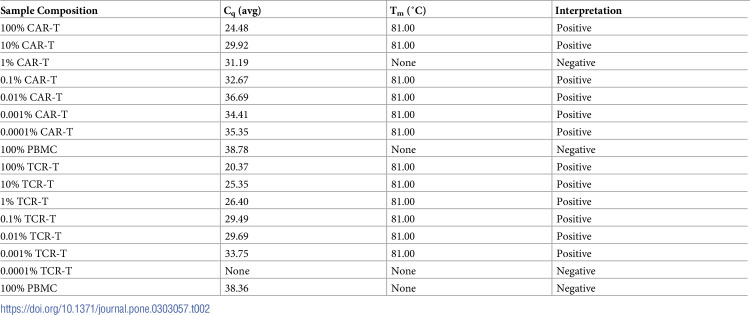 Figure 5
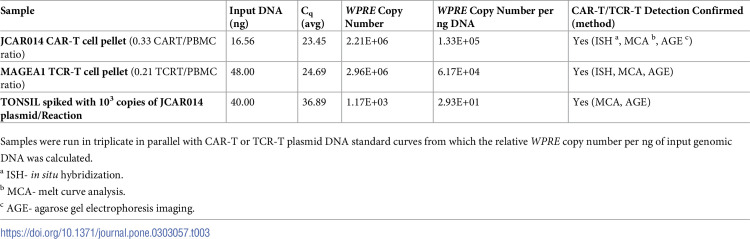 Figure 6
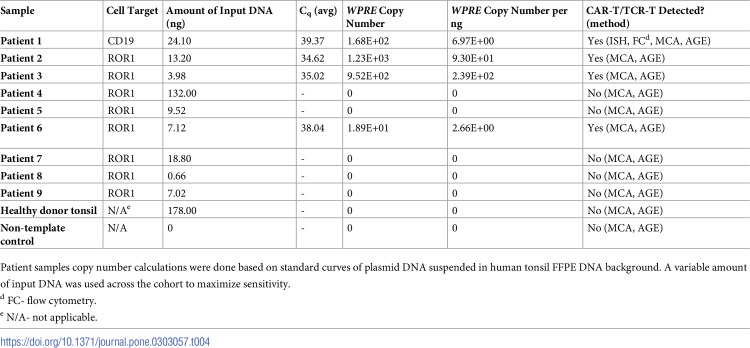 Figure 7
Peer Reviews
No public reviews on file for this paper yet. If you reviewed it on a platform where reviews are public (OpenReview, ICLR, NeurIPS, ICML), you can paste yours below so the community can read it here.
Videos
No videos yet. Explain this paper in a talk, walkthrough, or lecture? Add one.
Taxonomy
TopicsCAR-T cell therapy research · Virus-based gene therapy research · Viral Infectious Diseases and Gene Expression in Insects