Radiation-Induced DNA Damage in Uveal Melanoma Is Influenced by Dose Delivery and Chromosome 3 Status
Aysegül Tura, Yingda Zhu, Siranush Vardanyan, Michelle Prasuhn, Vinodh Kakkassery, Julia Lüke, Hartmut Merz, Frank Paulsen, Dirk Rades, Florian Cremers, Karl-Ulrich Bartz-Schmidt, Salvatore Grisanti

TL;DR
This study shows that DNA damage in uveal melanoma tumors depends on the type of radiation treatment and the status of chromosome 3.
Contribution
The study reveals that fractionated radiation causes more DNA damage than single-dose treatment and that monosomy 3 tumors are less radiosensitive.
Findings
Fractionated radiotherapy caused 2.1-fold more DNA damage than single-dose treatment.
Monosomy 3 tumors showed significantly fewer DNA breaks compared to disomy 3 tumors.
Metastases after radiotherapy correlated with monosomy 3 and less DNA damage.
Abstract
The purpose of this study was to analyze the extent of DNA breaks in primary uveal melanoma (UM) with regard to radiotherapy dose delivery (single-dose versus fractionated) and monosomy 3 status. A total of 54 patients with UM were included. Stereotactic radiotherapy (SRT) was performed in 23 patients, with 8 undergoing single-dose SRT (sdSRT) treatment and 15 receiving fractionated SRT (fSRT). DNA breaks in the enucleated or endoresected tumors were visualized by a TUNEL assay and quantified by measuring the TUNEL-positive area. Protein expression was analyzed by immunohistochemistry. Co-detection of chromosome 3 with proteins was performed by immuno-fluorescent in situ hybridization. The amount of DNA breaks in the total irradiated group was increased by 2.7-fold (P < 0.001) compared to non-irradiated tissue. Tumors treated with fSRT were affected more severely, showing 2.1-fold…
Genes, proteins, chemicals, diseases, species, mutations and cell lines named across the full text — each resolved to its canonical identifier and authoritative record.
Click any figure to enlarge with its caption.
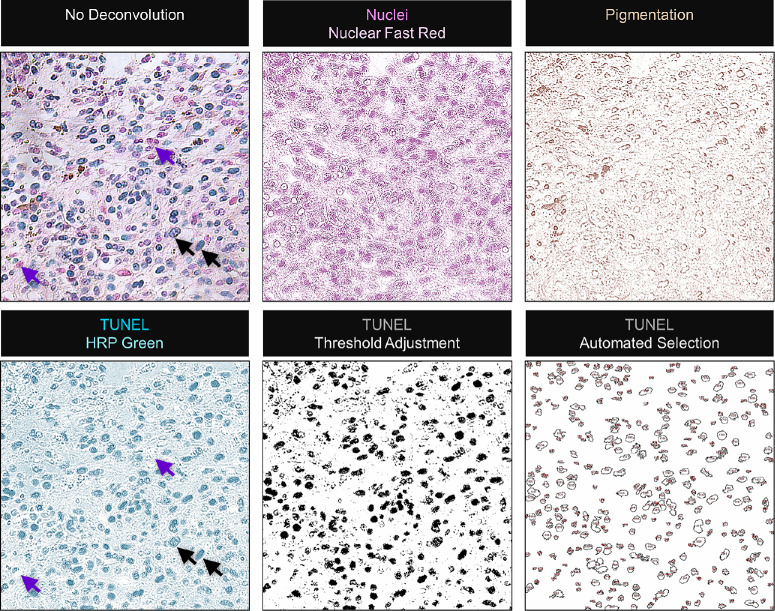 Figure 1
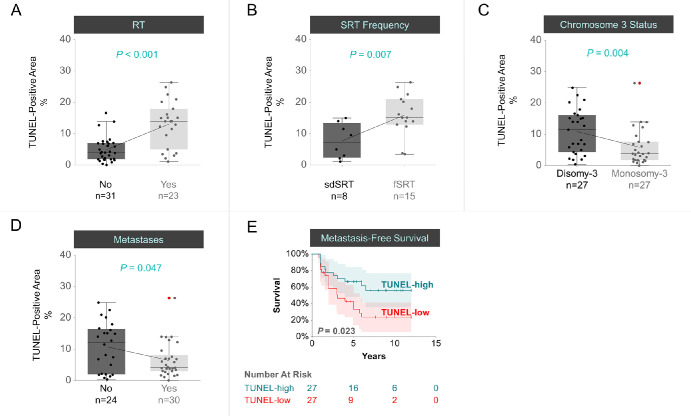 Figure 2
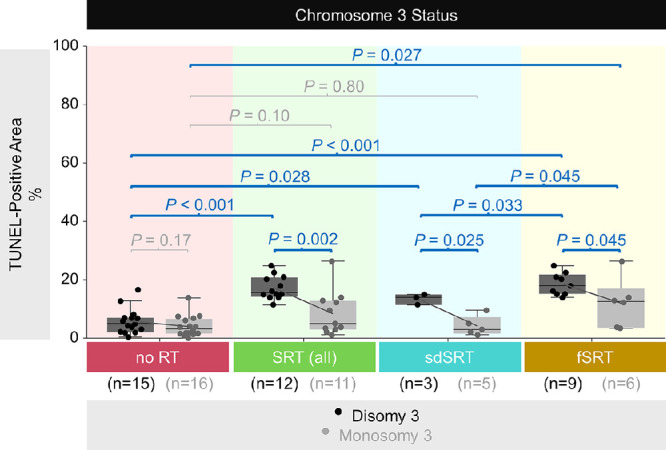 Figure 3
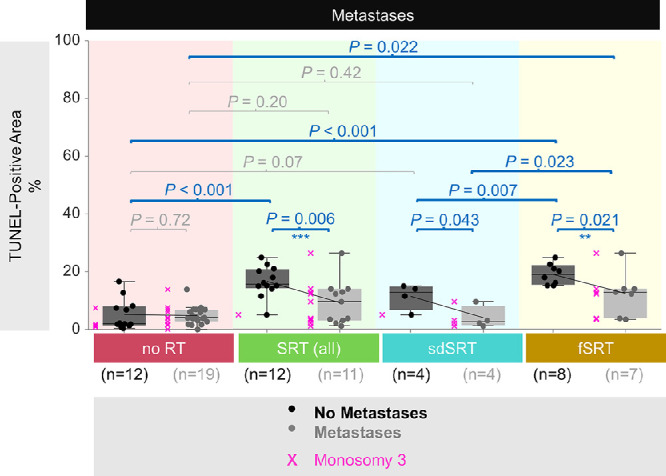 Figure 4
Peer Reviews
No public reviews on file for this paper yet. If you reviewed it on a platform where reviews are public (OpenReview, ICLR, NeurIPS, ICML), you can paste yours below so the community can read it here.
Videos
No videos yet. Explain this paper in a talk, walkthrough, or lecture? Add one.
Taxonomy
TopicsOcular Oncology and Treatments · Cancer and Skin Lesions · Immunotherapy and Immune Responses