Optimization of genetic distance threshold for inferring the CRF01_AE molecular network based on next-generation sequencing
Lijuan Hu, Bin Zhao, Mingchen Liu, Yang Gao, Haibo Ding, Qinghai Hu, Minghui An, Hong Shang, Xiaoxu Han

TL;DR
This study finds the best genetic distance threshold for tracking HIV transmission in CRF01_AE subtype using next-generation sequencing data.
Contribution
The study identifies an optimal genetic distance threshold range for CRF01_AE subtype HIV transmission network inference.
Findings
A GD threshold range of 0.008-0.013 substitutions/site best identifies recent HIV transmission events.
Higher GD thresholds increase the proportion of recent infections in molecular networks.
The optimal threshold helps track HIV transmission within the past three years.
Abstract
HIV molecular network based on genetic distance (GD) has been extensively utilized. However, the GD threshold for the non-B subtype differs from that of subtype B. This study aimed to optimize the GD threshold for inferring the CRF01_AE molecular network. Next-generation sequencing data of partial CRF01_AE pol sequences were obtained for 59 samples from 12 transmission pairs enrolled from a high-risk cohort during 2009 and 2014. The paired GD was calculated using the Tamura-Nei 93 model to infer a GD threshold range for HIV molecular networks. 2,019 CRF01_AE pol sequences and information on recent HIV infection (RHI) from newly diagnosed individuals in Shenyang from 2016 to 2019 were collected to construct molecular networks to assess the ability of the inferred GD thresholds to predict recent transmission events. When HIV transmission occurs within a span of 1-4 years, the mean…
Genes, proteins, chemicals, diseases, species, mutations and cell lines named across the full text — each resolved to its canonical identifier and authoritative record.
Click any figure to enlarge with its caption.
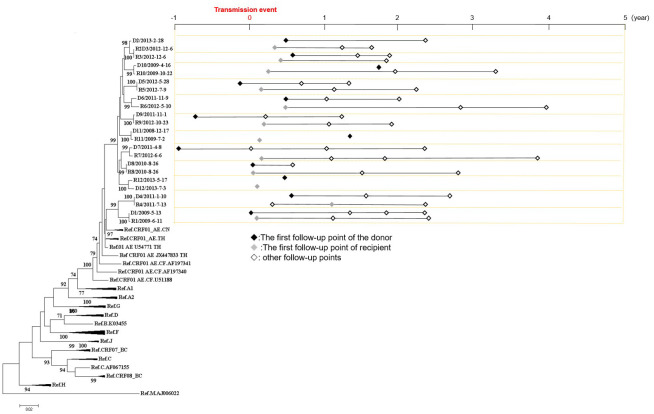 Figure 1
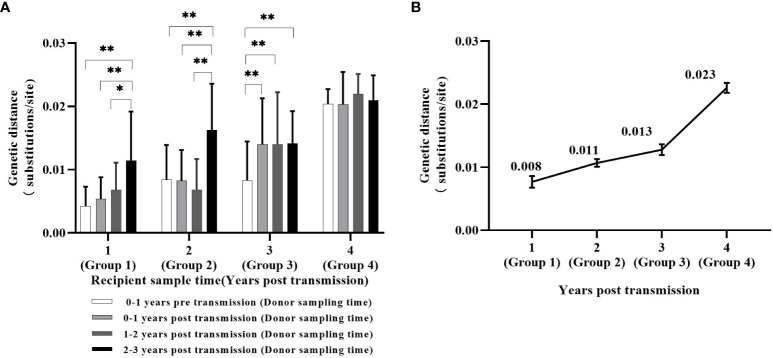 Figure 2
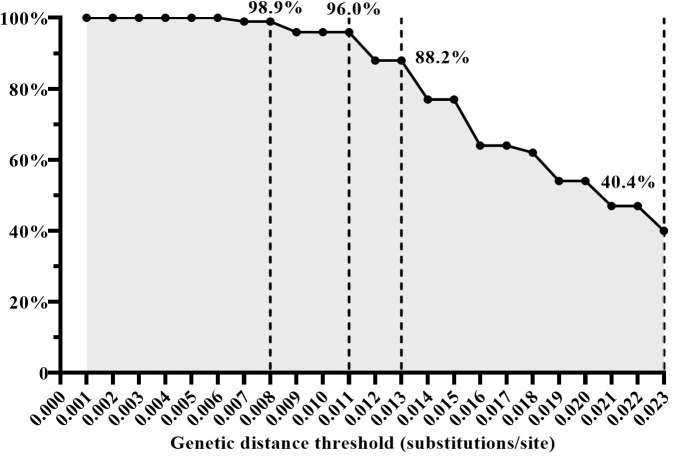 Figure 3
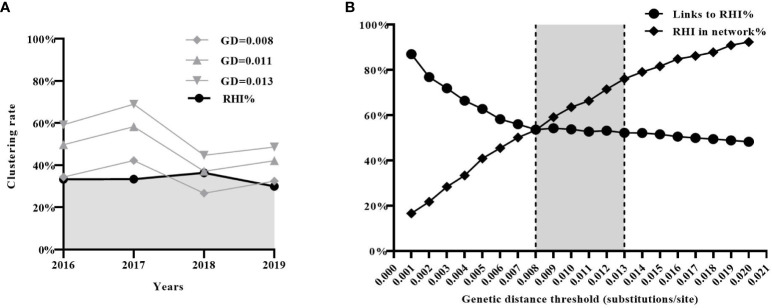 Figure 4
Peer Reviews
No public reviews on file for this paper yet. If you reviewed it on a platform where reviews are public (OpenReview, ICLR, NeurIPS, ICML), you can paste yours below so the community can read it here.
Videos
No videos yet. Explain this paper in a talk, walkthrough, or lecture? Add one.
Taxonomy
TopicsHIV Research and Treatment · Bacteriophages and microbial interactions · CRISPR and Genetic Engineering