Enhancing patient-clinician collaboration during treatment decision-making: study protocol for a community-engaged, mixed method hybrid type 1 trial of collaborative decision skills training (CDST) for veterans with psychosis
Emily B. H. Treichler, Lauren E. McBride, Elissa Gomez, Joanna Jain, Sydney Seaton, Kasey E. Yu, David Oakes, Dimitri Perivoliotis, Vanessa Girard, Samantha Reznik, Michelle P. Salyers, Michael L. Thomas, William D. Spaulding, Eric L. Granholm, Borsika A. Rabin, Gregory A. Light

TL;DR
This study aims to test a training program that helps veterans with psychosis participate more in their treatment decisions, using a mixed-method approach in a VA clinic.
Contribution
The study introduces a hybrid type 1 trial to evaluate a new collaborative decision skills training program for veterans with psychosis.
Findings
An open trial showed CDST is feasible and has preliminary effectiveness.
The RCT will assess CDST's effectiveness compared to an active control.
The study will identify barriers and facilitators to implementing CDST in VA clinics.
Abstract
Patient participation in treatment decision making is a pillar of recovery-oriented care and is associated with improvements in empowerment and well-being. Although demand for increased involvement in treatment decision-making is high among veterans with serious mental illness, rates of involvement are low. Collaborative decision skills training (CDST) is a recovery-oriented, skills-based intervention designed to support meaningful patient participation in treatment decision making. An open trial among veterans with psychosis supported CDST’s feasibility and demonstrated preliminary indications of effectiveness. A randomized control trial (RCT) is needed to test CDST’s effectiveness in comparison with an active control and further evaluate implementation feasibility. The planned RCT is a hybrid type 1 trial, which will use mixed methods to systematically evaluate the effectiveness and…
Genes, proteins, chemicals, diseases, species, mutations and cell lines named across the full text — each resolved to its canonical identifier and authoritative record.
Click any figure to enlarge with its caption.
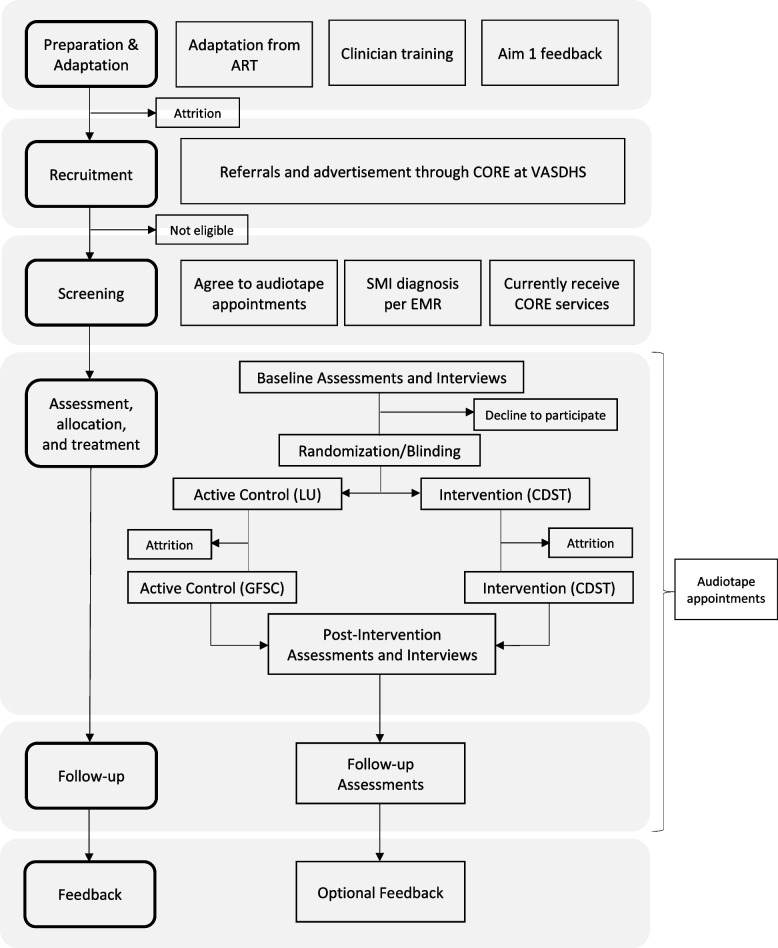 Figure 1
 Figure 2
Peer Reviews
No public reviews on file for this paper yet. If you reviewed it on a platform where reviews are public (OpenReview, ICLR, NeurIPS, ICML), you can paste yours below so the community can read it here.
Videos
No videos yet. Explain this paper in a talk, walkthrough, or lecture? Add one.
Taxonomy
TopicsMental Health and Patient Involvement · Patient-Provider Communication in Healthcare · Mental Health and Psychiatry