Towards Chemoenzymatic Syntheses of Both Enantiomers of Phosphoemeriamine
Piotr Kiełbasiński, Małgorzata Kwiatkowska, Piotr Łyżwa, Marian Mikołajczyk

TL;DR
Scientists developed a new method to efficiently synthesize both enantiomers of a phosphorus-containing compound called phosphoemeriamine using enzymes and chemical reactions.
Contribution
A novel chemoenzymatic approach was developed to synthesize both enantiomers of phosphoemeriamine with high enantiomeric purity.
Findings
A CAL-B-mediated acetylation under kinetic resolution conditions efficiently produced enantiomers of a key precursor.
The enantiomers of phosphoemeriamine were obtained with enantiomeric excess up to 90% as phosphoemeriamine sesquichloride.
The enzymatic step achieved enantiomeric excesses of 91% and 92% for the two enantiomers.
Abstract
An enzyme-promoted addition of nitromethane to the appropriate phosphorylated imine (aza-Henry reaction) intended to be used in the synthesis of the title phosphoemeriamine, a phospha-analog of emeriamine (aminocarnitine), failed due to the tautomerization of the imine to the corresponding enamine. Nevertheless, both enantiomers of phosphoemeriamine were synthesized in high yield and enantiomeric purity using another chemoenzymatic approach, starting with a crucial step involving a CAL-B-mediated acetylation of the appropriate racemic precursor—diethyl 2-amino-3-dimethylaminopropylphosphonate—under kinetic resolution conditions. The enzymatic reaction was very efficient and provided each enantiomeric product in acceptable yield and with enantiomeric excess of 91 and 92%. The following appropriate chemical transformations led to the desired enantiomers of phosphoemeriamine in the form of…
Genes, proteins, chemicals, diseases, species, mutations and cell lines named across the full text — each resolved to its canonical identifier and authoritative record.
Click any figure to enlarge with its caption.
 Figure 1
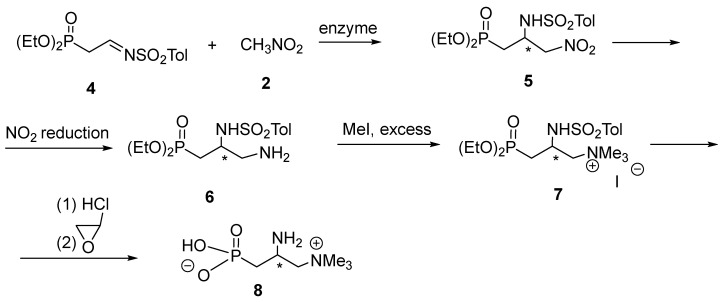 Figure 2
 Figure 3
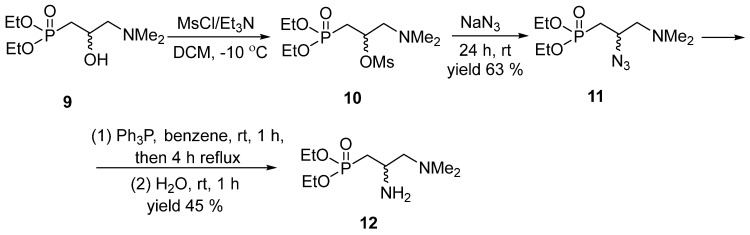 Figure 4
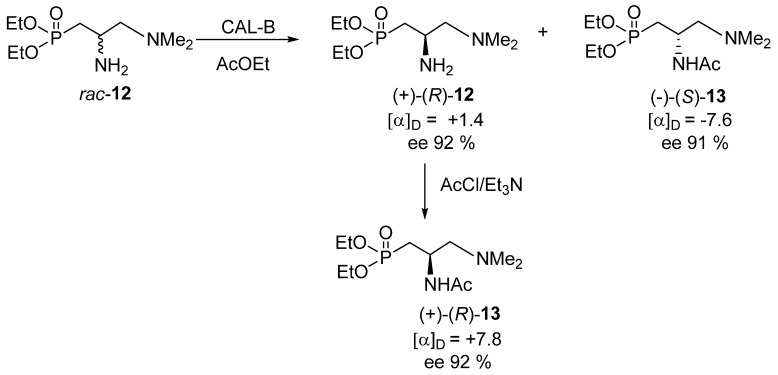 Figure 5
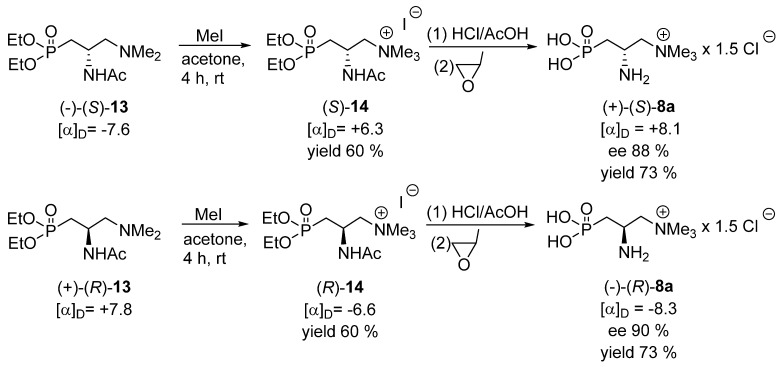 Figure 6
Peer Reviews
No public reviews on file for this paper yet. If you reviewed it on a platform where reviews are public (OpenReview, ICLR, NeurIPS, ICML), you can paste yours below so the community can read it here.
Videos
No videos yet. Explain this paper in a talk, walkthrough, or lecture? Add one.
Taxonomy
TopicsBiochemical and Molecular Research · Enzyme Catalysis and Immobilization · HIV/AIDS drug development and treatment