Fast Data Generation for Training Deep-Learning 3D Reconstruction Approaches for Camera Arrays
Théo Barrios, Stéphanie Prévost, Céline Loscos

TL;DR
This paper introduces a virtual data generator for training deep-learning models in 3D reconstruction using multi-camera arrays of varying configurations.
Contribution
The novel contribution is a flexible virtual data generator that adapts to any camera array setup for training depth reconstruction models.
Findings
The generator successfully creates diverse datasets for wide-baseline camera arrays.
Validation experiments showed that the generated data effectively train and test depth reconstruction algorithms.
The generator introduces realistic challenges like thin objects and texture randomness to avoid color bias.
Abstract
In the last decade, many neural network algorithms have been proposed to solve depth reconstruction. Our focus is on reconstruction from images captured by multi-camera arrays which are a grid of vertically and horizontally aligned cameras that are uniformly spaced. Training these networks using supervised learning requires data with ground truth. Existing datasets are simulating specific configurations. For example, they represent a fixed-size camera array or a fixed space between cameras. When the distance between cameras is small, the array is said to be with a short baseline. Light-field cameras, with a baseline of less than a centimeter, are for instance in this category. On the contrary, an array with large space between cameras is said to be of a wide baseline. In this paper, we present a purely virtual data generator to create large training datasets: this generator can adapt to…
Genes, proteins, chemicals, diseases, species, mutations and cell lines named across the full text — each resolved to its canonical identifier and authoritative record.
Click any figure to enlarge with its caption.
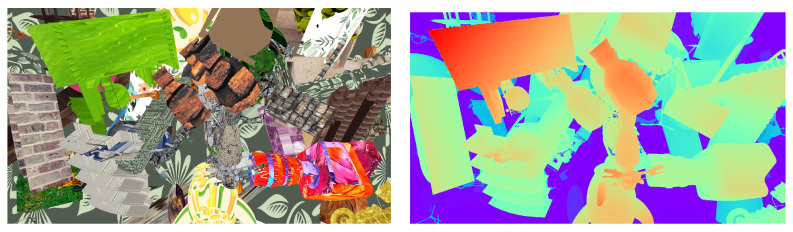 Figure 1
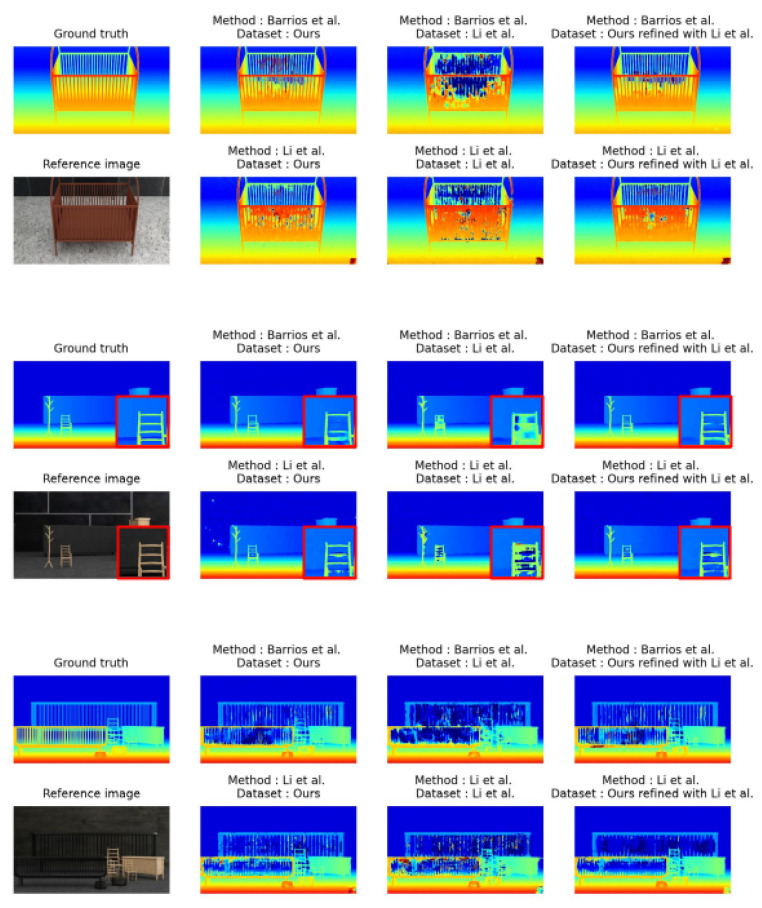 Figure 2
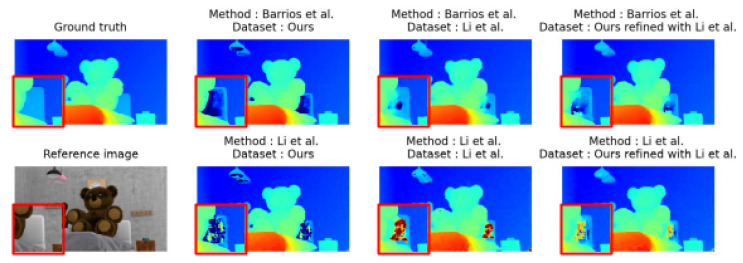 Figure 3
Peer Reviews
No public reviews on file for this paper yet. If you reviewed it on a platform where reviews are public (OpenReview, ICLR, NeurIPS, ICML), you can paste yours below so the community can read it here.
Videos
No videos yet. Explain this paper in a talk, walkthrough, or lecture? Add one.
Taxonomy
TopicsAdvanced Vision and Imaging · Optical measurement and interference techniques · Image Processing Techniques and Applications