Modelling phenotypes, variants and pathomechanisms of syndromic diseases in different systems
Anne Gregor, Christiane Zweier

TL;DR
This review discusses various model organisms and systems used to study syndromic diseases, their advantages, and limitations.
Contribution
The paper provides a comprehensive overview of modeling approaches for syndromic diseases across multiple systems.
Findings
Different model organisms offer unique insights into disease pathomechanisms and variant effects.
Each system has specific advantages and limitations for studying syndromic disorders.
Human cell-based systems complement traditional model organisms in disease modeling.
Abstract
In this review we describe different model organisms and systems that are commonly used to study syndromic disorders. Different use cases in modeling diseases, underlying pathomechanisms and specific effects of certain variants are elucidated. We also highlight advantages and limitations of different systems. Models discussed include budding yeast, the nematode worm, the fruit fly, the frog, zebrafish, mice and human cell-based systems.
Genes, proteins, chemicals, diseases, species, mutations and cell lines named across the full text — each resolved to its canonical identifier and authoritative record.
Click any figure to enlarge with its caption.
 Figure 1
 Figure 2
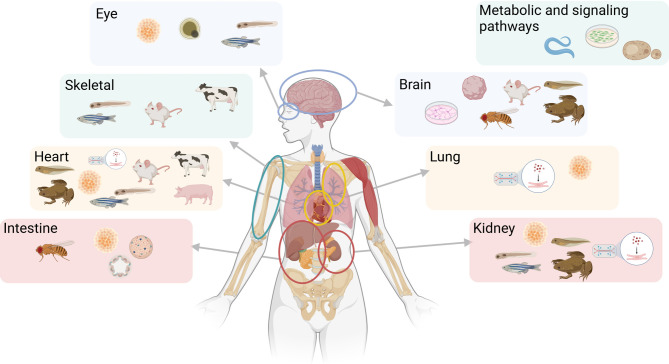 Figure 1
Peer Reviews
No public reviews on file for this paper yet. If you reviewed it on a platform where reviews are public (OpenReview, ICLR, NeurIPS, ICML), you can paste yours below so the community can read it here.
Videos
No videos yet. Explain this paper in a talk, walkthrough, or lecture? Add one.
Taxonomy
TopicsCRISPR and Genetic Engineering · Animal Genetics and Reproduction · Genetics, Aging, and Longevity in Model Organisms