Low testosterone levels relate to poorer cognitive function in women in an APOE-ε4-dependant manner
Melanie A. Dratva, Sarah J. Banks, Matthew S. Panizzon, Douglas Galasko, Erin E. Sundermann

TL;DR
Low testosterone in older women with a specific genetic risk factor is linked to worse cognitive performance, highlighting the need to study women and consider genetics in brain health research.
Contribution
The study reveals a testosterone-APOE-ε4 interaction in women that affects cognition, a novel insight not previously observed in males.
Findings
Lower testosterone levels in female APOE-ε4 carriers correlate with worse global cognition, processing speed, and verbal memory.
Testosterone levels did not affect cognitive outcomes in males or in females without the APOE-ε4 allele.
The study emphasizes the importance of including both sexes and considering APOE-ε4 status in testosterone-related brain health research.
Abstract
Past research suggests that low testosterone levels relate to poorer cognitive function and higher Alzheimer’s disease (AD) risk; however, these findings are inconsistent and are mostly derived from male samples, despite similar age-related testosterone decline in females. Both animal and human studies demonstrate that testosterone’s effects on brain health may be moderated by apolipoprotein E ε4 allele (APOE-ε4) carrier status, which may explain some previous inconsistencies. We examined how testosterone relates to cognitive function in older women versus men across healthy aging and the AD continuum and the moderating role of APOE-ε4 genotype. Five hundred and sixty one participants aged 55–90 (155 cognitively normal (CN), 294 mild cognitive impairment (MCI), 112 AD dementia) from the Alzheimer’s Disease Neuroimaging Initiative (ADNI), who had baseline cognitive and plasma…
Genes, proteins, chemicals, diseases, species, mutations and cell lines named across the full text — each resolved to its canonical identifier and authoritative record.
Click any figure to enlarge with its caption.
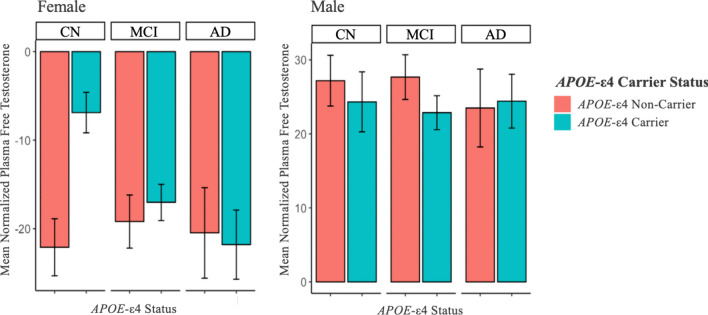 Figure 1
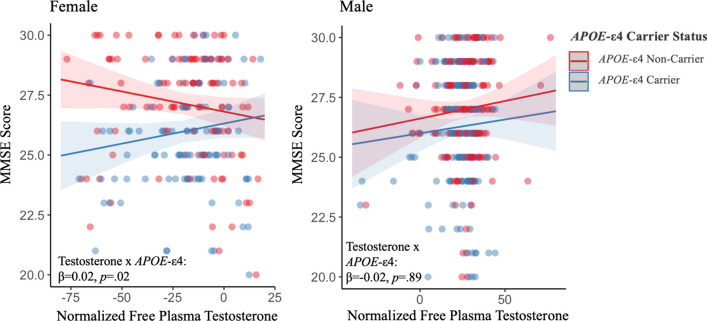 Figure 2
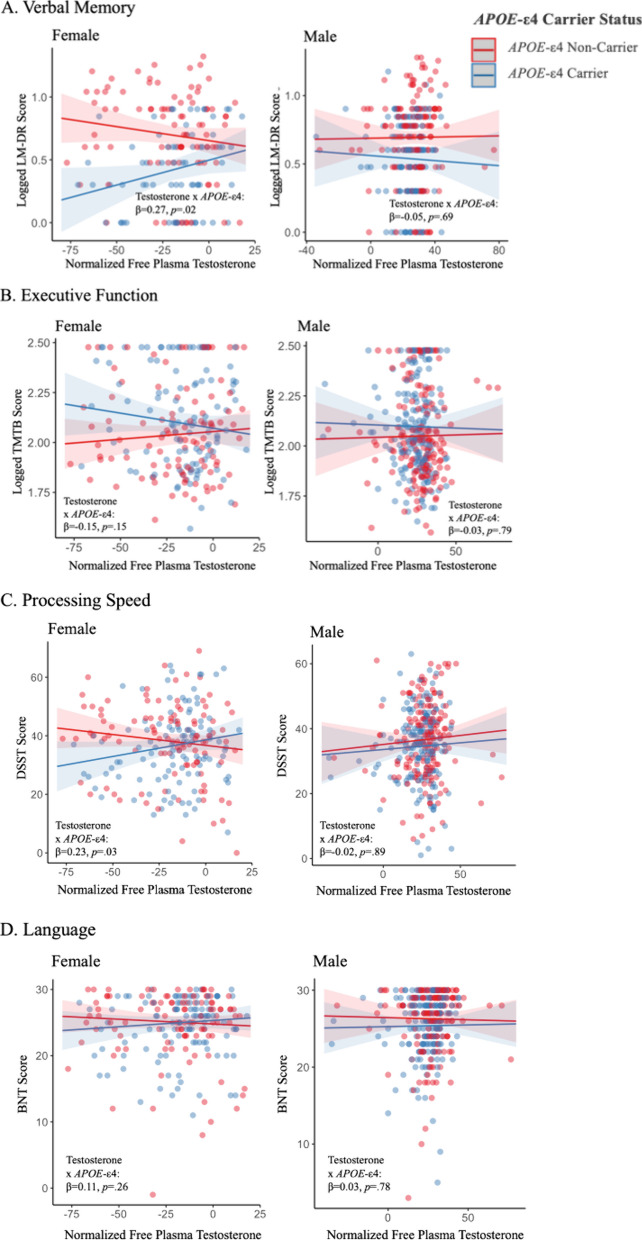 Figure 3
Peer Reviews
No public reviews on file for this paper yet. If you reviewed it on a platform where reviews are public (OpenReview, ICLR, NeurIPS, ICML), you can paste yours below so the community can read it here.
Videos
No videos yet. Explain this paper in a talk, walkthrough, or lecture? Add one.
Taxonomy
TopicsHormonal and reproductive studies · Menopause: Health Impacts and Treatments · Evolutionary Psychology and Human Behavior