Protective potential of mesenchymal stem cells against COVID-19 during pregnancy
Sihem Aouabdi, Doaa Aboalola, Samer Zakari, Suliman Alwafi, Taoufik Nedjadi, Rawiah Alsiary

TL;DR
This paper explores how mesenchymal stem cells from the fetus may protect pregnant women from severe COVID-19 symptoms.
Contribution
The paper proposes a novel hypothesis that fetal mesenchymal stem cells may naturally protect pregnant women from severe SARS-CoV-2 infection.
Findings
Pregnant women are less likely to develop severe forms of COVID-19 compared to non-pregnant individuals.
Mesenchymal stem cells (MSCs) from fetal tissues may confer protective effects against SARS-CoV-2-induced inflammation.
MSCs are being tested in over 100 clinical trials for treating severe cases of COVID-19.
Abstract
SARS-CoV-2 causes COVID-19. COVID-19 has led to severe clinical illnesses and an unprecedented death toll. The virus induces immune inflammatory responses specifically cytokine storm in lungs. Several published reports indicated that pregnant females are less likely to develop severe symptoms compared with non-pregnant. Putative protective role of maternal blood circulating fetal mesenchymal stem cells (MSCs) has emerged and have been put forward as an explanation to alleviated symptoms. MSCs with immune-modulatory, anti-inflammatory and anti-viral roles, hold great potential for the treatment of COVID-19. MSCs could be an alternative to treat infections resulting from the SARS-CoV-2 and potential future outbreaks. This review focuses on the MSCs putative protective roles against COVID-19 in pregnant females. The COVID-19 outbreak is still posing a global health concern. Despite the…
Genes, proteins, chemicals, diseases, species, mutations and cell lines named across the full text — each resolved to its canonical identifier and authoritative record.
Click any figure to enlarge with its caption.
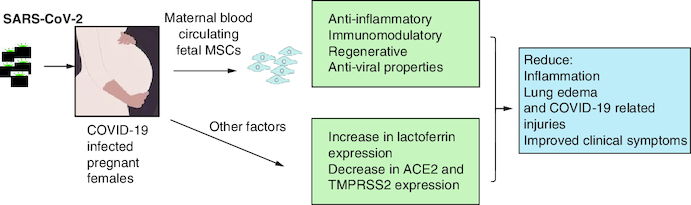 Figure 1
| Study population (country) | Cases SARS-CoV-2 positive (N) | Age (years) | Age of pregnancy | Asymptomatic/mild/moderate | Symptomatic/severe symptoms | Outcomes on pregnancy | ICU admission | Delivery status | Neonatal SARS-CoV-2 | Ref. |
|---|---|---|---|---|---|---|---|---|---|---|
| USA | 4,145 | 27–35 | <24 and >24 weeks | Recorded only critical cases | 32 | No maternal/fetal deaths, high preterm delivery, high cesarean delivery | 32 cases | 19 deliveries, 18 (94.7%) preterm, 11 (57.9%) delivered in ICU, | Not reported | [ |
| USA | 8207 | 15–44 | Not reported | Asymptomatic (2.9%) similar to non-pregnant females | 97.1% symptomatic similar to non-pregnant females (fever, cough, diarrhea, runny nose) | 31.5% hospitalized | 1.5% pregnant vs 0.9% in non-pregnant females) with underlying conditions (diabetes, cardiovascular disease) | Not reported | Not reported | [ |
| Japan | 254 | 26–35 | 13–31 weeks | 224 patients (88%) mild symptoms | 30 patients (12%) severe symptoms | Moderate to severe infection in presence of comorbidities (diabetes, obesity, smoking, pre-eclampsia) | No admissions | Not reported | Not reported | [ |
| Cross countries | 295 | 20–44 | 5–41 weeks | Third of patients asymptomatic or mild symptoms | 0–14% sever pneumonia | 3% (9) deaths | 4.7% cases | 219 deliveries (78.1% cesarean) | 8.7% (19 cases out of 219) positive SARS-CoV-2 | [ |
| China | 118 | 28–34 | 75 (64%) in third trimester | Mild symptoms (fever, cough) 109 (92%) | Severe symptoms (hypoxemia) 9 (8%) | No deaths, 94% discharged | 1 of 9 with severe symptoms | 68 (58%) gave birth, 3 abortions, 2 ectopic pregnancies, 4 induced abortions | No positive SARS-CoV-2 | [ |
| UK | 214 | 26–34 | First trimester to delivery | Asymptomatic 63.7% | Symptomatic 36.3%, pre-eclampsia 2.8% | More caesarean recorded during pandemic | 4 (1.9%) | Preterm birth in symptomatic patients, no neonatal death related to COVID-19 | 11% positive for SARS-CoV-2 | [ |
| Cross countries | 26528 | 18–44 | First to third trimester | 7.5–32.6% asymptomatic | Symptoms (rates differ for symptoms, from 6% for myalgia to 87.5% for fever | 1.4–12% likely to develop severe disease, maternal mortality <2% – neonatal mortality <3% – stillbirth <2.5%, neonatal ICU 3.1–76.9% | 3–10% admissions. | Caesarean (term and pre-term) 52.3–95.8%, | 1.6–10% positive SARS-CoV-2 | [ |
| Sweden | 155 | 13–>35 | In labor | 65% asymptomatic | 35% symptomatic presented pre-eclampsia | Pre-eclampsia, gestational diabetes, preterm birth <37 weeks, post-partum hemorrhage, emergency cesarean 1 stillbirth, | No admissions | Spontaneous (69%), instrumental (9%), cesarean (planned 13.5%, emergency 9.7%) | Not reported | [ |
| USA | 241 | 18–47 | Third trimester | 61.4% asymptomatic | 26.1% severe, 5% critical symptoms | Cesarean for symptomatic, mild, severe and critical cases (33.3%, 34.4% 52.4%, 91.7%, respectively) no maternal death | 7.1%, admissions 3.7% intubation during delivery | 99.2% successful delivery- | 2.5% positive SARS-CoV-2 | [ |
| Singapore | 55 | 23–40 | Third trimester except for 2 (<28 weeks) | Mostly mild symptoms, fever, cough, dyspnea | 2% severe COVID-19 | No mortality, miscarriage (2%), preterm birth (43%) neonatal death (2%) | Mechanical ventilation (2%), | Miscarriage, preterm birth | 4.4% (2 cases out of 46 neonates) positive SARS-CoV-2 | [ |
| China | 30 | 30–34 | Not reported | 76.6% respiratory system injury (fever, cough, sputum) | Abnormal heart, liver digestive function (3.3–20%), | No deaths, 76.7% low respiratory system injury vs 92.5% in non-pregnant females terminated pregnancies 22 (73.3%), 8 (26.7%) continued | No admissions | Not reported | Not reported | [ |
Peer Reviews
No public reviews on file for this paper yet. If you reviewed it on a platform where reviews are public (OpenReview, ICLR, NeurIPS, ICML), you can paste yours below so the community can read it here.
Videos
No videos yet. Explain this paper in a talk, walkthrough, or lecture? Add one.
Taxonomy
TopicsCOVID-19 Impact on Reproduction · Congenital Diaphragmatic Hernia Studies · Neonatal Respiratory Health Research
The first case of the COVID-19 was reported in late December 2019, in Wuhan, China [1,2]. The virus responsible for this disease was named by the International Committee on Taxonomy of Viruses as the SARS-CoV-2 [3]. COVID-19 is highly contagious and became a pandemic within few weeks from its first outbreak in China [4]. Incubation time of COVID-19 varies, ranging from 3–27 days [5]. The infection could last up to 6 weeks or longer if the patient has underlying health conditions [6].
The human to human fast spread of the COVID-19 makes it particularly concerning to health authorities. SARS-CoV-2 disseminated worldwide infecting around 237 million causing the death of more than 4 million [7]. There are currently few vaccines available and more are being developed targeting the new variants [8]. Vaccines are not enough to provide full protection against the COVID-19 infection as the current therapies showed no significant effects, especially on severe COVID-19 cases. Other therapies, which may hold great promises, need to be considered such as the application of the mesenchymal stem cells (MSCs).
Symptoms are varied, from asymptomatic or mild symptoms to pneumonia and severe respiratory failure. The most common symptoms of COVID-19 are high fever, tiredness, shortness of breath, dry cough, headache and sore throat. Other symptoms include a flu-like symptoms with runny nose, sneezing and diarrhea [1,2,9]. SARS-CoV-2 patients might also suffer from pneumonia and acute respiratory distress syndrome (ARDS), uncontrolled coagulation, metabolic acidosis, septic shock and multiple organ failure [10]. Patients with advanced age and with comorbidities are at higher risk of developing severe COVID-19 [11].
The cell entry mechanism of SARS-CoV-2 to the host cell surface is initiated by coupling the virus spike protein to the ACE2 receptors present on the epithelium of nose and the alveolar lung, thereby, leading to the respiratory symptoms [12,13]. In addition, the SARS-CoV-2 entry requires S protein priming via the TMPRSS2 that catalyzes the cleavage and fusion process [10]. The virus induces then inflammation, an immune response and cytokine storm in the lungs, which result in edema, disturbed oxygen exchange, hypoxia and ARDS, a life-threatening condition [1,14].
Currently, stem cells therapy is emerging as a potential therapeutic option against COVID-19. Stem cells especially MSCs, have been highlighted since the COVID-19 outbreak as an alternative therapy. For instance, these cells have previously shown to be effective in reducing pneumonia and pulmonary inflammation in mice infected with the avian influenza virus (H9N2) [14]. These cells are not only good candidate for allogeneic transplant, but they have immune-modulatory, anti-apoptotic and anti-inflammatory properties that point to their curative potential for treating inflammation and sepsis properties making them a potential therapy for treating COVID-19 [15,16].
It is documented that SARS-CoV-2 induces inflammation and decreases lymphocytes counts, therefore immunomodulation capabilities of MSCs in this respect to effectively inhibit the inflammation and increase the number of lymphocytes is being employed as an effective treatment [17]. There are a number of ongoing clinical trials exploring the use of MSCs for the treatment of coronavirus infection. It has been demonstrated that pregnant females with COVID-19 are less symptomatic and their intensive care unit (ICU) admission and respiratory distress rates are lower compared with non-pregnant females with COVID-19 [18].
Treatment trials for COVID-19 included antiviral, antimalarial and anti-inflammatory drugs, with no proven efficacy [19]. In the most critical cases, therapies recommended, including oxygen supply and mechanical ventilation, do not allow full recovery of the damaged lung function. In more than 70% of the cases at least one symptom will persist for several months after the infection [7]. Besides, the emergence of new variants that are not necessarily sensitive to the vaccines, more effective treatments need to be developed. Therefore, the potential of using stem cells as therapeutic target for critically ill COVID-19 patients is promising [20].
Mesenchymal stem cells therapy for COVID-19
In 1968, Friedenstein and Phinney first isolated adult MSCs from bone marrow [21,22]. MSCs can also be found in other tissues such as adipose tissue, dental pulp and fetal tissues like placenta, umbilical cord, cord blood and amniotic fluid [23]. MSCs from adipose tissues, cord blood, placenta are easily isolated and are readily available. In vitro, MSCs are plastic adherent, express specific cell surface markers (CD105, CD73, CD90) and are multipotent [24]. They can be differentiated into adipocytes, chondrocytes and osteocytes depending on the signals received from the cell environment [25]. Beside their differentiation to these specific cell lines, MSCs can also differentiate into most cell types. MSCs do not express the MHCII which makes them nonimmunogenic, ideal for allogeneic transplant [26]. The regenerative properties of MSCs on injured tissues is either direct by cell-to-cell contacts or via paracrine signaling pathways [14]. Fetal MSCs are found in maternal blood as early as 7 weeks of pregnancy [27]. Due to their multipotentiality capacity, MSCs possess a great therapeutic potential in regenerative medicine for various diseases.
MSCs have shown promising results for the treatment of various conditions affecting the lungs, the heart like myocardial infarction, diabetes, hepatic failure, autoimmune diseases like multiple sclerosis and systemic lupus erythematous, and acute versus host disease [8,28]. Several clinical trials employing infusion of MSCs for the treatment of COVID-19 patients with lung inflammation and fibrosis showed promising results in terms of lung function recovery and patient survival with no adverse effects [8,29].
Previously, the allogeneic transplant of the MSCs reduced organ failure and ventilated patients affected by the ARDS [30]. MSCs have been used in clinical trials to treat patients with ARDS caused by the influenza virus H7N9. The transplant of the MSCs in these patients reduced significantly the death rate (17.6%) in the test group compared with control placebo group (54.5%) [31]. Currently, over 100 clinical trials are registered for the treatment of COVID-19 with MSCs (source: clinicaltrials.gov). It has been reported that most clinical trials using the MSCs for the treatment of the COVID-19 showed good recovery of the patients with decrease in lung damage and improved patient survival [7].
Anti-inflammatory, immunomodulatory & antiviral roles of the MSCs
Because SARS-CoV-2 causes inflammation, MSCs could be a potential therapeutic target. It was previously shown that the injected MSCs reduced inflammation, pneumonia and lung injury resulting from the SARS infection [32,33]. There anti-inflammatory actions are mediated by modulating Treg cells and macrophages as well as alleviating cytokines proliferation [32]. They attenuate the recruitment of macrophages and mononuclear cells to the lungs together with increased IL10 levels [18]. The MSCs stimulate the transition of the inflammatory macrophage phenotype M1 to the anti-inflammatory and wound-healing M2 phenotype [34]. They trigger an increase in lymphocytes and a decrease in CRP correcting the decrease in lymphocytes and the increase in CRP caused by the COVID-19 [35]. Mesenchymal stem cells stimulate the secretion of growth factors like the Ang1, FGF-7, FGF-2, VEGF and HGF [8]. These factors are important in restoring the inflammatory and fibrosis damage caused by the COVID-19 in the lungs. Furthermore, MSCs inhibit the differentiation of monocytes into dendritic cells [36] and the secretion of TNF-α and IFN-γ by CD4^+^ T and CD8^+^ T cells [37]. The MSCs reduce the immune response of the B cells, T cells, neutrophils, natural killer (NK) cells and dendritic cells (DCs) [32]. Their immune-modulatory actions are also mediated by the TGFβ-1, HGF and INF-γ [38].
MSCs have antiviral actions mediated by the stimulation of antivirus gene IFTITM protecting the cells from viral invasion [39]. They secrete antibacterial peptide IL-37, human defensing-2 hepcidin and lipocalin-2 AMPs. They inhibit the synthesis of essential proteins, DNA and RNA of infected cells and regulate the infection and inflammation in COVID-19 patients [10]. MSCs express the ISGs, a factor that could induce resistance of MSCs to viral infection [17], so when injected, the cells will not be targeted by the SARS-CoV-2. Previous in vivo studies showed that the MSCs decreased the viral load in H1N1-infected animals [40].
MSCs represent a good therapeutic target against SARS-CoV-2-induced inflammation due to their anti-inflammatory, immunomodulatory and antiviral actions. Many clinical trials in phase I & II are ongoing for the application of the MSCs for the treatment of COVID-19 [14,41].
COVID-19 infection in pregnancy
During pregnancy, there is a transient down regulation of the immune system modulated by the suppression of the T cell activity to maintain the tolerance to the pregnancy considered as an allograft [42]. Therefore, pregnant women are more vulnerable to viral infections as it was previously reported during the H1N1 influenza pandemic, the severe acute respiratory distress syndrome (SARS) and the Middle East respiratory distress syndrome (MERS) [42]. The exposure and severity of COVID-19 during pregnancy may be impacted by physiological, mechanical and immunological changes throughout pregnancy. To date, the data are insufficient to evaluate whether pregnancy enhances the susceptibility to SARS-CoV-2 infection; due to the lack of comparable incidence data and the difficulties in separating differences in susceptibility from various exposure risks. The limited number of clinical studies and living systematic reviews published on the potential risk factor of pregnancy and the severity of COVID-19 have been inconclusive. Few data support pregnancy as a risk factor for COVID-19-related severe disease; some of the best evidence comes from the US Centers for Disease Control and Prevention's COVID-19 surveillance system. The latter reported that pregnant women have higher risk of dying, being admitted to an intensive care unit, needing invasive ventilation and needing extracorporeal membrane oxygenation than non-pregnant women [43]. Thus far, the prevalence of neonatal COVID-19 positivity did not exceed the 5% [18]. It is interesting to note that in the majority of COVID-19-pregnancy instances, SARS-CoV-2 mother-to-fetus transmission has not been identified which might be due to the presence of lactoferrin in the placenta, amniotic fluid and lacteal secretions. Lactoferrin takes antiviral protection action by inducing host defense during pregnancy and downregulating the expression of the ACE2; therefor, there may not be much vertical transfer [44]. The intrauterine transmission is rare probably also due to the low SARS-CoV-2 viremia levels and the decline in the co-expression of the TMPRSS2 together with the ACE2 proteins which are necessary for SARS-CoV-2 entry into placental cells [43].
Nevertheless, during the outbreak of the COVID-19, pregnant females seemed to have less adverse events compared with the previous outbreak of the H1N1 and MERS [42]. The number of critical cases reported of pregnant women infected with SARS-CoV-2 was very low together with the number of infected newborns [18]. In a recent systematic meta-analysis published paper on COVID-19 pneumonia and SARS-CoV-2 positive pregnant women that included 87 SARS-CoV-2 positive pregnant women; 78% suffered from mild to moderate COVID-19 and 99.9% had successful deliveries. The overall proportions of vertical transmission, still birth and neonatal death were zero, 0.002 and 0.002, respectively; proposing a similar pattern of the clinical characteristics of COVID-19 pneumonia to that of other adult populations [45]. The severity of COVID-19 in pregnant women in terms of ICU upon admission, was similar to non-pregnant COVID-19 patients [46,47]. The presence of comorbidities in pregnant females with COVID-19 represented risk factor to develop moderate to severe infection [48]. The clinical features of the COVID-19 in pregnant women were similar to those observed in non-pregnant women [49]. In a study carried out in Wuhan, the percentage of pregnant women with severe COVID-19 (8%) was much lower than the pregnant women with mild symptoms (92%) [50]. Another study showed that the percentage of asymptomatic pregnant women was much higher (63.7%) than the symptomatic pregnant patients (36.3%) [51]. However, pregnant women who had symptoms (like fever and cough) were more likely to develop severe disease [52]. Centers for Disease Control and Prevention (CDC) reported higher death rates among symptomatic pregnant women [53]. The preterm birth risk was higher in symptomatic COVID-19 women compared with asymptomatic COVID-19 and uninfected pregnant females [51], although, the preterm birth was attributed to iatrogenic effects rather than resulting from COVID-19 infection. Wastnedge et al., summarized data from 31 studies, involving 12,260 pregnant women with confirmed COVID-19 infection, on the outcomes of SARS-CoV-2 on pregnancy. The study showed the majority of females had mild to moderate symptoms and only minority were in critical care unit. Overall, there were 146 deaths in pregnant females, representing only 1.2% of all pregnant women infected with COVID-19 [54,55]. Another study carried out in Sweden showed that 65% of women in labor diagnosed positive for COVID-19 were asymptomatic [56]. Similar data were reported in a different study, where 61.4% of pregnant women were asymptomatic, 5% had severe COVID-19 and 97.5% of the newborns were negative for SARS-CoV-2 immediately after birth [57]. Dashraath et al., study showed no such deaths in pregnant women diagnosed with COVID-19 when compared with pregnant women with SARS and MERS [58]. The percentage of mechanical ventilation was 2% in pregnant women with COVID-19 compared with 35% and 41% in women with SARS and MERS, respectively [58]. Another study revealed no deaths of pregnant COVID-19 patients [59]. This study showed that 76.7% of respiratory injury in pregnant women with shorter time-to-discharge compared with 92.5% of respiratory injury in non-pregnant women. However, a meta-analysis study showed that pregnant women are more likely to be admitted in ICU compared with non-pregnant women [60]. The discrepancies in these data is probably due to the study protocol that is different from country to country in terms of care for pregnant women with COVID-19. Table 1 shows data from various studies carried out in different countries on the outcome of COVID-19 on pregnant females. The study population (country), the number of pregnant females testing positive for SARS-CoV-2, their age, age of pregnancy, patient's symptoms (absence or presence of symptoms and their intensity), the outcomes on pregnancy, the ICU status, delivery status, and neonatal SARS-CoV-2 status are summarized. The studies showed that the ICU admission was from no cases up to 10% of the cases admitted in ICU. Females suffered from preterm delivery with more recorded caesarean during the pandemic [51,52]. Transmission from mother to newly born babies was also very low.
Altogether, the current data suggest that pregnant women are less vulnerable to develop the severe form of the COVID-19, though, this needs to be validated in preclinical and clinical setting.
Clinical applications of MSCs for COVID-19 & their potential protection in SARS-CoV-2-infected pregnant females
MSCs have been used for decades in clinical trials for the treatment of many conditions including respiratory infections like for instance acute respiratory distress syndrome (ARDS) with promising results and with no major side effects [61,62]. Therefore, the use of MSCs in critically ill COVID-19 patients is very promising. Many countries have registered and initiated their clinical trials for the treatment with MSCs for COVID-19 infection and its complications (source: clinicaltrials.gov). The results demonstrated that MSC therapy is effective in alleviating immune response due to SARS-CoV-2, reducing lung inflammation and stimulating their regeneration [14,35,63]. Published reports revealed that injected MSCs homed in on the site of the mostly infected organ released anti-inflammatory factors by modulating regulatory T cells and macrophages and alleviated the proliferation of cytokines [32]. Shanchez-Guijo et al. demonstrated that MSCs injection to 13 mechanically ventilated patients secondary to COVID-19 pneumonia significantly improved patients' outcome, where almost half of the patients were extubated at day 16 [64]. Furthermore, patients treated with MSCs showed improved lung functions, x-rays findings and reduced inflammatory markers [65]. Large cohort and long term studies are needed to ensure safety and efficacy of the treatment with MSCs [63,66]. As discussed earlier, it is suggested that pregnant females are less likely to have severe form of the COVID-19 infection. The presence of fetal MSCs in the mother's blood suggest that the MSCs from fetal tissues (placenta, amniotic fluid, cord blood) might protect the mothers against the serious outcomes of the COVID-19 during pregnancy [18]. Lactoferrin might also protect females from viral infection by reducing the expression of the ACE2, together with the down expression of TMPRSS2 as stated earlier. Figure 1 shows the putative protecting roles of the maternal blood circulating fetal MSCs and other factors such as lactoferrin, ACE2 and TMPRSS2.
Factors putatively protecting COVID-19 pregnant females.Maternal blood circulating fetal mesenchymal stem cells (MSCS), lactoferrin lead to reducing COVID-19-related symptoms.
Few approaches might be applied to test the hypothesis of the protective potentials of the fetal MSCs in COVID-19 pregnant females. Analysis of the proteomic, transcriptomic, genetic and epigenetic of the blood from pregnant females with COVID-19 to determine specific genes, epigenetic components, proteins, or processes involved in fetal MSC presence and functions. Examine the modulatory effects of fetal MSCs on maternal immunological responses in pregnant females with COVID-19 in terms of cytokines and anti-inflammatory markers. Evaluate the effects of injected fetal MSCs in in vivo model of COVID-19 pregnant animals and comparing them to healthy pregnant animals and their counterpart of non-pregnant. The injected MSCs could be tagged to follow their homing capacity using an in vivo animal imaging to test their roles in various tissues and organs.
Gentile et al. suggested two protocols for the treatment of the COVID-19 patients, the first is the emergency protocol and the second is the consolidated administration [10]. In the first protocol, cells can be acquired from an approved authority for example the Food and Drug Administration (FDA), GMP laboratory, or European approved labs or tissue bank. In the second protocol, the cell infusion could be autologous or allogeneic.
Conclusion
MSCs are a promising tool for the treatment of COVID-19 patients especially those in critical status. The presence of fetal MSCs in maternal blood are believed to reduce the severeness of COVID-19 related symptoms in pregnant women indicating that MSCs might be naturally protective. The positive outcomes of the MSCs transplantation to severely ill patients affected by the COVID-19, might be the solution for the treatment of COVID-19 patients. Large randomized multicenter clinical trials are necessary to validate the recent findings and to set the ground for solid application of MSCs in clinical practice.
Future perspective
In the last decades the application of MSCs in clinical trials for various conditions have advanced greatly owing to their immunomodulatory characteristics [62]. During the COVID-19 outbreak, the application of MSCs as a treatment, especially in critically ill patients, showed promising results with no major adverse effects. Given the contagious nature of the SARS-CoV-2 and the possibility of future outbreaks from other viruses, MSCs represent a great potential for the treatment of COVID-19, especially that no definite treatment was successful in treating critical cases of the infection. The role of the MSCs in protecting the pregnant females need to be investigated in more depth. These studies could be designed as either an autologous or an allogeneic transplantation of the MSCs. To effectively utilize MSCs in the fight against COVID-19, cooperation between researchers, clinicians, and health organizations is essential. Standardized protocols have to be implemented to comprehensively conclude the clinical efficacy and safety of MSCs. The conditions could be optimized to test the protective potentials of the MSCs and their use in clinical trials in pregnant females with COVID-19. In the 10 years, MSCs applications will benefit the pregnant females and the general population, especially those categories suffering from underlying comorbidities where no medical treatment nor vaccination can help.
The reference list from the paper itself. Each links out to its DOI / PubMed record.
- 1Huang C, Wang Y, Li X et al. Clinical features of patients infected with 2019 novel coronavirus in Wuhan, China. Lancet 395(10223), 497–506 (2020).31986264 10.1016/S 0140-6736(20)30183-5PMC 7159299 · doi ↗ · pubmed ↗
- 2Nadeem MS, Zamzami MA, Choudhry H et al. Origin, potential therapeutic targets and treatment for coronavirus disease (COVID-19). Pathogens 9(4), 307 (2020).32331255 10.3390/pathogens 9040307 PMC 7238035 · doi ↗ · pubmed ↗
- 3Cui J, Li F, Shi ZL. Origin and evolution of pathogenic coronaviruses. Nat Rev Microbiol 17(3), 181–192 (2019).30531947 10.1038/s 41579-018-0118-9PMC 7097006 · doi ↗ · pubmed ↗
- 4Guan W-J, Ni Z-Y, Hu Y et al. Clinical characteristics of 2019 novel coronavirus infection in China. med Rxiv doi: 10.1101/2020.02.06.20020974 (2020) (Epub ahead of print). · doi ↗
- 5Lauer SA, Grantz KH, Bi Q et al. The incubation period of coronavirus disease 2019 (COVID-19) from publicly reported confirmed cases: estimation and application. Ann. Intern. Med. 172(9), 577–582 (2020).32150748 10.7326/M 20-0504 PMC 7081172 · doi ↗ · pubmed ↗
- 6Munster VJ, Koopmans M, van Doremalen N, van Riel D, de Wit E. A novel coronavirus emerging in china - key questions for impact assessment. N. Engl. J. Med. 382(8), 692–694 (2020).31978293 10.1056/NEJ Mp 2000929 · doi ↗ · pubmed ↗
- 7Shi L, Yuan X, Yao W et al. Human mesenchymal stem cells treatment for severe COVID-19: 1-year follow-up results of a randomized, double-blind, placebo-controlled trial. E Bio Medicine 75, 103789 (2022). 34963099 10.1016/j.ebiom.2021.103789 PMC 8709782 · doi ↗ · pubmed ↗
- 8Karakas N, Ucuncuoglu S, Uludag D, Karaoglan BS, Shah K, Ozturk G. Mesenchymal stem cell-based COVID-19 therapy: bioengineering perspectives. Cells 11(3), 465 (2022).35159275 10.3390/cells 11030465 PMC 8834073 · doi ↗ · pubmed ↗