Trichuris Globulosa Von Linstow, 1901 from one-humped camel (Camelus dromedarius) in Egypt: prevalence, morphological and molecular study
Badawy I. B. Ismail, Mahmoud A. El-Seify, Reda E. Khalafalla, Shimaa S. Sorour, Khaled Sultan, Nagwa M. Elhawary

TL;DR
This study reports the first confirmation of Trichuris globulosa in Egyptian camels using both morphological and molecular methods.
Contribution
First molecular and morphological confirmation of T. globulosa in camels in Egypt.
Findings
Trichuris spp. had a 27.56% prevalence in camels in Beheira Governorate.
T. globulosa was identified using morphometric and molecular analyses.
Infection rates varied by season, with the highest in summer.
Abstract
Trichuris spp. (whipworms) are soil-transmitted helminths distributed worldwide, parasitizing several mammalian hosts such as ruminants, primates, and rodents. Trichuris spp. is one of the most common intestinal parasites affecting both humans and animals, and it can spread directly through the fecal-oral route, resulting in severe illness and financial loss. So, this work aims to detect the frequency of Trichuris spp. in camels in Beheira Governorate, Egypt, and to identify Trichuris spp. through morphometrical studies, molecular analysis, and phylogenetic analysis. A total of 35 dromedaries out of 127 investigated had Trichuris spp. infection, meaning that the overall prevalence was 27.56%. The age of the camel affected the infection rate, older animals (> 5 years) having a higher prevalence of infection (24%) than animals of ages (< 3 years) (20%) than animals of ages (3–5 years)…
Genes, proteins, chemicals, diseases, species, mutations and cell lines named across the full text — each resolved to its canonical identifier and authoritative record.
Click any figure to enlarge with its caption.
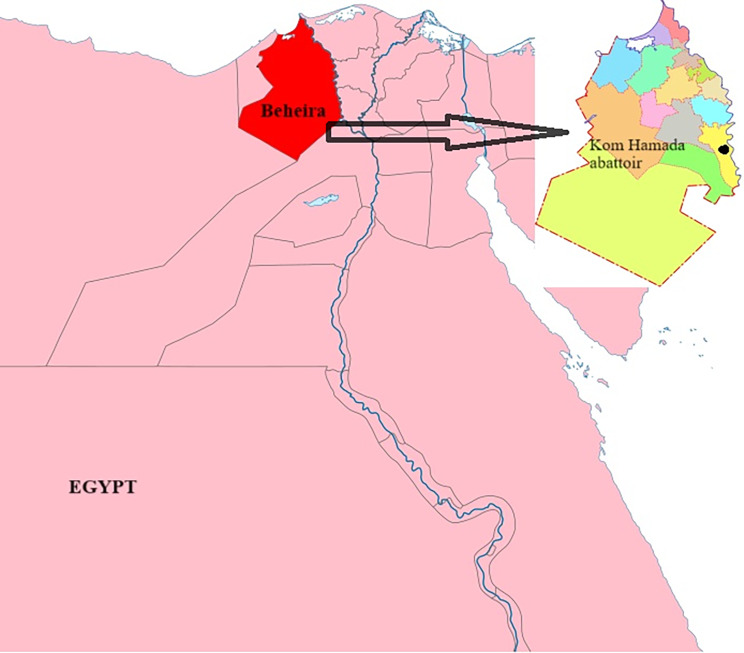 Figure 1
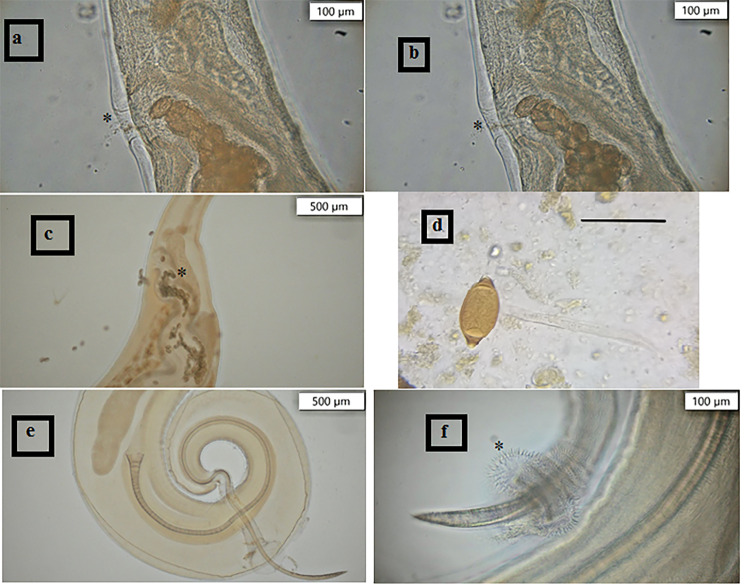 Figure 2
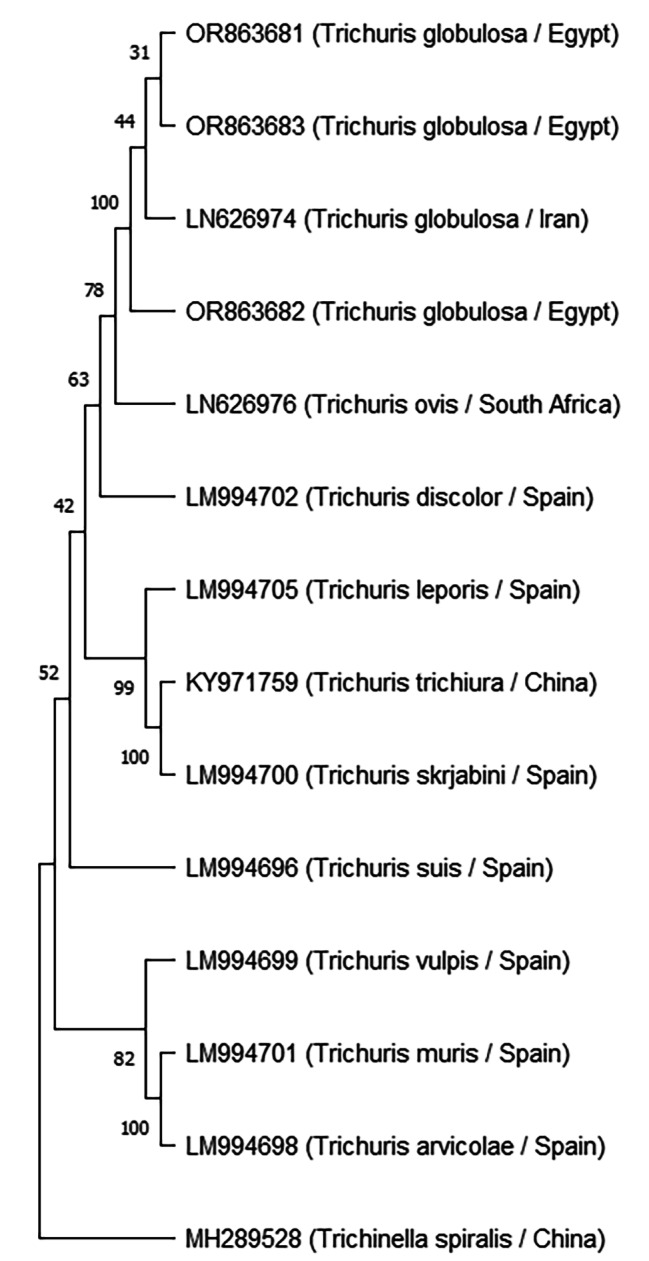 Figure 3
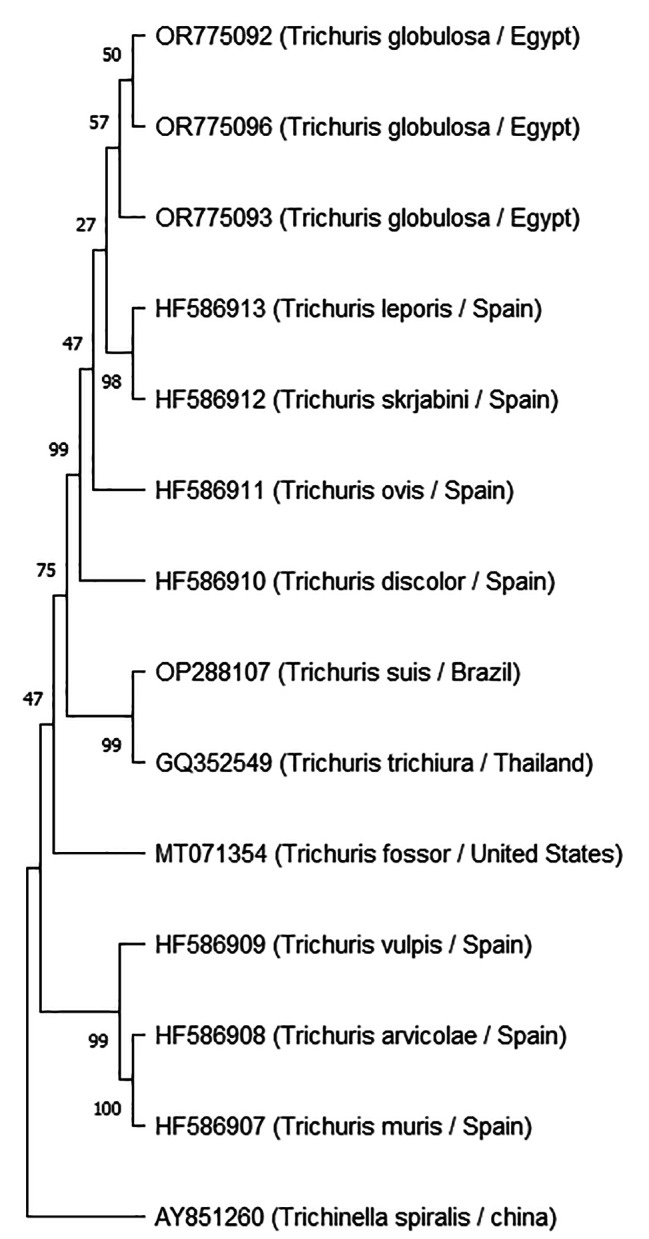 Figure 4
- —Kafr El Shiekh University
Peer Reviews
No public reviews on file for this paper yet. If you reviewed it on a platform where reviews are public (OpenReview, ICLR, NeurIPS, ICML), you can paste yours below so the community can read it here.
Videos
No videos yet. Explain this paper in a talk, walkthrough, or lecture? Add one.
Taxonomy
TopicsParasitic Infections and Diagnostics · Helminth infection and control · Parasites and Host Interactions
Background
Throughout the world, one-humped camels (Camelus dromedarius) serve various purposes. Many parts of the world use camels as a source of milk, meat, and transportation [1, 2].
Due to improper hygiene practices, several parasites could infect camels as gastro-intestinal nematodes, especially Trichuris [3].
Infected camels with parasites produced less milk and meat, had poorer fertility, and had lower calving rates [4]. Camels play a significant role in the epidemiology of parasitic diseases [5]. In Egypt, the camel population was estimated at 80,000, most of which was in upper Egypt.
Helminths that could infect camels include trematodes, cestodes, and nematodes. Whipworms are soil-transmitted nematodes distributed worldwide, parasitizing several mammalian hosts such as ruminants, primates, and rodents [6, 7]. Trichuris spp. is one of the most common intestinal parasites affecting both humans and animals, and it can spread directly through the fecal-oral route, resulting in severe illness and financial loss [8, 9].
Trichuris is closely related to Trichinella and Capillaria and belongs to the class Enoplea, subclass Dorylaimia, and order Trichinellida [10]. The diagnosis of Trichuris is made by observing eggs in fecal samples in living animals [11].
As many characters used to distinguish between species interfere, Trichuris species morphological identification is difficult [12]. The spicule length is the most essential character to differentiate Trichuris spp [13].
In the distal portion of the spicule sheath of T. globulosa, males exhibit a spherical bulge covered with longer spines than the rest of the sheath. Less than 4.9 mm in spicule length and no prominent vulva in females [13, 14].
While molecular identification has been used successfully, especially when combined with morphometrical analysis [15–18].
Until now, there have been few studies on T. globulosa in camels, especially in Egypt. So, this work aims to identify the prevalence of T. globulosa in camels in Beheira Governorate, Egypt, through morphometrical studies, molecular analysis, and phylogenetic analysis.
Methods
Study area
During the period that extended between August 2022 and July 2023, cecum was collected from 127 imported camels aged < 3 years, 3–5 years, and > 5 years, and their numbers were (10, 92 and 25), respectively, at Kom Hamada abattoir in Kom Hamada city, which is located at a latitude of 30°45’45"N and a longitude of 30°41’50"E, Beheira Governorate, Egypt (Fig. 1).
Fig. 1. Map of Egypt, illustrating the sampling site
Samples
Each cecum was ligated and removed from the camels slaughtered at the abattoir, collected in clean bags labeled (age, seasonal dynamics), and transferred to the laboratory of Parasitology in an ice container for further examinations. Initial examination was done within hours (24 h.) after transportation.
Parasitic materials
In the laboratory of the parasitology Department, Faculty of Veterinary Medicine, Kafrelsheikh University, Egypt, each cecum was opened; contents were evacuated and scrutinized for whipworms with the aid of a hand magnification lens and OLYMPUS stereomicroscope. The worms were collected from the collected cecum. The worms were preserved in formalin 10% and ethyl 70% alcohol for morphometrical identification and molecular analysis.
Morphological and biometrical examination
After initial morphological examination of collected whipworms, adults (30) of Trichuris spp. (15 males and 15 females) represented 15 infected camels were measured using an OLYMPUS microscope equipped with a camera (OLYMPUS DP 28) according to parameters cited by other studies [13–15]. The worms were identified using available keys and descriptions based on morphological features [14, 15, 18–20].
Molecular examination
Genomic DNA was extracted from three adult Trichuris spp. samples using the QIAamp DNA Mini Kit (Catalogue no. 51,304) following the instructions of the manufacturing.
Molecular characterization
The genes for cytochrome b (Ctyb) and Nuclear small subunit ribosomal RNA (18s rRNA) were subjected to amplification. Fragments of genes amplified using specific primers.
(5 ´-GAGTAATTTTTATAATACGAGAAGT-3 ´) and (5 ´-AATTTTCAGGGTCTCTGCTTCAATA-3 ´) for Cytb as forward and reverse primers, respectively [11].
(5 ´-CGCGAATRGCTCATTACAACAGC-3 ´) and (5 ´- GGGCGGTATCTGATCGCC − 3 ´) for 18 S, as forward and reverse primers, respectively [21].
Cycling conditions and PCR Mix were applied as Callejón et al. [15] and Floyd et al. [21].
Electrophoresis with 1.5% Agarose gel in TAE buffer and stained with 0.5 µg/ml ethidium bromide (Sigma) was used for visualization of PCR products. A 100-bp ladder and, a known sample (positive control), and distilled water (negative control) were included in the gel. A gel documentation system (SYNGENE) was used to take images of the gels, and computer software was used to analyze the data.
Sequencing and phylogenetic study
Using an Applied Biosystems 3130 automated DNA sequencer (ABI, 3130, USA), a purified PCR product of the Cytb and 18s genes was sequenced forward and backward. Using a ready reaction Bigdye Terminator V3.1 cycle sequencing kit. (Perkin-Elmer/Applied Biosystems, Foster City, CA).
A BLAST analysis (Basic Local Alignment Search Tool) was initially performed to establish sequence identity to GenBank accessions [22]. Higher identity sequences were downloaded from Genbank, and Trichinella spiralis was used as an out-group species for phylogenesis. Sequences were aligned using the alignment tool in Mega 11 software [23].
A phylogenetic tree was built using the Maximum Likelihood method and the Tamura Nei model [24].
Finally, the sequences obtained in this work were submitted to Genbank for accession numbers.
Statistical analysis
A statistical application called GraphPad Prism 9 was used to examine statistical significance differences using a Chi-square. P values less than 0.05 were used to determine statistical significance.
Results
Survey finding
A total of 35 dromedaries out of 127 investigated had Trichuris spp. infection, meaning that the overall prevalence was 27.56%.
The age of the camel affected the infection rate, older animals (> 5 years) having a higher prevalence of infection (24%) than animals of ages (< 3 years) (20%) than animals of ages (3–5 years) (19.14%). However, the statistical analysis indicated these changes were not statistically significant.
According to season: Trichuris spp. showed a unique pattern in camels in different seasons: summer (31.25%) > autumn (28.13%) > spring (25.8%) > winter (25%) indicating year-round infection. However, the statistical analysis indicated these changes were not statistically significant.
Morphological and biometrical results (Fig. 2)
We studied the morphology of thirty adult camel worms (fifteen male and fifteen female) isolated from the camel’s cecum.
The vaginal length of females varied from 0.7 to 0.9 mm with an average: 0.79 mm, while their overall length varied from 37.7 to 59.9 mm (average: 52.9 mm). A morphological analysis revealed that the vulva had a round margin free from spines. Vulva looked smooth. A tiny egg chamber was located anterior to the vulva, and the vagina was short and occasionally slightly convoluted in multiple loops.
Males had a total length of 43.5 to 62.8 mm (average: 53.3 mm), while the spicule length ranged from 3.91 to 4.9 mm (average: 4.4 mm). Spicule diameters varied from 0.031 to 0.075 mm (average of 0.046 mm). The distal portion of the spicule sheath in males featured a spherical bulge covered in spines that were longer than the remaining spines in the sheath.
Fig. 2Trichuris globulosa detected in the current study: (a) and (b) female vulva and vagina, (c) and (d) egg (scale bar 70 μm), (e) male caudal region showing the spicule, the evaginated spicule sheath and (f) spherical bulge covered with spines
Molecular results
Using particular primers, the cytb and18s genes were amplified by PCR to produce bands measuring approximately 450 bp and 900 bp, respectively. The adult T. globulosa Ctyb sequences were placed in Genbank with accession numbers OR863681, OR863682, and OR863683 and varied between 439 and 444 bp. while the adult T. globulosa 18s sequences placed in Genbank with accession numbers OR775092, OR775093, and OR775096 and varied from 786 to 860 bp. The Genbank database was used for the BLAST analysis of the sequenced data, which indicated the existence of the T. globulosa isolate from camels based on the 18s and Cytb genes.
The Cytb sequences (OR863681, OR863682, and OR863683) had 100% homology to T. globulosa recovered from Camelus dromedaries in Iran (LN626974) (Fig. 3). While The 18s sequences (OR775092 and OR775093) had 99.88% homology to T. ovis recovered from Capra hircus in Spain (HF586911) and showed 99.65, 99.62% homology to T. discolor recovered from Bos Taurus in Spain (HF586910). While OR775096 had 97.2% homology to T. ovis recovered from Capra hircus in Spain (HF586911), and T. discolor recovered from Bos Taurus in Spain (HF586910) (Fig. 4).
This study identified Trichuris from Egypt as T. globulosa based on morphological and molecular examinations.
Fig. 3. Maximum Likelihood tree based on Cytb DNA gene of Trichuris globulosa in the current study, Trichinella spiralis was used as the outgroup. * Current study
Fig. 4. Maximum Likelihood tree based on 18s partial gene of ribosomal RNA gene of Trichuris globulosa in the current study, Trichinella spiralis was used as the outgroup. * Current study
Discussion
Important camelid parasites, whipworms (Trichuris spp.) are under-estimated parasite infections compared with other gastrointestinal nematodes, although they could result in a significant loss. The large intestine and caecum contain adult parasites. Significant enteritis brought on by Trichuris spp. causes diarrhea, dehydration, and weight loss [25]. The most common and widespread trichurid in camels is Trichuris globulosa [26].
According to the current study, Trichuris spp. was present in 27.56% of the camels in Beheira that had been slaughtered. The findings of the current study were lower than 40% in Iran [27] and higher than the1.5%, 4.1%, 4.9%and 12.24% in Pakistan [28], Iran [29, 30], and Toukh, Egypt [31], respectively. Variations in ecological location, conditions of the environment, animal rearing practices, degree of exposure to infectious eggs, and hygienic system could all contribute to the variation in prevalence.
In this study, Trichuris globulosa was detected at all ages, and the infection rates at ages of (< 3 years), (3–5 years) and (> 5 years) were 20%, 19.14%, and 24%. These results were matched those of the previous study [31]. This could be because the older animals have contact with the eggs of Trichuris spp. more than young animals.
Summer and spring had the highest infection rates, followed by autumn and then winter. Some studies showed the infection rate was the highest in winter [31]. Differences in environmental conditions, pastures among seasons, and geographical distribution could cause these variations.
There were different species of Trichuris affecting camels: T. tenuis [32], T. globulosa [15], T. skrjabini [30], and T. ovis [33].
In the present study, the worms were identified as T.globulosa parasitizing Camelus dromedarius from Egypt. Similar to females of Trichuris tenuis, T. discolor, and T. globulosa, females of Trichuris spp. of Egyptian camels did not have an everted vagina without spines [13, 15, 34, 35]. In contrast, female T. ovis and T. skrjabini were distinguished from each other based on the presence of everted vagina covered in sharp, acute spines (T. skrjabini) and large, papilla-like spines (T. ovis) [15, 34, 35].
The structure and lining of the vagina and the distance between the vulva and the uterine sphincter are the main factors that determine how differentiable the females of Trichuris spp. are from one another. The distance between the vulva and uterine sphincter of the females of T. globulosa of Iranian camels varied from 0.7 to 0.8 mm (average: 0.73 mm) [15] in contrast, it varied from 0.7 to 0.9 mm (average: 0.79 mm) in the current study. For T. discolor, this distance varied from 3.6 to 5.3 mm [34] and 1.40 to 2.85 mm [36], while T. tenuis varied from 2.5 to 3.4 mm [36].
The spicule length was considered the primary characteristic distinguishing Trichuris species [13, 15].
The Trichuris species key is based on spicule length longer than 5 mm (T. ovis = 5.69; T. tenuis = 7.2) [35, 37] or spicule length shorter than 5 mm (T. discolor) [34, 35].
In line with T. globulosa, the male Trichuris in the current study on Egyptian camels displayed a range of 4.1 mm to 5.1 mm [13–15, 38] but slightly overlapping T. ovis.
The distal end of the spicule of males of Trichuris from Egypt is pointed, resembling T. globulosa, whereas the distal end of the spicule in T. tenuis and T. discolor is bluntly rounded [13–15, 35].
Although there are some notable differences between T. globulosa and T. ovis, these two species are remarkably alike in size and external body shape as well as the size and shape of the eggs (the spicule lengths of 2 species overlapped slightly) [13]. Specifically, the males of both species have a spherical bulge at the distal end of the spicule sheath when fully protruded. T. globulosa exhibits noticeably longer protrusion spines, while the protrusion’s spines in T. ovis are smaller than those on the rest of the sheath. Overall, spicule sheath spines are generally longer and closer together in T. globulosa than those in T. ovis [14, 39, 40]. Tenora et al. [38] disagreed with these studies and concluded that there isn’t a difference in character between the two species.
The nuclear small subunit ribosomal RNA (18s rRNA) gene has been widely employed in nematode phylogenetics. This gene was sequenced and used in phylogenetics in more than 1000 species of nematodes [16, 17].
According to the mitochondrial data, there is a different genetic lineage between T. ovis and T. globulosa. A distinct genetic lineage of T. ovis from South African sheep, which would be closely linked to the T. globulosa populations found in Iranian camels, was confirmed by cytochrome b partial gene sequences (Ctyb). For the first time, the cytb partial gene sequences of T. globulosa have been published [15].
Through BLAST, a comparison of the newly obtained Cytb and 18s sequence with other Trichuris sequences on Genbank, the current study’s sequence indicated that the species was T. globulosa.
A phylogenetic tree based on Cytb revealed high similarity between Trichuris globulosa in the present study and T. globulosa from camels in Iran [15], which reported T. globulosa’s Cytb partial gene sequences for the first time, and this study reported T. globulosa’s 18s partial gene sequences for the first time.
Conclusion
A high prevalence of T. globulosa was found in camels in Beheira Governorate, Egypt. This is the first report to confirm the identification of T. globulosa from camel based on morphometrical studies and molecular and phylogenetic analysis in Egypt. More thorough studies on the incidence, molecular, and genetic analysis of Trichuris spp. in Egypt are required in addition to camel control programs.
Table 1Trichuris globulosa measurements (mm) from current study with comparison with previous studiesMaleCurrent study, camel and EgyptSkrjabin et al., (1957) [13]Cutillas et al. (1995), copra hircus and Spain [14]Callejón et al., (2015), camel and Iran [15]Total length53.3 (43.5–62.8)ND59 (44–74)NDLength of anterior part36.87 (30.35–43.2)ND17.5 (12–23)NDLength of posterior part16.48 (12.9–20)ND45 (30–60)NDDiameter of anterior part0.188 (0.143–0.225)NDND0.13 (0.11–0.15)Diameter of posterior part1.052 (0.425–1.225)0.71ND0.65 (0.52–0.8)Length of spicule4.4 (3.91–4.9)4.75 (3.8–5.7)4.69 (4.48–4.94.5 (4.1–5.1)Diameter of spicule0.046 (0.031–0.075)0.04 (0.032–0.05)ND0.04 (0.03–0.05)Length of spicule sheath0.62 (0.44–0.82)NDND0.62 (0.39–0.78)Width of spicule sheath0.165 (0.102–0.296)NDND0.18 (0.09–0.28) Female Total length52.9 (37.7–59.9)NDND36 (31–40)Length of anterior part40.04 (28.83–50.5)NDND37 (23–32)Length of posterior part10.6 (8.08–13.98)NDND8 (7–8)Diameter of anterior part0.158 (0.133–0.194)NDND0.14 (0.11–0.16)Diameter of posterior part0.95 (0.78–1.23)0.87ND0.73 (0.64–0.82)Width of uterus0.76 (0.63–0.9)NDNDNDDistance from vulva to sphincter of uterus0.79 (0.7–0.9)NDND0.73 (0.7–0.8)Egg length0.067 (0.065–0.07)0.06ND0.06 (0.06–0.07)Egg width0.03 (0.027–0.0325)0.04ND0.03 (0.03–0.04)ND Not determined
The reference list from the paper itself. Each links out to its DOI / PubMed record.
- 1Anwar M Hayat CS Gastrointestinal parasitic fauna of camel (Camelus dromedarius) slaughtered at Faisalabad abattoir Pak J Biol Sci 1998212091010.3923/pjbs.1999.209.210 · doi ↗
- 2Mohanapriya T Saravanan S Ramprabhu R Concomitant infection of Trichuris Globulosa and Trichostrongylus spp. in a dromedary camel J Entomol Zool Stud 2020833279
- 3Parsani HR Singh V Momin RR Common parasitic diseases of camel Vet World 20081103178
- 4Sazmand A, Joachim A. Parasitic diseases of camels in Iran (1931–2017)–a literature review. Parasite. 2017; 24.10.1051/parasite/2017024 PMC 547940228617666 · doi ↗ · pubmed ↗
- 5Rivero J Cutillas C Callejón R New genetic lineage of whipworm present in bactrian camel (Camelus bactrianus)Vet Parasitol 202331510988610.1016/j.vetpar.2023.10988636724679 · doi ↗ · pubmed ↗
- 6Di Filippo MM Berrilli F De Liberato C Di Giovanni VD’Amelio S Friedrich KG Cavallero S Molecular characterization of Trichuris spp. from captive animals based on mitochondrial markers Parasitol Int 20207510204310.1016/j.parint.2019.10204331881362 · doi ↗ · pubmed ↗
- 7Roepstorff A Mejer H Nejsum P Thamsborg SM Helminth parasites in pigs: new challenges in pig production and current research highlights Vet Parasitol 20111801–2728110.1016/j.vetpar.2011.05.02921684689 · doi ↗ · pubmed ↗
- 8Jex AR Nejsum P Schwarz EM Hu L Young ND Hall RS Korhonen PK Liao S Thamsborg S Xia J Xu P Waang S Scheerlinck JP Hofmann A Sternberg PW Wang J Gasser RB Genome and transcriptome of the porcine whipworm Trichuris Suis Nat Genet 2014467701610.1038/ng.301224929829 PMC 4105696 · doi ↗ · pubmed ↗