Analyzing Trends in Mental and Behavioral Health Support for Children: A Comprehensive Study Using National Survey of Children’s Health Database
Emmanuel O Ilori, Nkechi M Eziechi, Chinaza Erechukwu, Nkechi B Obijiofor, Ogochukwu Agazie, Vivien O Obitulata-Ugwu, Okelue E Okobi, Lara Aderemi, Mujeeb A Salawu, Zimakor D Ewuzie, Eberechukwu G Anamazobi, Amaka S Alozie

TL;DR
This study examines trends in mental health treatment for U.S. children from 2016 to 2020, finding disparities by age, gender, and socioeconomic status.
Contribution
The study provides new insights into demographic disparities in mental health treatment for children using recent national survey data.
Findings
51.7% of children received mental health treatment, with higher rates in females than males.
Younger children (3-5) had lower treatment rates (33.5%) compared to adolescents (58.1%).
Disparities were observed across race/ethnicity and socio-economic status.
Abstract
Objective This study aimed to explore mental and behavioral health support trends for children aged 3-17, analyzing treatment and counseling using United States data from the 2016-2020 National Survey of Children's Health (NSCH) database. Methods Employing a retrospective observational design, we systematically retrieved and analyzed NSCH Database data from 2016 to 2020. The focus was on understanding mental and behavioral health treatment percentages over time, specifically targeting demographic variations such as age groups, gender, race/ethnicity, and the federal poverty level percentage. Graphical representation utilized Excel, summarizing results based on aggregated data for distinct time intervals, highlighting the importance of mental and behavioral health support for children aged 3-17. Results The study identified significant temporal trends in mental and behavioral health…
Genes, proteins, chemicals, diseases, species, mutations and cell lines named across the full text — each resolved to its canonical identifier and authoritative record.
Click any figure to enlarge with its caption.
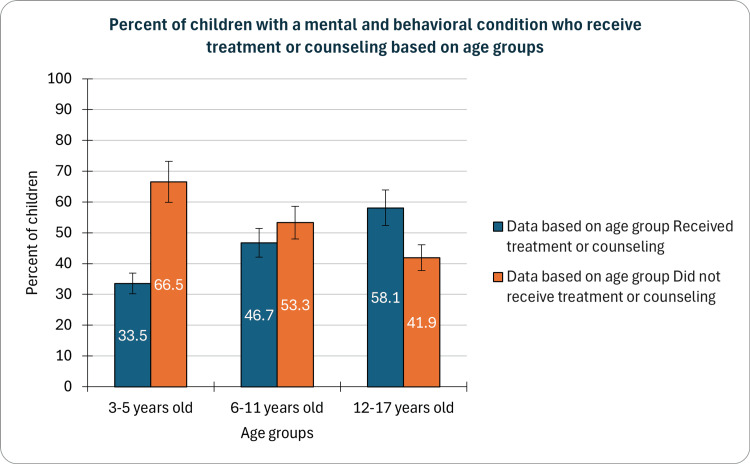 Figure 1
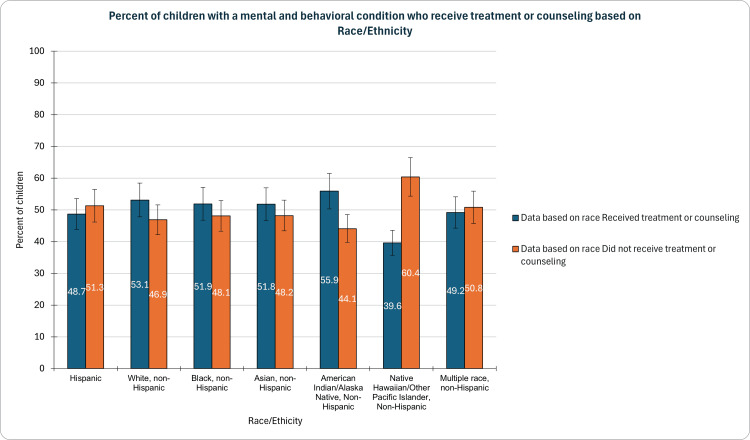 Figure 2
 Figure 3
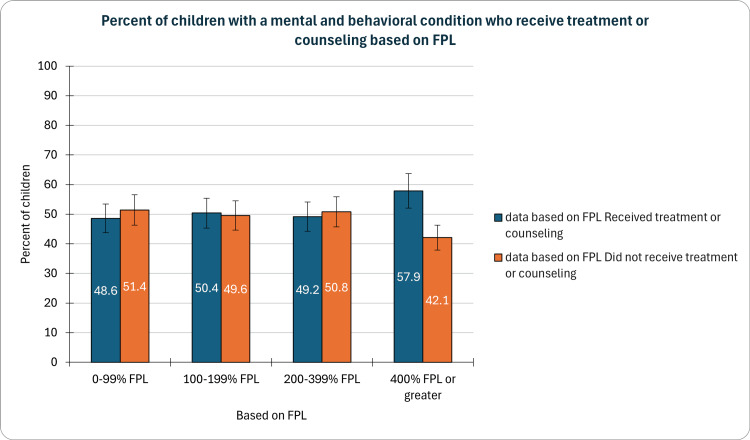 Figure 4
Peer Reviews
No public reviews on file for this paper yet. If you reviewed it on a platform where reviews are public (OpenReview, ICLR, NeurIPS, ICML), you can paste yours below so the community can read it here.
Videos
No videos yet. Explain this paper in a talk, walkthrough, or lecture? Add one.
Taxonomy
TopicsChild and Adolescent Psychosocial and Emotional Development · Early Childhood Education and Development · Family and Disability Support Research