Association between voriconazole-induced visual hallucination and dopamine in an analysis of the food and drug administration (FDA) adverse event reporting system database
Hideo Kato, Chihiro Shiraishi, Mao Hagihara, Hiroshige Mikamo, Takuya Iwamoto

TL;DR
This study explores how voriconazole, an antifungal drug, may cause visual hallucinations by affecting dopamine levels, using FDA adverse event data.
Contribution
The study links voriconazole-induced visual hallucinations to dopamine modulation through FAERS database analysis.
Findings
Combining voriconazole with levodopa significantly increases the risk of visual hallucinations.
Dopamine antagonists like risperidone and chlorpromazine do not increase the risk when used with voriconazole.
Dopaminergic drugs may enhance the likelihood of hallucinations in voriconazole-treated patients.
Abstract
Voriconazole is a second-generation azole used to treat serious fungal infections. Visual hallucinations constitute a representative adverse event caused by voriconazole. However, its mechanism of action remains unclear. In patients with schizophrenia or Parkinson’s disease, the frequency of visual hallucinations is associated with brain dopamine levels. This study investigated the frequency of visual hallucinations in patients treated with voriconazole alone or in combination with dopaminergic medicines or dopamine antagonists, using data collected from the Food and Drug Administration Adverse event Reporting System (FAERS). The frequency of visual hallucinations with voriconazole alone and in combination with a dopaminergic medicine (levodopa) or dopamine antagonists (risperidone and chlorpromazine) was compared using data from the FAERS between 2004 and 2023, using the reporting odds…
Genes, proteins, chemicals, diseases, species, mutations and cell lines named across the full text — each resolved to its canonical identifier and authoritative record.
Click any figure to enlarge with its caption.
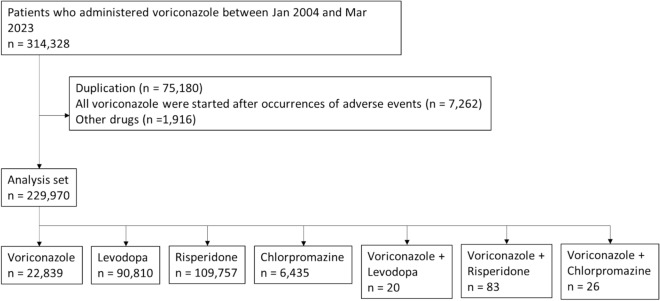 Figure 1
Peer Reviews
No public reviews on file for this paper yet. If you reviewed it on a platform where reviews are public (OpenReview, ICLR, NeurIPS, ICML), you can paste yours below so the community can read it here.
Videos
No videos yet. Explain this paper in a talk, walkthrough, or lecture? Add one.
Taxonomy
TopicsItalian Literature and Culture · Educational and Social Studies