A differential impact of action–effect temporal contiguity on different measures of response inhibition in the Go\No-Go and Stop-signal paradigms
Noam Karsh, Eden Soker-Mijalevich, Omer Horovitz

TL;DR
This study shows that the timing of action effects influences response inhibition differently in two cognitive tasks, suggesting a role for motor control in suppressing actions.
Contribution
The study reveals that action–effect temporal contiguity enhances response inhibition in Go/No-Go but not in Stop-signal tasks.
Findings
Immediate action–effect reduced response times in both Go/No-Go and Stop-signal tasks.
Immediate action–effect improved response inhibition in Go/No-Go but not in Stop-signal.
Higher error rates were observed in the Immediate condition during Stop-signal trials.
Abstract
Response inhibition refers to suppressing a prepotent motor response and is often studied and discussed as an act of cognitive control. Much less attention was given to the potential contribution of motor control processes to response inhibition. Accumulated empirical findings show that a perceptual effect temporally contiguous with a response improves motor control performance. In the current study, we followed this work by manipulating action–effect temporal contiguity to enhance motor performance and investigated its impact on response selection and inhibition. In two experiments, we integrated a Go/No-Go (GNGT; Experiment 1) and a Stop-signal (SST; Experiment 2) task with the Effect–Motivation task, previously used to capture the facilitating impact of action–effect temporal contiguity on response times (RTs). Replicating previous findings, RTs were shorter following temporally…
Genes, proteins, chemicals, diseases, species, mutations and cell lines named across the full text — each resolved to its canonical identifier and authoritative record.
Click any figure to enlarge with its caption.
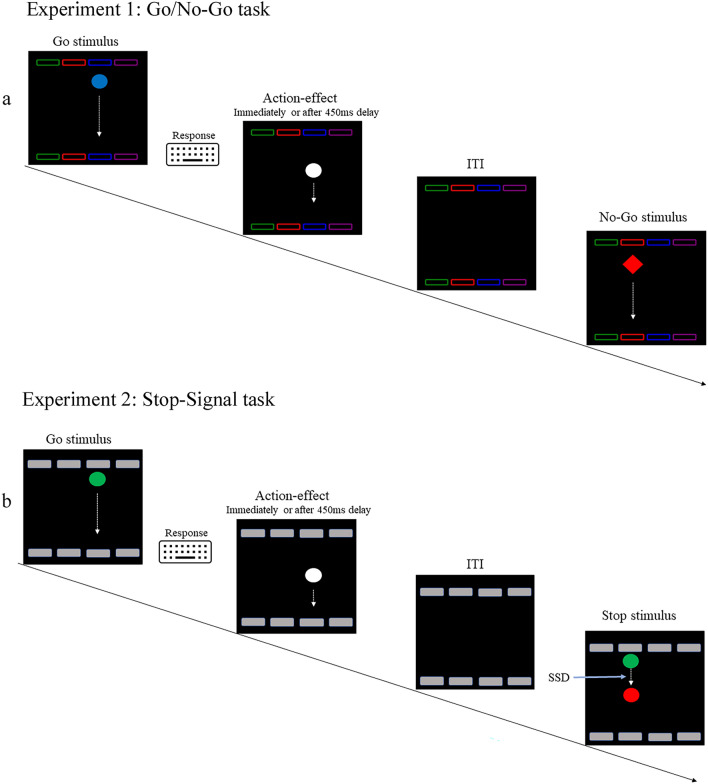 Figure 1
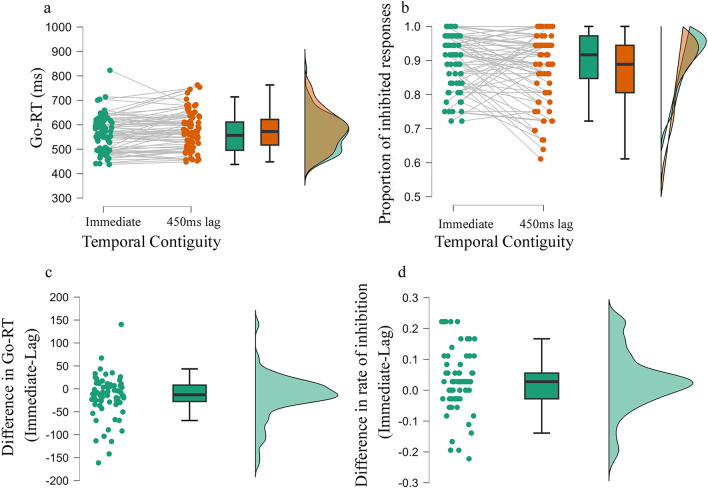 Figure 2
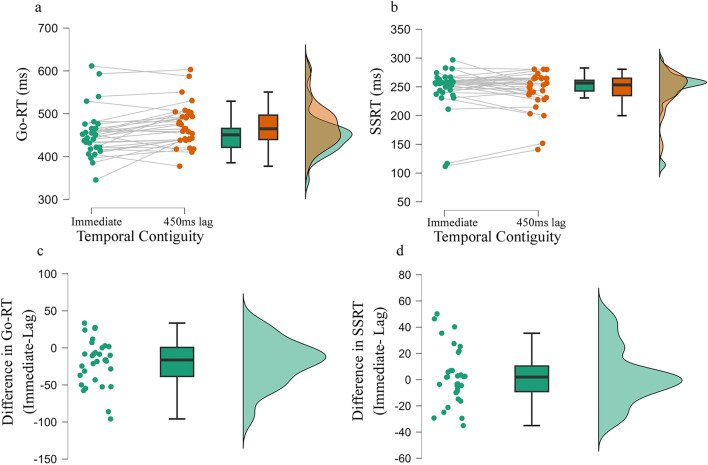 Figure 3
Peer Reviews
No public reviews on file for this paper yet. If you reviewed it on a platform where reviews are public (OpenReview, ICLR, NeurIPS, ICML), you can paste yours below so the community can read it here.
Videos
No videos yet. Explain this paper in a talk, walkthrough, or lecture? Add one.
Taxonomy
TopicsNeural and Behavioral Psychology Studies · Motor Control and Adaptation · Action Observation and Synchronization