Instructed speed and accuracy affect binding
Silvia Selimi, Birte Moeller

TL;DR
This study shows that instructions to prioritize speed or accuracy can influence how actions are linked in the mind, affecting performance.
Contribution
The study demonstrates that binding effects in action control are modulated by instructed speed-accuracy settings.
Findings
Binding effects were observed in response times regardless of instructions.
Error rate binding effects occurred only under speed or ambivalent instructions.
Speed-accuracy settings influence the manifestation of binding effects.
Abstract
In the past few decades, binding and retrieval mechanisms have gained increased interest in research on human action control. Recent studies show that these mechanisms also play a role in the control of multiple independent actions. Here, two or more successively executed responses seem to be bound to each other so that repeating one of them can retrieve the other, affecting performance in this second response and resulting in so-called response–response binding effects. Binding effects are typically found in the response time data and, somewhat less reliably, also in the error rates. Whether binding effects show in the response times, the error rates, or both, is likely influenced by the current speed–accuracy settings of the participants, with binding effects more likely showing in error rates under a speed setting, while more likely showing in RTs under an accuracy setting.…
Genes, proteins, chemicals, diseases, species, mutations and cell lines named across the full text — each resolved to its canonical identifier and authoritative record.
Click any figure to enlarge with its caption.
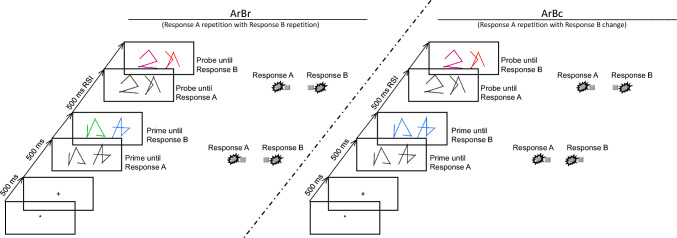 Figure 1
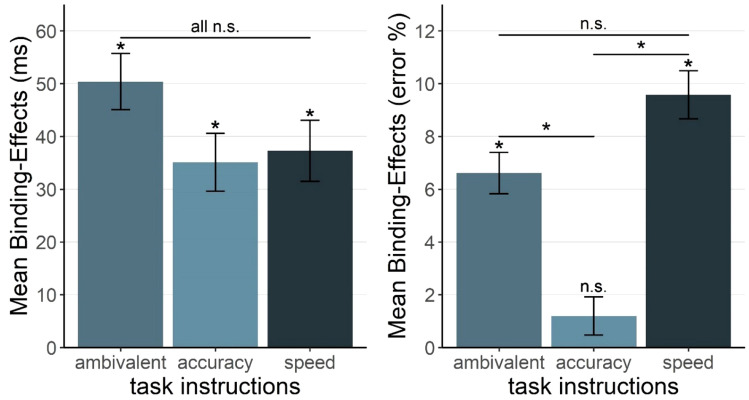 Figure 2
Peer Reviews
No public reviews on file for this paper yet. If you reviewed it on a platform where reviews are public (OpenReview, ICLR, NeurIPS, ICML), you can paste yours below so the community can read it here.
Videos
No videos yet. Explain this paper in a talk, walkthrough, or lecture? Add one.
Taxonomy
TopicsNeural and Behavioral Psychology Studies · Action Observation and Synchronization · Child and Animal Learning Development