Legionella maintains host cell ubiquitin homeostasis by effectors with unique catalytic mechanisms
Jiaqi Fu, Siying Li, Hongxin Guan, Chuang Li, Tao-Tao Chen, Wei Xian, Zhengrui Zhang, Yao Liu, Qingtian Guan, Jingting Wang, Qiuhua Lu, Lina Kang, Si-Ru Zheng, Jinyu Li, Shoujing Cao, Chittaranjan Das, Xiaoyun Liu, Lei Song, Songying Ouyang, Zhao-Qing Luo

TL;DR
This paper explains how the bacterium Legionella prevents damage to host cells by converting harmful ubiquitin into a usable form using a newly discovered enzyme.
Contribution
The study identifies a new family of enzymes capable of protein AMPylation and reveals how Legionella maintains ubiquitin homeostasis.
Findings
LnaB converts phosphoribosyl ubiquitin into ADP-ribosylated ubiquitin, which is then processed to functional ubiquitin.
LnaB requires an S-HxxxE motif for activity, found in toxins from various bacterial pathogens.
LnaB undergoes self-AMPylation when activated by Actin.
Abstract
The reversal of ubiquitination induced by members of the SidE effector family of Legionella pneumophila produces phosphoribosyl ubiquitin (PR-Ub) that is potentially detrimental to host cells. Here we show that the effector LnaB functions to transfer the AMP moiety from ATP to the phosphoryl moiety of PR-Ub to convert it into ADP-ribosylated ubiquitin (ADPR-Ub), which is further processed to ADP-ribose and functional ubiquitin by the (ADP-ribosyl)hydrolase MavL, thus maintaining ubiquitin homeostasis in infected cells. Upon being activated by Actin, LnaB also undergoes self-AMPylation on tyrosine residues. The activity of LnaB requires a motif consisting of Ser, His and Glu (S-HxxxE) present in a large family of toxins from diverse bacterial pathogens. Our study not only reveals intricate mechanisms for a pathogen to maintain ubiquitin homeostasis but also identifies a new family of…
Genes, proteins, chemicals, diseases, species, mutations and cell lines named across the full text — each resolved to its canonical identifier and authoritative record.
Click any figure to enlarge with its caption.
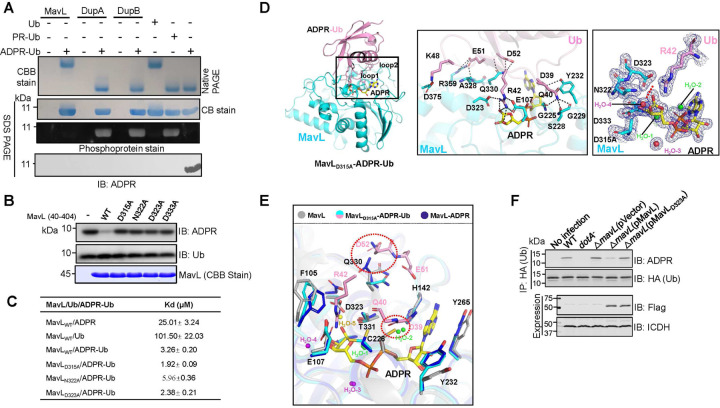 Figure 1
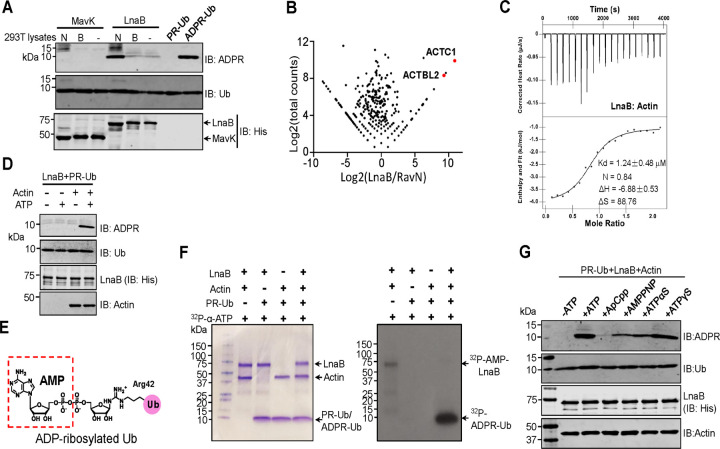 Figure 2
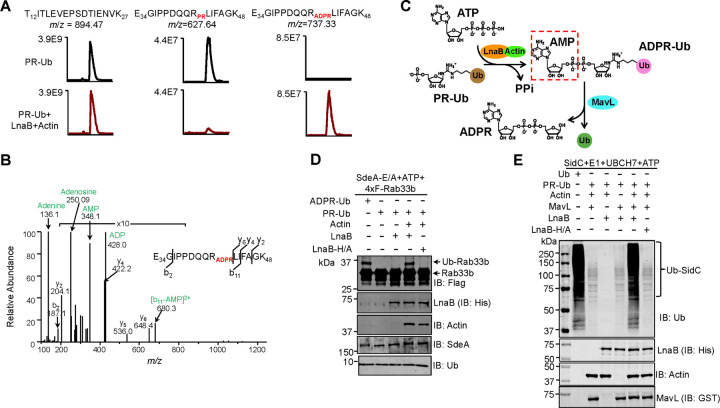 Figure 3
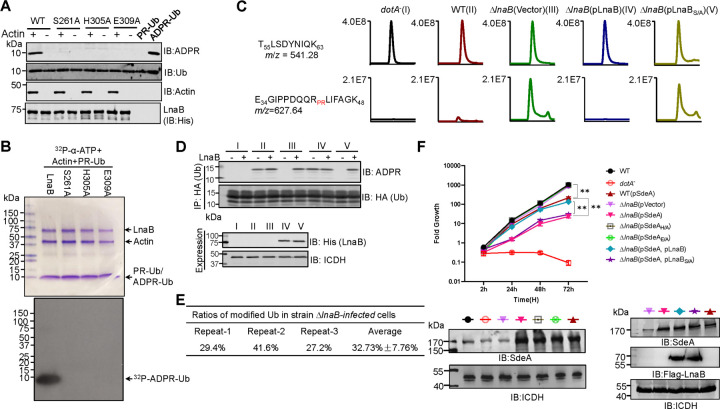 Figure 4
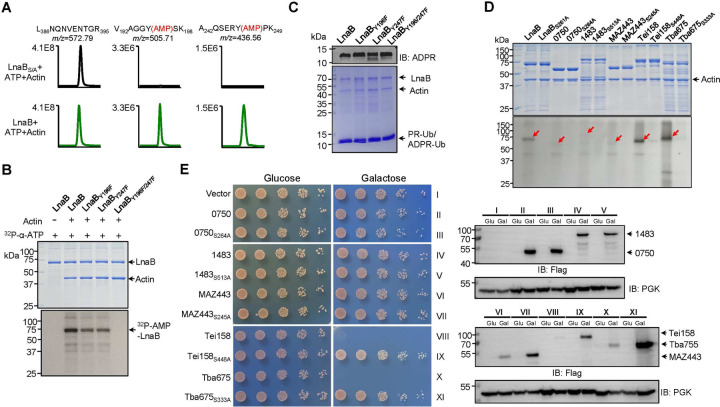 Figure 5
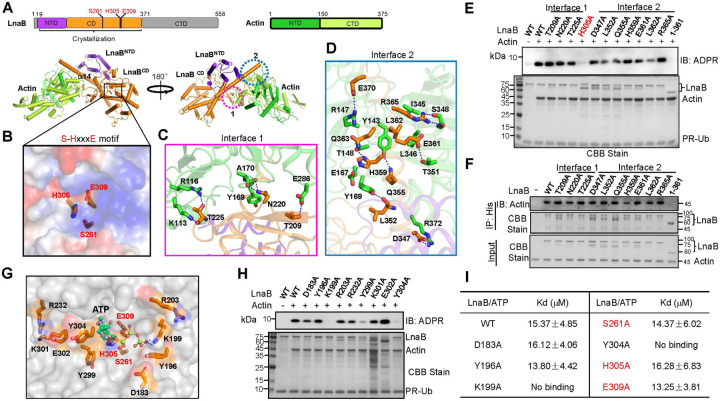 Figure 6
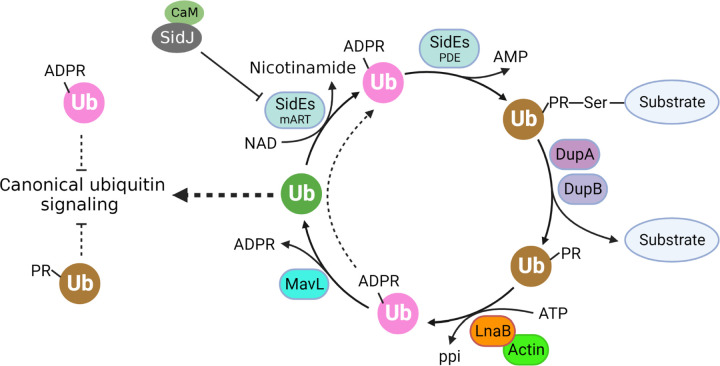 Figure 7
Peer Reviews
No public reviews on file for this paper yet. If you reviewed it on a platform where reviews are public (OpenReview, ICLR, NeurIPS, ICML), you can paste yours below so the community can read it here.
Videos
No videos yet. Explain this paper in a talk, walkthrough, or lecture? Add one.
Taxonomy
TopicsLegionella and Acanthamoeba research · Autophagy in Disease and Therapy · Toxoplasma gondii Research Studies