Influence of High-Risk Pathological Factors and their Interaction on the Survival Benefit of Adjuvant Chemotherapy in Stage II Rectal Cancer: A Retrospective Study
Kailong Zhao, Hongzhou Li, Wenwen Pang, Xuanzhu Zhao, Baofeng Zhang, Zhiqiang Fen, Leixin Jin, Jun Xue, Tianhao Chu, Suying Yan, Wanting Wang, Qiurong Han, Yao Yao, Xipeng Zhang, Xiaomin Su, Chunze Zhang

TL;DR
This study examines how high-risk factors in stage II rectal cancer patients affect the survival benefits of adjuvant chemotherapy, offering guidance for personalized treatment.
Contribution
The study identifies significant interactions between high-risk factors and adjuvant chemotherapy, particularly the number of cleared lymph nodes.
Findings
Age, TNM stage, lymph node count, and lymphovascular invasion were independent risk factors for survival outcomes.
Adjuvant chemotherapy showed significant interactions with the number of cleared lymph nodes in both overall and disease-free survival.
The study highlights the need for individualized treatment decisions based on high-risk factors.
Abstract
Objectives: We investigated the impact of high-risk factors in stage II (TNM stage) rectal cancer patients to determine whether they benefit from adjuvant chemotherapy after surgery. Additionally, we explored the interaction between high-risk factors and adjuvant chemotherapy. Our study provides refined guidance for postoperative treatment in patients with stage II rectal cancer. Methods: The retrospective study included 570 stage II rectal adenocarcinoma patients who underwent total mesorectal excision surgery at Tianjin Union Medical Center from August 2012 to July 2019. We employed Cox regression models to assess the collected pathological and clinical factors, identifying the risk factors for overall survival (OS) and disease-free survival (DFS). Additionally, we thoroughly examined the interaction between various high-risk pathological factors and postoperative chemotherapy (ACT),…
Genes, proteins, chemicals, diseases, species, mutations and cell lines named across the full text — each resolved to its canonical identifier and authoritative record.
Click any figure to enlarge with its caption.
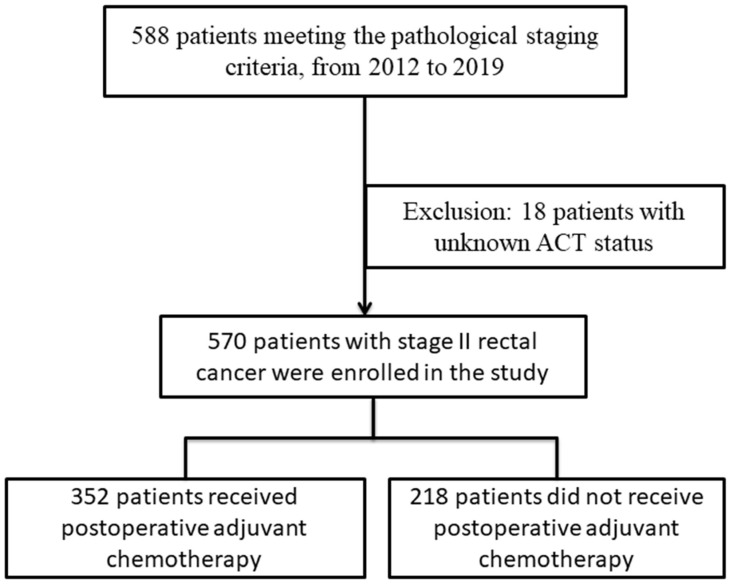 Figure 1
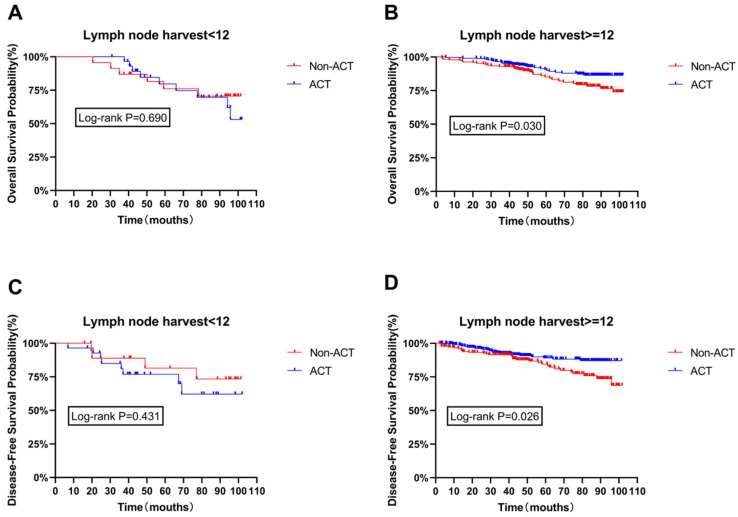 Figure 2
Peer Reviews
No public reviews on file for this paper yet. If you reviewed it on a platform where reviews are public (OpenReview, ICLR, NeurIPS, ICML), you can paste yours below so the community can read it here.
Videos
No videos yet. Explain this paper in a talk, walkthrough, or lecture? Add one.
Taxonomy
TopicsColorectal Cancer Surgical Treatments · Gastric Cancer Management and Outcomes · Colorectal and Anal Carcinomas