Cortical excitation/inhibition ratios in patients with major depression treated with electroconvulsive therapy: an EEG analysis
Sven Stuiver, Julia C. M. Pottkämper, Joey P. A. J. Verdijk, Freek ten Doesschate, Eva Aalbregt, Michel J. A. M. van Putten, Jeannette Hofmeijer, Jeroen A. van Waarde

TL;DR
This study investigates how electroconvulsive therapy affects brain excitation/inhibition ratios in depressed patients, finding that frontal brain changes correlate with treatment success.
Contribution
A novel method based on critical dynamics is used to estimate cortical excitation/inhibition ratios during ECT treatment.
Findings
Frontal fE/I ratios in frequencies 12–28 Hz increased significantly in responders to ECT.
No changes in fE/I ratios were observed in non-responders or healthy controls.
Frontal fE/I ratio modulation may be a key mechanism of ECT effectiveness.
Abstract
Electroconvulsive therapy (ECT) is an effective treatment for major depression, but its working mechanisms are poorly understood. Modulation of excitation/inhibition (E/I) ratios may be a driving factor. Here, we estimate cortical E/I ratios in depressed patients and study whether these ratios change over the course of ECT in relation to clinical effectiveness. Five-minute resting-state electroencephalography (EEG) recordings of 28 depressed patients were recorded before and after their ECT course. Using a novel method based on critical dynamics, functional E/I (fE/I) ratios in the frequency range of 0.5–30 Hz were estimated in frequency bins of 1 Hz for the whole brain and for pre-defined brain regions. Change in Hamilton Depression Rating Scale (HDRS) score was used to estimate clinical effectiveness. To account for test–retest variability, repeated EEG recordings from an independent…
Genes, proteins, chemicals, diseases, species, mutations and cell lines named across the full text — each resolved to its canonical identifier and authoritative record.
Click any figure to enlarge with its caption.
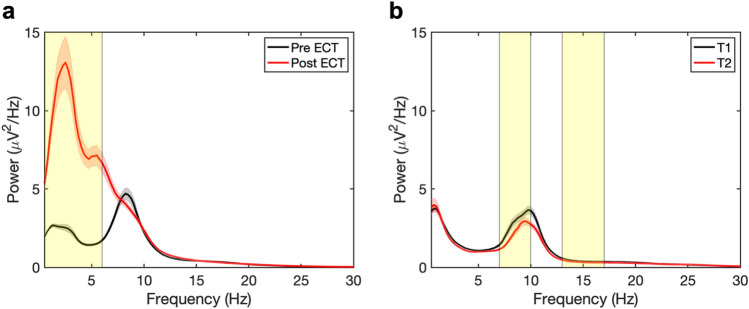 Figure 1
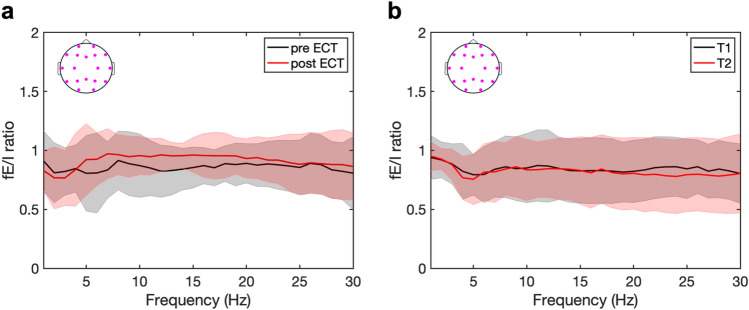 Figure 2
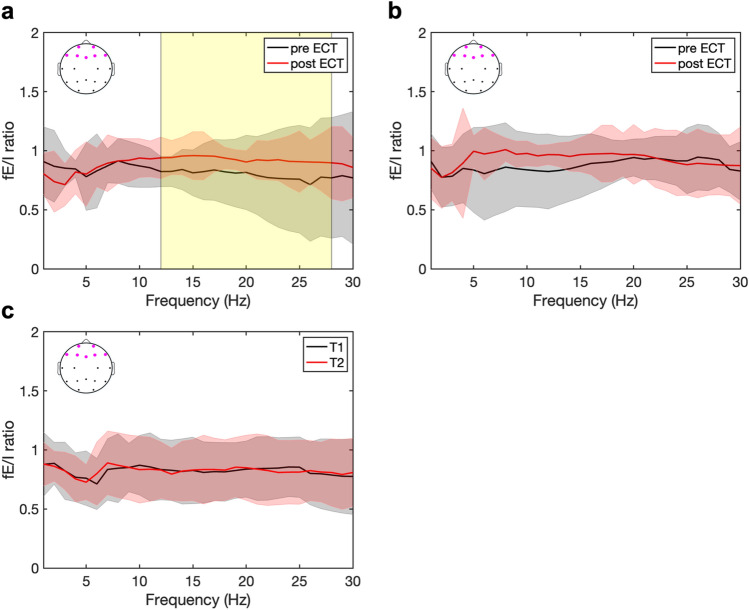 Figure 3
Peer Reviews
No public reviews on file for this paper yet. If you reviewed it on a platform where reviews are public (OpenReview, ICLR, NeurIPS, ICML), you can paste yours below so the community can read it here.
Videos
No videos yet. Explain this paper in a talk, walkthrough, or lecture? Add one.
Taxonomy
TopicsCarbon Nanotubes in Composites · Graphene research and applications · Nanotechnology research and applications