The benefit of adding polygenic risk scores, lifestyle factors, and breast density to family history and genetic status for breast cancer risk and surveillance classification of unaffected women from germline CHEK2 c.1100delC families
Maartje A.C. Schreurs, Teresa Ramón y Cajal, Muriel A. Adank, J. Margriet Collée, Antoinette Hollestelle, Jeroen van Rooij, Marjanka K. Schmidt, Maartje J. Hooning

TL;DR
Adding genetic risk scores, lifestyle factors, and breast density improves breast cancer risk classification for women in families with a CHEK2 gene mutation.
Contribution
This study shows that integrating polygenic risk scores and additional risk factors refines breast cancer surveillance recommendations in CHEK2 mutation families.
Findings
Adding PRS311 reclassified 34.5% of heterozygotes and 35.6% of non-carriers in surveillance categories.
Including breast density further shifted risk classifications in 23.1% of heterozygotes and 27.8% of non-carriers.
Most heterozygotes moved to less intensive surveillance, while non-carriers needed more intensive monitoring.
Abstract
To determine the changes in surveillance category by adding a polygenic risk score based on 311 breast cancer (BC)-associated variants (PRS311), questionnaire-based risk factors and breast density on personalized BC risk in unaffected women from Dutch CHEK2 c.1100delC families. In total, 117 unaffected women (58 heterozygotes and 59 non-carriers) from CHEK2 families were included. Blood-derived DNA samples were genotyped with the GSAMDv3-array to determine PRS311. Lifetime BC risk was calculated in CanRisk, which uses data from the Breast and Ovarian Analysis of Disease Incidence and Carrier Estimation Algorithm (BOADICEA). Women, were categorized into three surveillance groups. The surveillance advice was reclassified in 20 (34.5%) heterozygotes and 21 (35.6%) non-carriers after adding PRS311. Including questionnaire-based risk factors resulted in an additional change in 11 (20.0%)…
Genes, proteins, chemicals, diseases, species, mutations and cell lines named across the full text — each resolved to its canonical identifier and authoritative record.
Click any figure to enlarge with its caption.
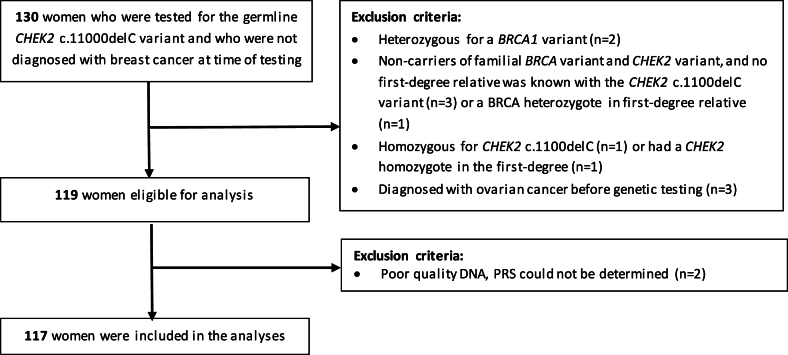 Figure 1
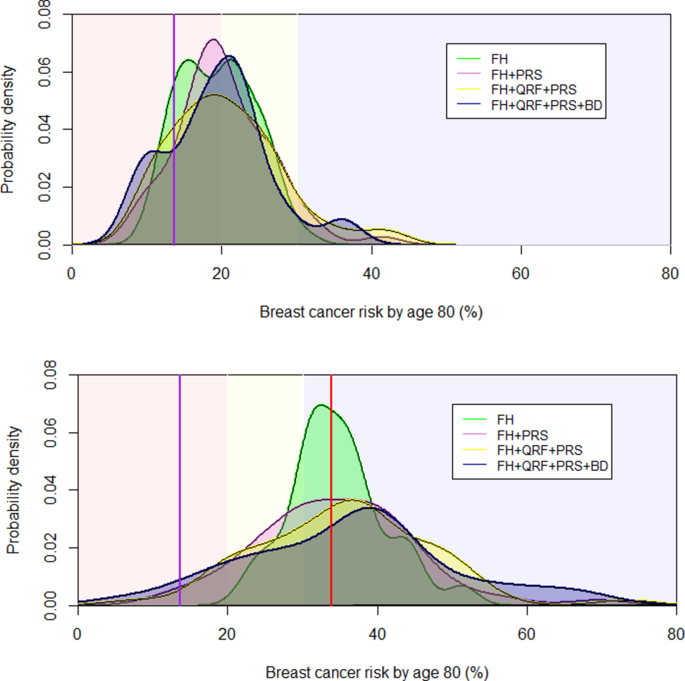 Figure 2
Peer Reviews
No public reviews on file for this paper yet. If you reviewed it on a platform where reviews are public (OpenReview, ICLR, NeurIPS, ICML), you can paste yours below so the community can read it here.
Videos
No videos yet. Explain this paper in a talk, walkthrough, or lecture? Add one.
Taxonomy
TopicsBRCA gene mutations in cancer · Global Cancer Incidence and Screening · Cancer Genomics and Diagnostics