Reactivation of Multidrug-Resistant HSV-1 in a Post–Allogenic Hematopoietic Stem Cell Transplant Patient: Dynamic Detection of the Rare A605V Mutation by Next-Generation Sequencing
Shuxuan Zheng, Lidewij W Rümke, Bruno Tello Rubio, Malbert R C Rogers, Geerte L van Sluis, Jürgen H E Kuball, Annelies Riezebos-Brilman, Robert Jan Lebbink, Frans M Verduyn Lunel

TL;DR
A patient with a weakened immune system experienced a rare drug-resistant herpes virus reactivation, detected using advanced sequencing techniques.
Contribution
Dynamic detection of a rare HSV-1 mutation (A605V) using next-generation sequencing in an immunocompromised patient.
Findings
Next-generation sequencing identified a rare A605V mutation in the HSV-1 DNA polymerase gene.
Multiple drug-resistant strains were detected before treatment, with altered ratios observed during treatment.
The mutation affected the patient's clinical response to aciclovir and foscarnet.
Abstract
We present an immunocompromised patient with a multiresistant herpes simplex virus–1 reactivation with a rare mutation (A605V) in the viral DNA polymerase gene. Next-generation sequencing suggests the presence of multiple drug-resistant strains before treatment and altered ratios during treatment, affecting the clinical response to aciclovir and foscarnet.
Genes, proteins, chemicals, diseases, species, mutations and cell lines named across the full text — each resolved to its canonical identifier and authoritative record.
Click any figure to enlarge with its caption.
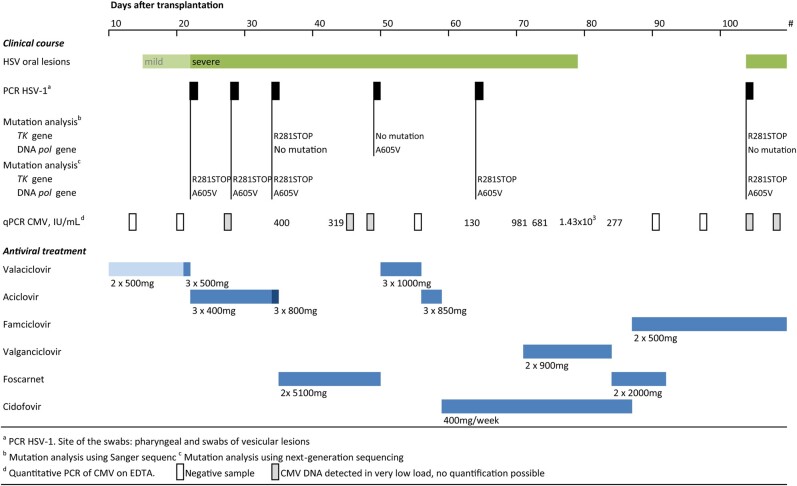 Figure 1
Peer Reviews
No public reviews on file for this paper yet. If you reviewed it on a platform where reviews are public (OpenReview, ICLR, NeurIPS, ICML), you can paste yours below so the community can read it here.
Videos
No videos yet. Explain this paper in a talk, walkthrough, or lecture? Add one.
Taxonomy
TopicsHerpesvirus Infections and Treatments · Cytomegalovirus and herpesvirus research · Drug-Induced Adverse Reactions