An inorganic-blended p-type semiconductor with robust electrical and mechanical properties
You Meng, Weijun Wang, Rong Fan, Zhengxun Lai, Wei Wang, Dengji Li, Xiaocui Li, Quan Quan, Pengshan Xie, Dong Chen, He Shao, Bowen Li, Zenghui Wu, Zhe Yang, SenPo Yip, Chun-Yuen Wong, Yang Lu, Johnny C. Ho

TL;DR
Researchers developed a new inorganic semiconductor material that improves p-type performance and enables efficient, flexible electronic devices.
Contribution
A novel inorganic-blended p-type semiconductor (TeSeO) is introduced with tunable bandgaps and high hole mobility.
Findings
TeSeO films exhibit high hole field-effect mobility of 48.5 cm²/(Vs) and robust transport properties.
Nanopatterned TeSeO photodetectors show 603 A/W responsivity and 5 μs response time.
The material is scalable, adaptable, and suitable for flexible and broadband electronic applications.
Abstract
Inorganic semiconductors typically have limited p-type behavior due to the scarcity of holes and the localized valence band maximum, hindering the progress of complementary devices and circuits. In this work, we propose an inorganic blending strategy to activate the hole-transporting character in an inorganic semiconductor compound, namely tellurium-selenium-oxygen (TeSeO). By rationally combining intrinsic p-type semimetal, semiconductor, and wide-bandgap semiconductor into a single compound, the TeSeO system displays tunable bandgaps ranging from 0.7 to 2.2 eV. Wafer-scale ultrathin TeSeO films, which can be deposited at room temperature, display high hole field-effect mobility of 48.5 cm2/(Vs) and robust hole transport properties, facilitated by Te-Te (Se) portions and O-Te-O portions, respectively. The nanosphere lithography process is employed to create nanopatterned honeycomb…
Genes, proteins, chemicals, diseases, species, mutations and cell lines named across the full text — each resolved to its canonical identifier and authoritative record.
Click any figure to enlarge with its caption.
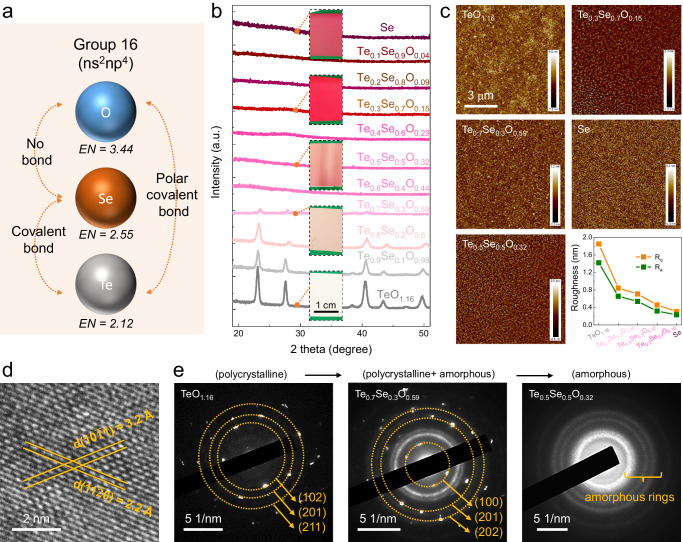 Figure 1
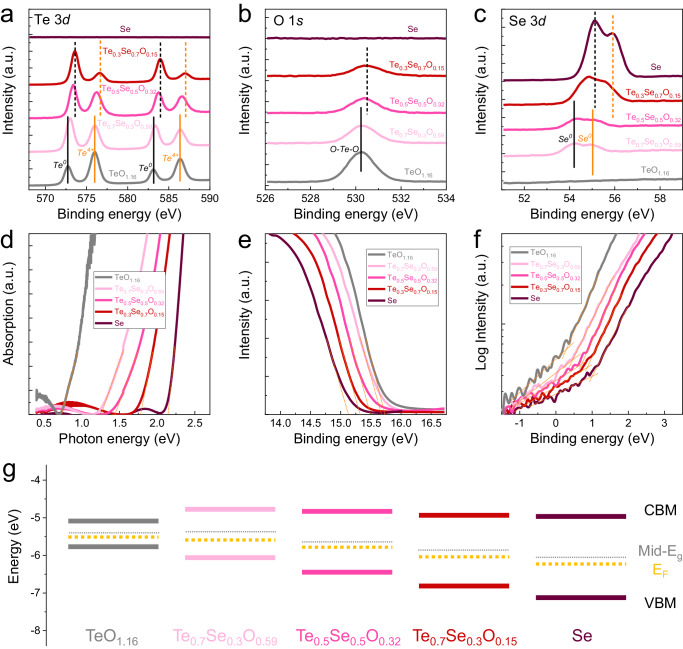 Figure 2
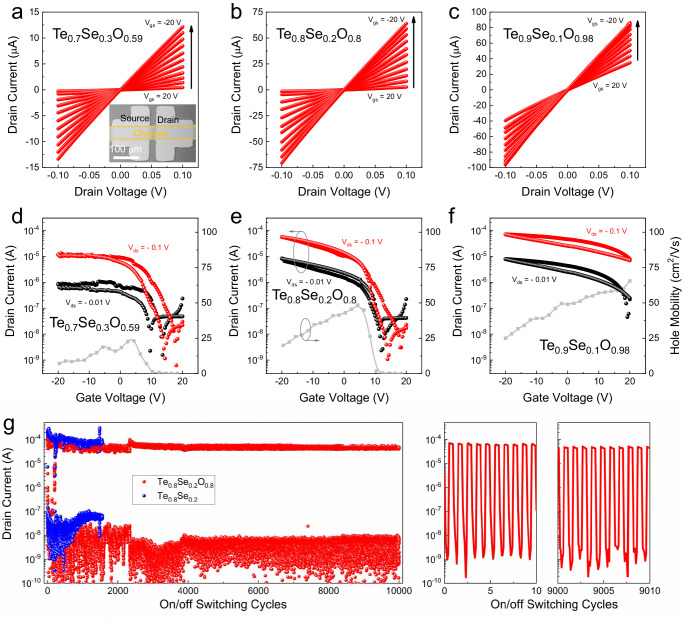 Figure 3
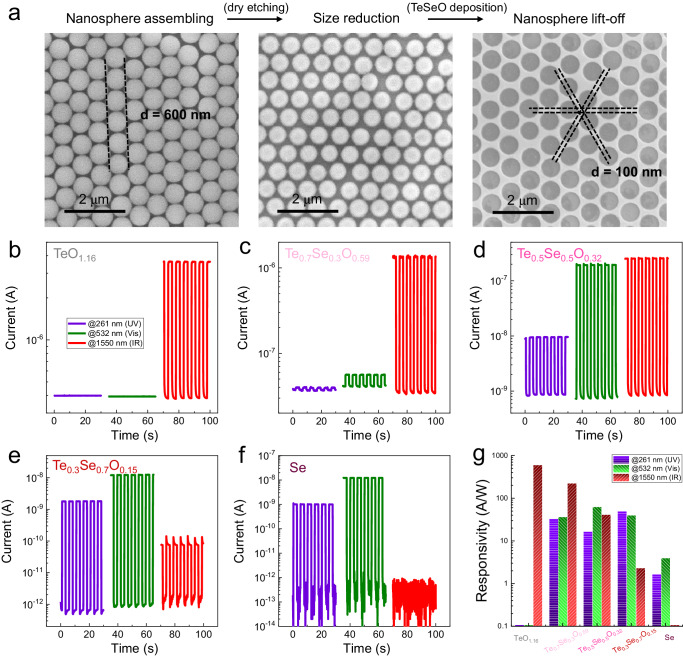 Figure 4
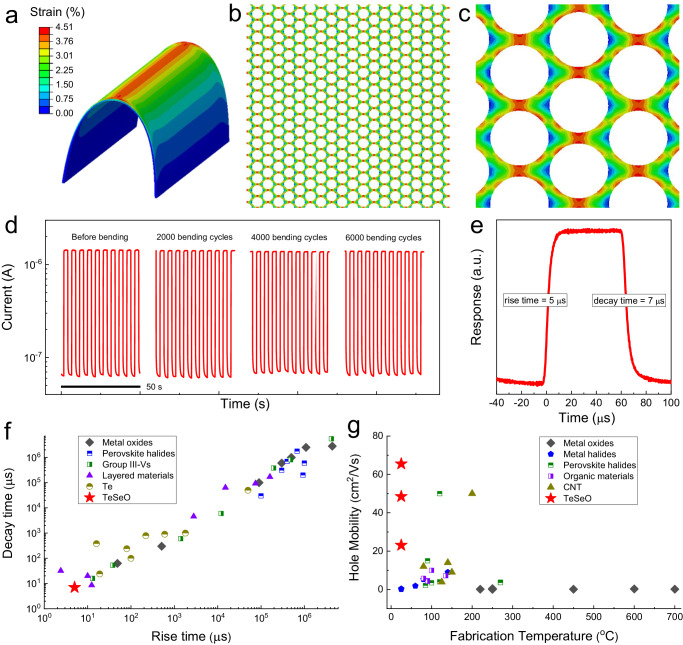 Figure 5
Peer Reviews
No public reviews on file for this paper yet. If you reviewed it on a platform where reviews are public (OpenReview, ICLR, NeurIPS, ICML), you can paste yours below so the community can read it here.
Videos
No videos yet. Explain this paper in a talk, walkthrough, or lecture? Add one.
Taxonomy
TopicsPhase-change materials and chalcogenides · Chalcogenide Semiconductor Thin Films · 2D Materials and Applications