Spatial Variation in Mercury Accumulation in Bottlenose Dolphins (Tursiops spp.) in Southeastern U.S.A
Mackenzie L. Griffin, Colleen E. Bryan, Tara M. Cox, Brian C. Balmer, Russell D. Day, Laura Garcia Barcia, Antoinette M. Gorgone, Jeremy J. Kiszka, Jenny A. Litz, Robin M. Perrtree, Teri K. Rowles, Lori H. Schwacke, Randall S. Wells, Eric Zolman

TL;DR
This study finds that mercury levels in dolphins vary significantly across different coastal areas in the southeastern U.S., highlighting the need for targeted human health assessments.
Contribution
The study provides new spatial insights into mercury accumulation in dolphins, linking it to regional environmental and atmospheric factors.
Findings
Mercury levels in dolphins were highest in St. Joseph Bay, Florida Everglades, and Choctawhatchee Bay.
Mercury levels were lowest in dolphins from Charleston and Skidaway River Estuary.
Mercury patterns were consistent across sex and age classes, indicating regional environmental influences.
Abstract
Bottlenose dolphins (Tursiops spp.) inhabit bays, sounds, and estuaries (BSEs) throughout the southeast region of the U.S.A. and are sentinel species for human and ecosystem-level health. Dolphins are vulnerable to the bioaccumulation of contaminants through the coastal food chain because they are high-level predators. Currently, there is limited information on the spatial dynamics of mercury accumulation in these dolphins. Total mercury (THg) was measured in dolphin skin from multiple populations across the U.S. Southeast Atlantic and Gulf of Mexico coasts, and the influence of geographic origin, sex, and age class was investigated. Mercury varied significantly among sampling sites and was greatest in dolphins in St. Joseph Bay, Florida Everglades, and Choctawhatchee Bay (14,193 ng/g ± 2196 ng/g, 10,916 ng/g ± 1532 ng/g, and 7333 ng/g ± 1405 ng/g wet mass (wm), respectively) and lowest…
Genes, proteins, chemicals, diseases, species, mutations and cell lines named across the full text — each resolved to its canonical identifier and authoritative record.
Click any figure to enlarge with its caption.
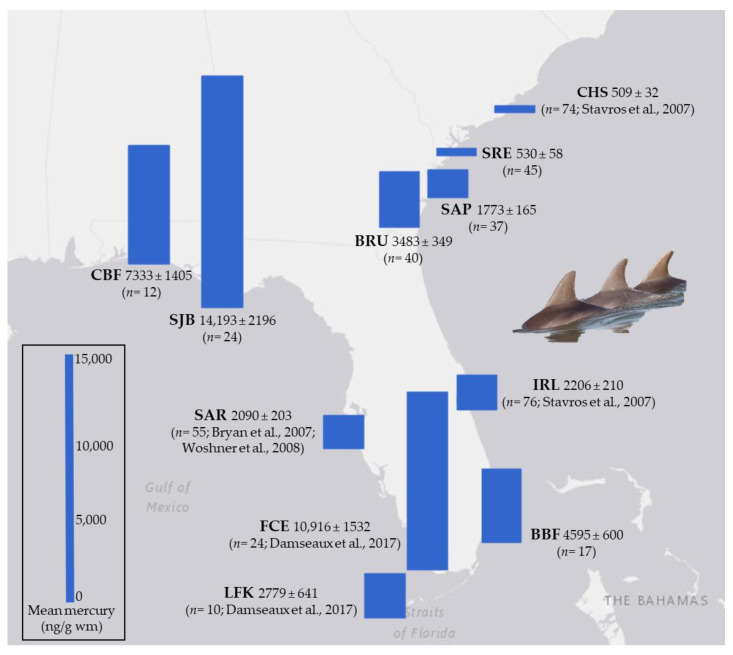 Figure 1
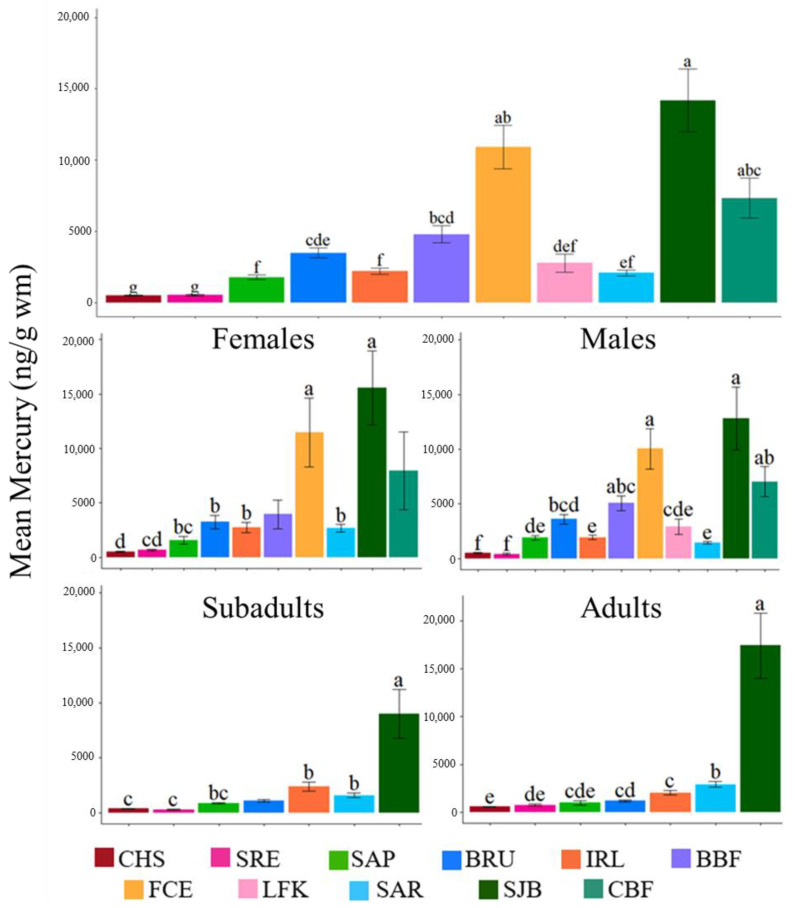 Figure 2
Peer Reviews
No public reviews on file for this paper yet. If you reviewed it on a platform where reviews are public (OpenReview, ICLR, NeurIPS, ICML), you can paste yours below so the community can read it here.
Videos
No videos yet. Explain this paper in a talk, walkthrough, or lecture? Add one.
Taxonomy
TopicsMercury impact and mitigation studies · Marine animal studies overview · Toxic Organic Pollutants Impact