Trends in Targeted Therapy Usage in Inflammatory Bowel Disease: TRENDY Study of ENEIDA
Celia Gómez-Labrador, Elena Ricart, Marisa Iborra, Eva Iglesias, María Dolores Martín-Arranz, Luisa de Castro, Ruth De Francisco, Francisco Javier García-Alonso, Ana Sanahuja, Carla J. Gargallo-Puyuelo, Francisco Mesonero, María José Casanova, Míriam Mañosa, Montserrat Rivero

TL;DR
This study analyzed trends in targeted IBD treatments from 2015 to 2021, showing how drug use evolved over time for Crohn's disease and ulcerative colitis.
Contribution
The study provides real-world insights into treatment patterns and drug positioning in IBD over a six-year period.
Findings
Anti-TNF therapies were most commonly used in first-line treatment for IBD, with adalimumab in Crohn's disease and infliximab in ulcerative colitis.
Ustekinumab and vedolizumab gained prominence in second and third-line treatments for Crohn's disease and ulcerative colitis, respectively.
Biosimilar use increased over time, but machine learning could not predict treatment patterns.
Abstract
Markers that allow for the selection of tailored treatments for individual patients with inflammatory bowel diseases (IBD) are yet to be identified. Our aim was to describe trends in real-life treatment usage. For this purpose, patients from the ENEIDA registry who received their first targeted IBD treatment (biologics or tofacitinib) between 2015 and 2021 were included. A subsequent analysis with Machine Learning models was performed. The study included 10,009 patients [71% with Crohn’s disease (CD) and 29% with ulcerative colitis (UC)]. In CD, anti-TNF (predominantly adalimumab) were the main agents in the 1st line of treatment (LoT), although their use declined over time. In UC, anti-TNF (mainly infliximab) use was predominant in 1st LoT, remaining stable over time. Ustekinumab and vedolizumab were the most prescribed drugs in 2nd and 3rd LoT in CD and UC, respectively. Overall, the…
Genes, proteins, chemicals, diseases, species, mutations and cell lines named across the full text — each resolved to its canonical identifier and authoritative record.
Click any figure to enlarge with its caption.
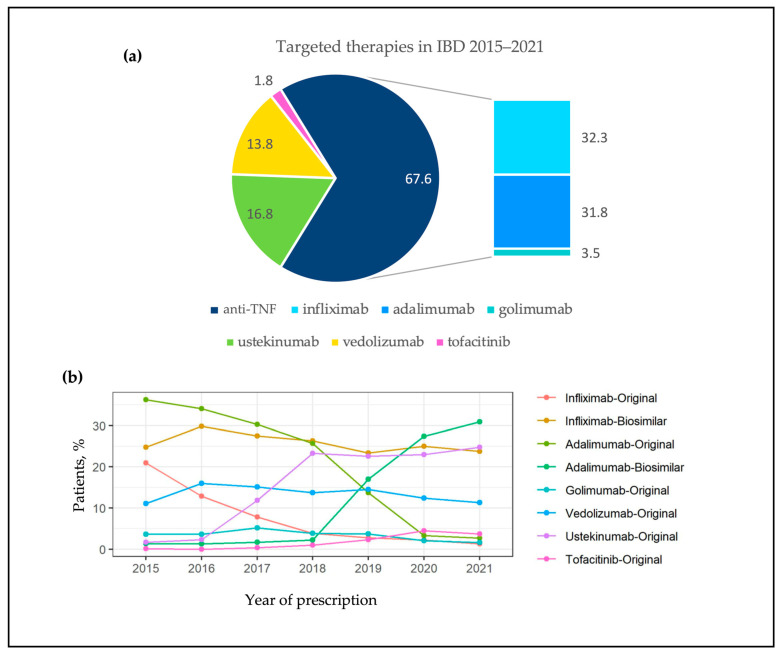 Figure 1
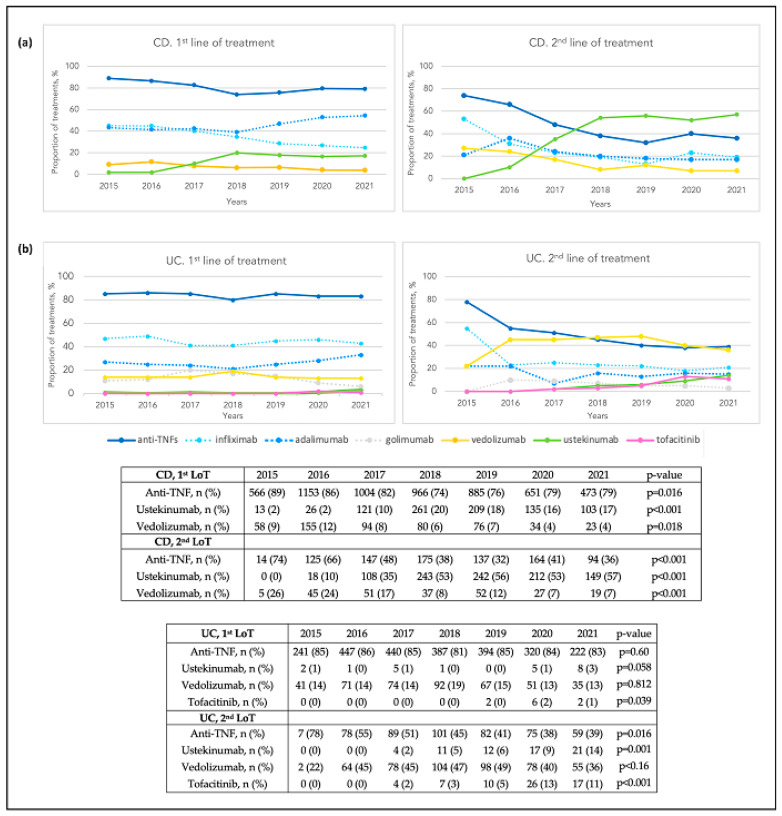 Figure 2
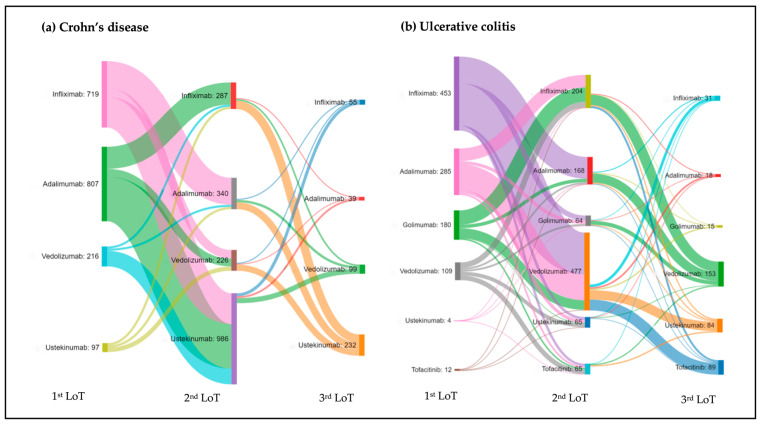 Figure 3
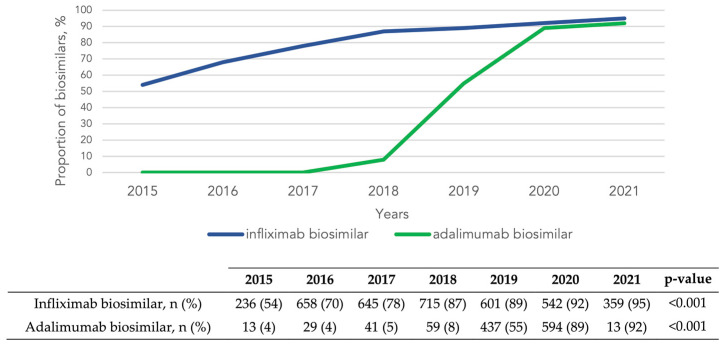 Figure 4
Peer Reviews
No public reviews on file for this paper yet. If you reviewed it on a platform where reviews are public (OpenReview, ICLR, NeurIPS, ICML), you can paste yours below so the community can read it here.
Videos
No videos yet. Explain this paper in a talk, walkthrough, or lecture? Add one.
Taxonomy
TopicsLatin American Cultural Politics · Latin American Literature Studies · Spanish Literature and Culture Studies