A Hadal Streptomyces-Derived Echinocandin Acylase Discovered through the Prioritization of Protein Families
Xuejian Jiang, Hongjun Shu, Shuting Feng, Pinmei Wang, Zhizhen Zhang, Nan Wang

TL;DR
Scientists discovered a new enzyme from deep-sea bacteria that can modify antifungal drugs, potentially improving their safety and effectiveness.
Contribution
The discovery of the first echinocandin E acylase from a hadal Streptomyces species using protein family prioritization.
Findings
Echinocandin E acylase (ECEA) was identified from a deep-sea Streptomyces sp. SY1965 isolate.
The enzyme efficiently cleaves the acyl side chain of echinocandin E, aiding drug development.
The study highlights the potential of hadal ecosystems for discovering functional molecules.
Abstract
Naturally occurring echinocandin B and FR901379 are potent antifungal lipopeptides featuring a cyclic hexapeptide nucleus and a fatty acid side chain. They are the parent compounds of echinocandin drugs for the treatment of severe fungal infections caused by the Candida and Aspergilla species. To minimize hemolytic toxicity, the native fatty acid side chains in these drug molecules are replaced with designer acyl side chains. The deacylation of the N-acyl side chain is, therefore, a crucial step for the development and manufacturing of echinocandin-type antibiotics. Echinocandin E (ECE) is a novel echinocandin congener with enhanced stability generated via the engineering of the biosynthetic machinery of echinocandin B (ECB). In the present study, we report the discovery of the first echinocandin E acylase (ECEA) using the enzyme similarity tool (EST) for enzymatic function mining…
Genes, proteins, chemicals, diseases, species, mutations and cell lines named across the full text — each resolved to its canonical identifier and authoritative record.
Click any figure to enlarge with its caption.
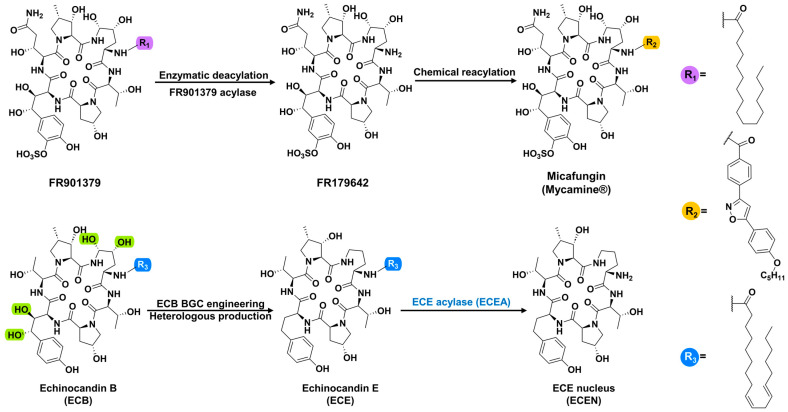 Figure 1
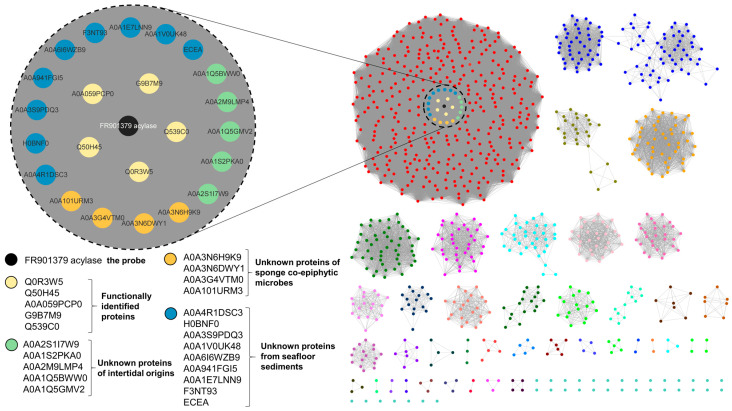 Figure 2
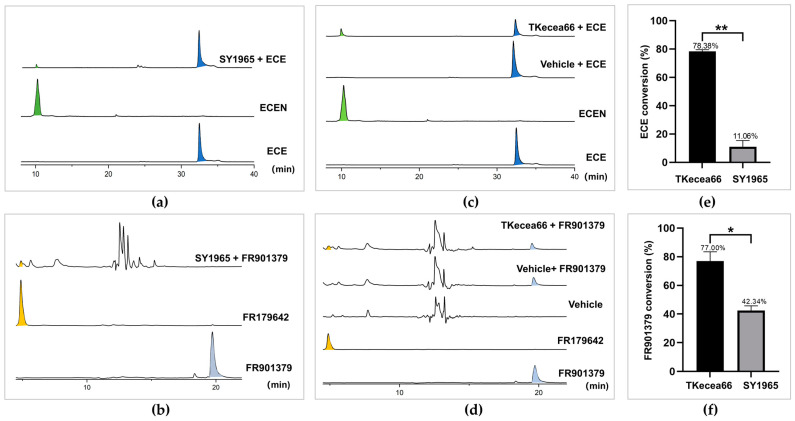 Figure 3
 Figure 4
Peer Reviews
No public reviews on file for this paper yet. If you reviewed it on a platform where reviews are public (OpenReview, ICLR, NeurIPS, ICML), you can paste yours below so the community can read it here.
Videos
No videos yet. Explain this paper in a talk, walkthrough, or lecture? Add one.
Taxonomy
TopicsMicrobial Natural Products and Biosynthesis · Biochemical and Molecular Research · 14-3-3 protein interactions