Prenatal Diagnosis of Fryns Syndrome through Identification of Two Novel Splice Variants in the PIGN Gene—A Case Series
Aruna Marchetto, Susanne Leidescher, Theresia van Hoi, Niklas Hirschberger, Florian Vogel, Siegmund Köhler, Ivonne Alexandra Bedei, Roland Axt-Fliedner, Moneef Shoukier, Corinna Keil

TL;DR
This paper reports two new genetic mutations in the PIGN gene causing Fryns syndrome in a family with two affected children.
Contribution
The study identifies two novel splice variants in the PIGN gene as the cause of Fryns syndrome in a non-consanguineous family.
Findings
RNA sequencing confirmed exon skipping caused by two splice-affecting mutations in the PIGN gene.
Compound heterozygosity for these novel variants was found to underlie Fryns syndrome in two patients.
Abstract
Fryns syndrome (FS) is a multiple congenital anomaly syndrome with different multisystemic malformations. These include congenital diaphragmatic hernia, pulmonary hypoplasia, and craniofacial dysmorphic features in combination with malformations of the central nervous system such as agenesis of the corpus callosum, cerebellar hypoplasia, and enlarged ventricles. We present a non-consanguineous northern European family with two recurrent cases of FS: a boy with multiple congenital malformations who died at the age of 2.5 months and a female fetus with a complex developmental disorder with similar features in a following pregnancy. Quad whole exome analysis revealed two likely splicing-affecting disease-causing mutations in the PIGN gene: a synonymous mutation c.2619G>A, p.(Leu873=) in the last nucleotide of exon 29 and a 30 bp-deletion c.996_1023+2del (NM_176787.5) protruding into intron…
Genes, proteins, chemicals, diseases, species, mutations and cell lines named across the full text — each resolved to its canonical identifier and authoritative record.
Click any figure to enlarge with its caption.
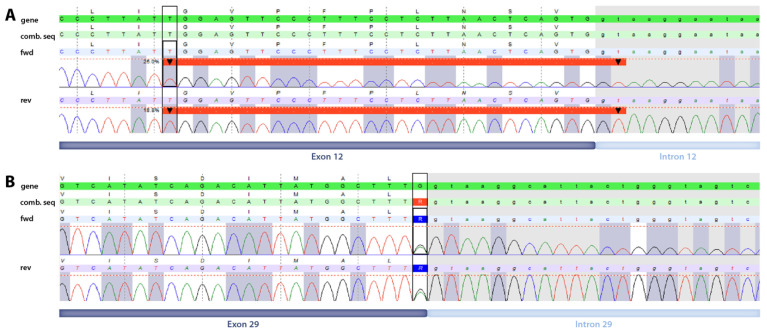 Figure 1
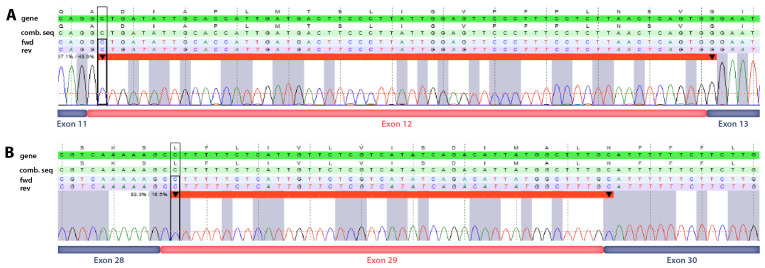 Figure 2
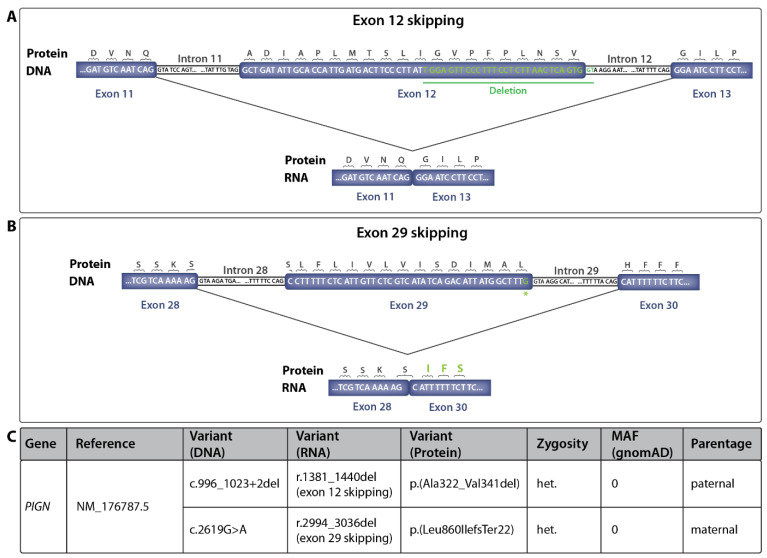 Figure 3
Peer Reviews
No public reviews on file for this paper yet. If you reviewed it on a platform where reviews are public (OpenReview, ICLR, NeurIPS, ICML), you can paste yours below so the community can read it here.
Videos
No videos yet. Explain this paper in a talk, walkthrough, or lecture? Add one.
Taxonomy
TopicsCongenital Diaphragmatic Hernia Studies · RNA modifications and cancer · Fetal and Pediatric Neurological Disorders