Snapshot of Anti-SARS-CoV-2 IgG Antibodies in COVID-19 Recovered Patients in Guinea
Solène Grayo, Houlou Sagno, Oumar Diassy, Jean-Baptiste Zogbelemou, Sia Jeanne Kondabo, Marilyn Houndekon, Koussay Dellagi, Inès Vigan-Womas, Samia Rourou, Wafa Ben Hamouda, Chaouki Benabdessalem, Melika Ben Ahmed, Noël Tordo

TL;DR
This study examines IgG antibody levels in Guinea's recovered COVID-19 patients, showing how immunity changes over time and the importance of specific tests for accurate results.
Contribution
The study provides new data on long-term antibody persistence and test accuracy in a predominantly African population in Guinea.
Findings
73% of recovered patients had detectable IgG antibodies to SARS-CoV-2, with OD values decreasing after 3 months.
The RBD/S1-IH ELISA kit showed better agreement with whole spike1 protein tests than nucleoprotein-based tests.
Older individuals (60–100 years) had significantly higher antibody levels compared to younger age groups.
Abstract
Background: Because the regular vaccine campaign started in Guinea one year after the COVID-19 index case, the profile of naturally acquired immunity following primary SARS-CoV-2 infection needs to be deepened. Methods: Blood samples were collected once from 200 patients (90% of African extraction) who were recovered from COVID-19 for at least ~2.4 months (72 days), and their sera were tested for IgG antibodies to SARS-CoV-2 using an in-house ELISA assay against the Receptor Binding Domain (RBD) of the SARS-CoV-2 spike1 protein (RBD/S1-IH kit). Results: Results revealed that 73% of sera (146/200) were positive for IgG to SARS-CoV-2 with an Optical Density (OD) ranging from 0.13 to 1.19 and a median value of 0.56 (IC95: 0.51–0.61). The median OD value at 3 months (1.040) suddenly decreased thereafter and remained stable around OD 0.5 until 15 months post-infection. The OD median value…
Genes, proteins, chemicals, diseases, species, mutations and cell lines named across the full text — each resolved to its canonical identifier and authoritative record.
Click any figure to enlarge with its caption.
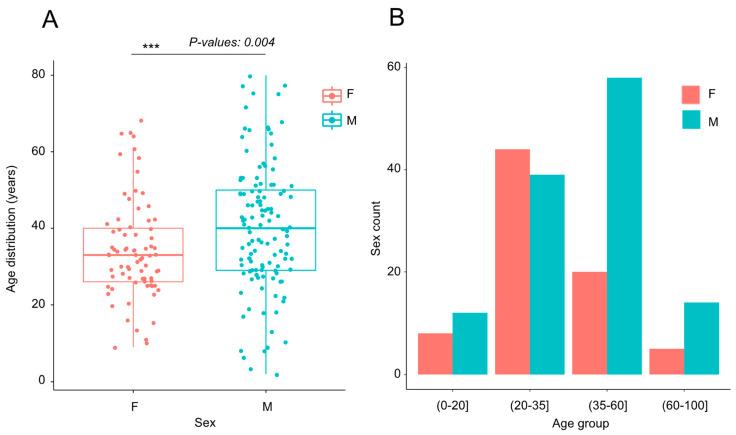 Figure 1
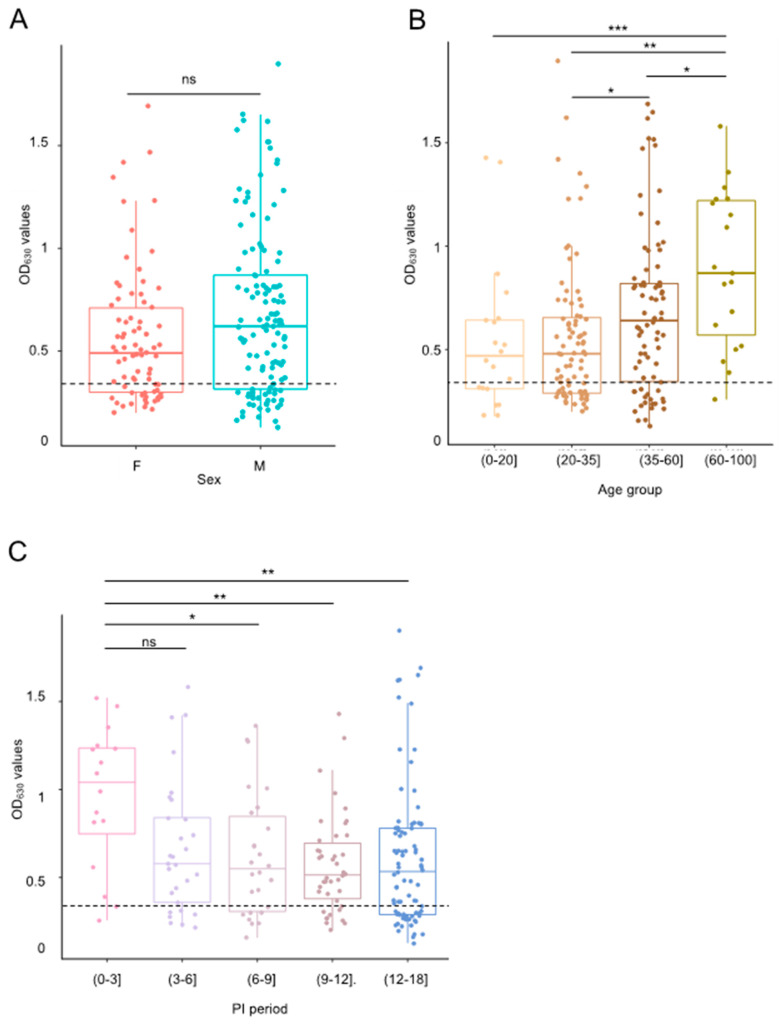 Figure 2
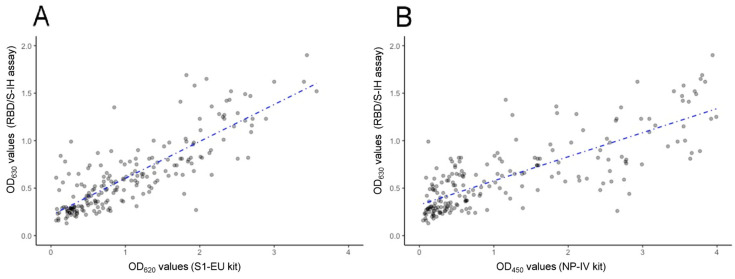 Figure 3
Peer Reviews
No public reviews on file for this paper yet. If you reviewed it on a platform where reviews are public (OpenReview, ICLR, NeurIPS, ICML), you can paste yours below so the community can read it here.
Videos
No videos yet. Explain this paper in a talk, walkthrough, or lecture? Add one.
Taxonomy
TopicsSARS-CoV-2 and COVID-19 Research · COVID-19 Clinical Research Studies · COVID-19 epidemiological studies