Follistatin as a Potential Biomarker for Identifying Metabolically Healthy and Unhealthy Obesity: A Cross-Sectional Study
Ayşe N. Erbakan, H. Hicran Mutlu, Mehmet Uzunlulu, Lütfullah Caştur, Muhammet Mikdat Akbaş, Fatoş N. Kaya, Mehmet Erbakan, Ferruh K. İşman, Aytekin Oğuz

TL;DR
This study explores whether follistatin can help identify metabolically healthy versus unhealthy obesity, but finds it is not a useful biomarker.
Contribution
The study evaluates follistatin as a potential biomarker for distinguishing metabolically healthy and unhealthy obesity for the first time in this context.
Findings
Follistatin levels did not significantly differ between metabolically healthy and unhealthy obese individuals.
Insulin was the strongest predictor of follistatin levels, followed by C-peptide.
Quantile regression revealed complex associations between follistatin and metabolic parameters.
Abstract
Metabolically healthy obesity (MHO) refers to obese individuals with a favorable metabolic profile, without severe metabolic abnormalities. This study aimed to investigate the potential of follistatin, a regulator of metabolic balance, as a biomarker to distinguish between metabolically healthy and unhealthy obesity. This cross-sectional study included 30 metabolically healthy and 32 metabolically unhealthy individuals with obesity. Blood samples were collected to measure the follistatin levels using an enzyme-linked immunosorbent assay (ELISA). While follistatin did not significantly differentiate between metabolically healthy (median 41.84 [IQR, 37.68 to 80.09]) and unhealthy (median 42.44 [IQR, 39.54 to 82.55]) individuals with obesity (p = 0.642), other biochemical markers, such as HDL cholesterol, triglycerides, C-peptide, and AST, showed significant differences between the two…
Genes, proteins, chemicals, diseases, species, mutations and cell lines named across the full text — each resolved to its canonical identifier and authoritative record.
Click any figure to enlarge with its caption.
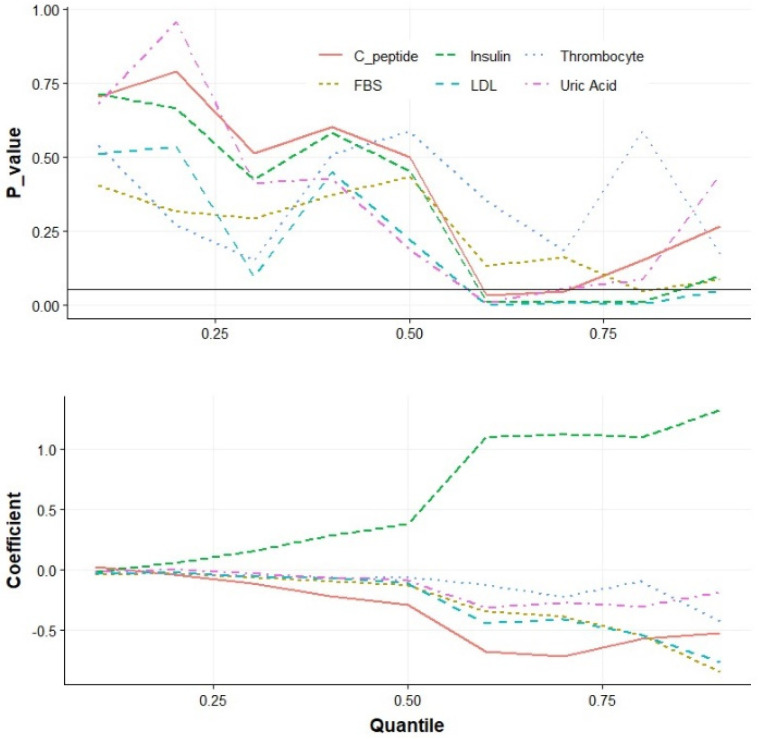 Figure 1
Peer Reviews
No public reviews on file for this paper yet. If you reviewed it on a platform where reviews are public (OpenReview, ICLR, NeurIPS, ICML), you can paste yours below so the community can read it here.
Videos
No videos yet. Explain this paper in a talk, walkthrough, or lecture? Add one.
Taxonomy
TopicsAdipokines, Inflammation, and Metabolic Diseases · Adipose Tissue and Metabolism · Lipid metabolism and disorders