Selenoprotein P-1 (SEPP1) as an Early Biomarker of Myocardial Injury in Patients Undergoing Cardiopulmonary Bypass
Giuseppe Filiberto Serraino, Davide Bolignano, Federica Jiritano, Giuseppe Coppolino, Désirée Napolitano, Mariateresa Zicarelli, Patrizia Pizzini, Sebastiano Cutrupi, Alessandra Testa, Belinda Spoto, Michele Andreucci, Pasquale Mastroroberto, Raffaele Serra

TL;DR
This study explores selenoprotein P-1 (SEPP1) as a potential early indicator of heart injury in patients undergoing heart surgery with cardiopulmonary bypass.
Contribution
The study identifies SEPP1 as a novel early biomarker for predicting myocardial injury after cardiac surgery.
Findings
SEPP1 levels 4 hours after surgery strongly correlate with CK-MB levels at 48 and 72 hours.
Early SEPP1 measurements correlate with troponin values and CPB and cross-clamp times.
SEPP1 may help identify patients at risk of perioperative myocardial injury.
Abstract
Background: Biomarkers development for prognostication or prediction of perioperative myocardial disease is critical for the evolution of treatment options in patients undergoing cardiac surgery. The aim of our prospective monocentric study was to investigate the role of selenoprotein 1 (SEEP 1) as a potential biomarker for assessing the risk of myocardial injury after cardiac surgery. Methods: Circulating SEPP1 was measured in the blood of 45 patients before surgery and at 4 h, 8 h and 12 h after CPB by enzyme-linked immunosorbent assay (ELISA); (3) Results: circulating SEPP-1 levels measured 4 h after surgery were strongly correlated with CK-MB levels measured at 48 h (R = 0.598, p < 0.0001) and at 72 h (R = 0.308, p = 0.05). Close correlations were also found between 4 h SEPP-1 and Hs-c troponin values measured at 24 h (R = 0.532, p < 0.0001), 48 h (R = 0.348, p = 0.01) and 72 h (R =…
Genes, proteins, chemicals, diseases, species, mutations and cell lines named across the full text — each resolved to its canonical identifier and authoritative record.
Click any figure to enlarge with its caption.
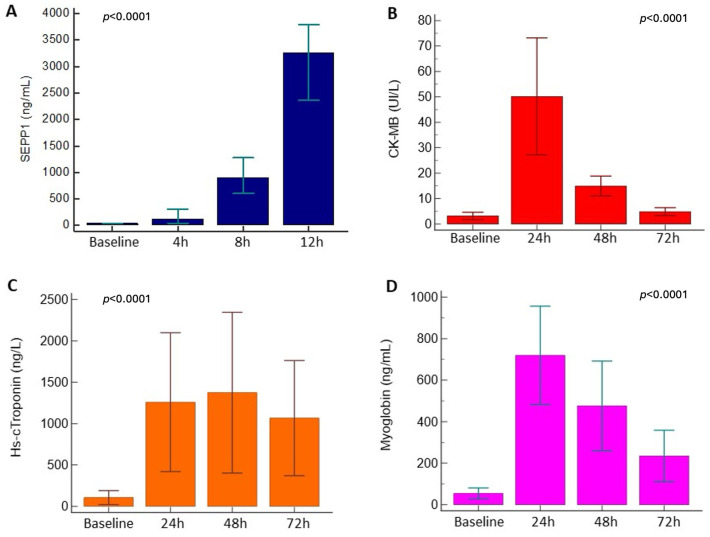 Figure 1
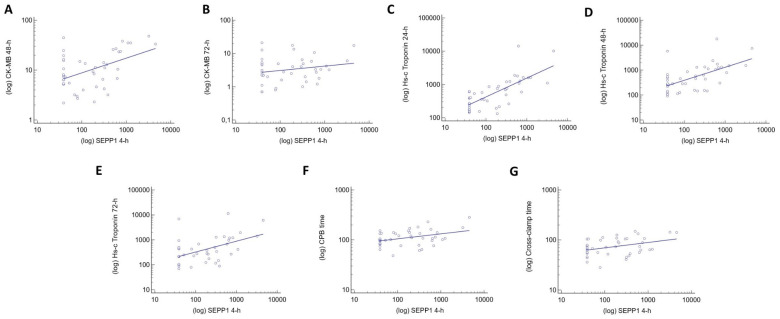 Figure 2
Peer Reviews
No public reviews on file for this paper yet. If you reviewed it on a platform where reviews are public (OpenReview, ICLR, NeurIPS, ICML), you can paste yours below so the community can read it here.
Videos
No videos yet. Explain this paper in a talk, walkthrough, or lecture? Add one.
Taxonomy
TopicsCardiac, Anesthesia and Surgical Outcomes · Cardiac Ischemia and Reperfusion · Lipoproteins and Cardiovascular Health