Factors Influencing the Preference of Medical Students at Umm Al-Qura University for Otorhinolaryngology-Head and Neck Surgery as a Future Specialty: A Cross-Sectional Study
Saad M Alharthi, Bader Al-Kaabi, Shaimaa K Alnajjar, Raghad Y Shosho, Ameera A Alkhamesi, Abdulrahman F Kabli, Ahmed Alzahrani, Lina F Serhan, Mokhtar Shatla

TL;DR
This study explores why medical students at Umm Al-Qura University in Saudi Arabia prefer otorhinolaryngology as a future specialty.
Contribution
The study is the first to investigate factors influencing ORL specialty preference among Umm Al-Qura University students.
Findings
36.2% of participants reported involvement in ORL.
Female students made up 77.2% of the participants.
Students found ORL fascinating and recommend more educational efforts to promote the specialty.
Abstract
Background: Otorhinolaryngology (ORL) specialists treat patients of different ages, ranging from elderly patients with head and neck tumors to neonates with respiratory problems. No studies have been conducted to explore the factors that affect the preference for ORL among Umm Al-Qura University students. We aimed to investigate factors and motivators influencing medical students at Umm Al-Qura University in Makkah, Saudi Arabia, who choose to pursue a career in ORL-head and neck surgery. Methods and materials: This cross-sectional study was conducted over two months in 2023 among 439 students in the pre-clinical, clinical, and internship years of the Faculty of Medicine at Umm Al-Qura University, Saudi Arabia. We shared a Google Forms questionnaire (Google, Inc., Mountain View, CA) and explored factors associated with interest in ear, nose, and throat (ENT) as a future specialty. We…
Genes, proteins, chemicals, diseases, species, mutations and cell lines named across the full text — each resolved to its canonical identifier and authoritative record.
Click any figure to enlarge with its caption.
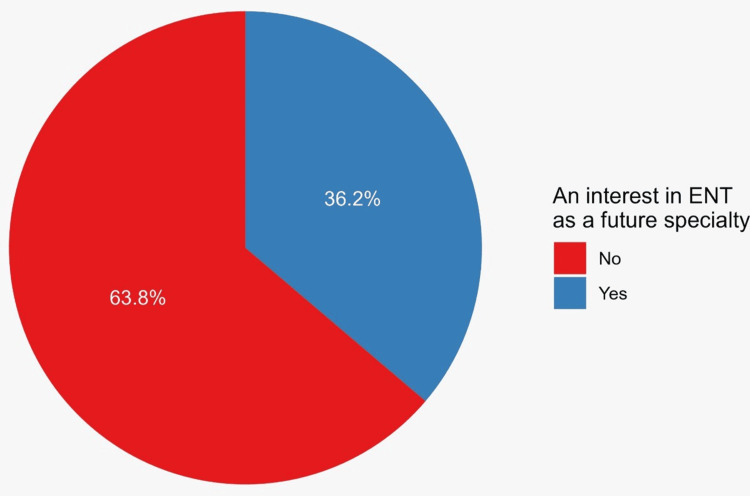 Figure 1
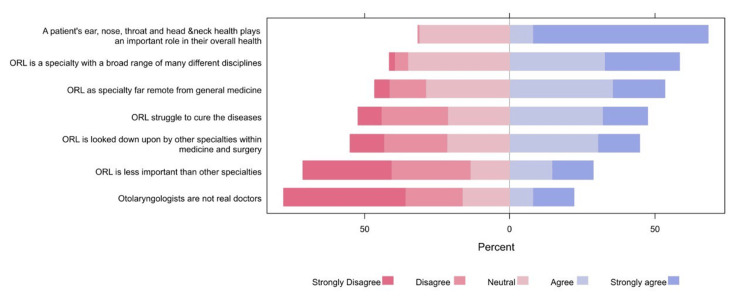 Figure 2
| Characteristic | N=439 (N (%)) |
| Gender | |
| Male | 100 (22.8%) |
| Female | 339 (77.2%) |
| Marital status | |
| Non-engaged | 402 (91.6%) |
| Engaged | 37 (8.4%) |
| Academic year | |
| Pre-clinical | 213 (48.5%) |
| Clinical | 207 (47.2%) |
| Intern | 19 (4.3%) |
| GPA (out of 4) | |
| <3.00 | 17 (3.9%) |
| 3.00-3.39 | 37 (8.4%) |
| 3.40-3.69 | 94 (21.4%) |
| >3.70 | 291 (66.3%) |
| Have you completed your ORL-head and neck rotation? | 78 (17.8%) |
| Your preference regarding accompanying physician in ORL-head and neck surgery outpatient clinics and operation rooms | |
| Resident | 144 (32.8%) |
| Specialist | 136 (31.0%) |
| Consultant | 159 (36.2%) |
| Characteristic | Having an interest in ENT | p-value | |
| No (N=280) (N (%)) | Yes (N=159) (N (%)) | ||
| Gender | 0.773 | ||
| Male | 65 (23.2%) | 35 (22.0%) | |
| Female | 215 (76.8%) | 124 (78.0%) | |
| Marital status | 0.198 | ||
| Non-engaged | 260 (92.9%) | 142 (89.3%) | |
| Engaged | 20 (7.1%) | 17 (10.7%) | |
| Academic year | 0.113 | ||
| Pre-clinical | 128 (45.7%) | 85 (53.5%) | |
| Clinical | 142 (50.7%) | 65 (40.9%) | |
| Intern | 10 (3.6%) | 9 (5.7%) | |
| GPA (out of 4) | 0.294 | ||
| <3.00 | 13 (4.6%) | 4 (2.5%) | |
| 3.00-3.39 | 26 (9.3%) | 11 (6.9%) | |
| 3.40-3.69 | 64 (22.9%) | 30 (18.9%) | |
| >3.70 | 177 (63.2%) | 114 (71.7%) | |
| Have you completed your ORL-head and neck rotation? | 45 (16.1%) | 33 (20.8%) | 0.217 |
| Your preference regarding accompanying physician in ORL-head and neck surgery outpatient clinics and operation rooms | 0.776 | ||
| Resident | 94 (33.6%) | 50 (31.4%) | |
| Specialist | 88 (31.4%) | 48 (30.2%) | |
| Consultant | 98 (35.0%) | 61 (38.4%) | |
| Characteristic | Strongly disagree | Disagree | Neutral | Agree | Strongly agree |
| The most attractive features in otolaryngologists' work that could make you choose to work in ORL | |||||
| Long-term doctor-patient relationships | 6 (1.4%) | 56 (12.8%) | 120 (27.3%) | 138 (31.4%) | 119 (27.1%) |
| Versatile, challenging work | 2 (0.5%) | 34 (7.7%) | 120 (27.3%) | 170 (38.7%) | 113 (25.7%) |
| Comprehensive doctor-patient relationships | 2 (0.5%) | 29 (6.6%) | 122 (27.8%) | 170 (38.7%) | 116 (26.4%) |
| A window into ordinary people's everyday life | 0 (0.0%) | 32 (7.3%) | 117 (26.7%) | 192 (43.7%) | 98 (22.3%) |
| Opportunity to meet people of different age groups and various backgrounds | 4 (0.9%) | 19 (4.3%) | 75 (17.1%) | 201 (45.8%) | 140 (31.9%) |
| Well-paid job | 2 (0.5%) | 11 (2.5%) | 91 (20.7%) | 160 (36.4%) | 175 (39.9%) |
| Rewarding work, grateful patients | 0 (0.0%) | 6 (1.4%) | 88 (20.0%) | 164 (37.4%) | 181 (41.2%) |
| Secure and respected job | 0 (0.0%) | 4 (0.9%) | 96 (21.9%) | 160 (36.4%) | 179 (40.8%) |
| The most unattractive features in otolaryngologists' work that make you rethink the possibility of working as an otolaryngologist in the future | |||||
| Long-term doctor-patient relationships with demanding patients | 19 (4.3%) | 72 (16.4%) | 127 (28.9%) | 111 (25.3%) | 110 (25.1%) |
| Work too challenging and difficult | 21 (4.8%) | 65 (14.8%) | 137 (31.2%) | 158 (36.0%) | 58 (13.2%) |
| Work too routine and tedious | 22 (5.0%) | 58 (13.2%) | 134 (30.5%) | 148 (33.7%) | 77 (17.5%) |
| Too much dealing with non-medical problems | 29 (6.6%) | 75 (17.1%) | 132 (30.1%) | 128 (29.2%) | 75 (17.1%) |
| Too hasty and pressing work | 17 (3.9%) | 68 (15.5%) | 167 (38.0%) | 119 (27.1%) | 68 (15.5%) |
| Poor-paid job | 44 (10.0%) | 89 (20.3%) | 133 (30.3%) | 82 (18.7%) | 91 (20.7%) |
| Characteristic | N=439 (N (%)) |
| Main cause of non-preference for ORL-head and neck specialty among students not-preferring ORL-head and neck specialty | |
| Bad surgical lifestyle | 99 (22.6%) |
| Bad teaching | 63 (14.4%) |
| Difficult surgery | 68 (15.5%) |
| No information | 199 (45.3%) |
| Prefer other surgical | 143 (32.6%) |
| Require high grades | 152 (34.6%) |
| Not interesting | 250 (56.9%) |
| Prefer other medical specialty | 227 (51.7%) |
| Main cause of preference for ORL-head and neck specialty among students preferring ORL-head and neck specialty | |
| Able to spend appropriate time with my family | 172 (39.2%) |
| Acceptable on-call schedule | 140 (31.9%) |
| Health promotion is important | 50 (11.4%) |
| Experiences in health fields during medical school | 63 (14.4%) |
| Focus on in-hospital care | 72 (16.4%) |
| High income potential | 152 (34.6%) |
| Keep options open | 119 (27.1%) |
| Flexibility outside of medicine | 107 (24.4%) |
| Research interest | 111 (25.3%) |
| Focus on patients in community | 69 (15.7%) |
| Good match to career | 127 (28.9%) |
| Intervention results immediate | 78 (17.8%) |
| Meaningful past experience | 57 (13.0%) |
| Patient population is interesting | 71 (16.2%) |
| Prefer medical to social problems | 55 (12.5%) |
| Acceptable hours of practice | 214 (48.7%) |
| Experiences with role models during medical school | 66 (15.0%) |
| Stable/secure future | 194 (44.2%) |
| Flexibility inside of medicine | 198 (45.1%) |
Peer Reviews
No public reviews on file for this paper yet. If you reviewed it on a platform where reviews are public (OpenReview, ICLR, NeurIPS, ICML), you can paste yours below so the community can read it here.
Videos
No videos yet. Explain this paper in a talk, walkthrough, or lecture? Add one.
Taxonomy
TopicsDiversity and Career in Medicine · Medical Education and Admissions · Global Health Workforce Issues
Introduction
Otorhinolaryngology (ORL) is a surgical subspecialty that focuses on diseases affecting the ears, nose, throat, head, and neck. ORL specialists treat patients from all age groups, ranging from neonates with airway challenges to elderly patients with head and neck cancer [1].
Knowledge of professional choices among medical students is important to ensure a balanced distribution of doctors in different specialties. Specialties lacking an adequate workforce need to be incentivized. In medical colleges, students encounter a broad range of specialties. Numerous factors are considered to guarantee a reasonable understanding of the burdens in each specialty, including personality characteristics, lifestyle, flexibility of work hours, and income [2-7].
Various factors influence the professional decisions of undergraduate students, such as individual passion for the specialty, future aspirations, career reputation, job movement, and salary expectations [8]. Published data suggest that medical students prefer certain specialties before graduation [9].
Studies have also shown that medical students frequently choose surgery, internal medicine, pediatrics, obstetrics, and gynecology [10]. Female doctors favored specialties where they could find flexibility in work hours, which gave them more time to spend with their families and friends. Male doctors exhibited an affinity for high-income specialties [10]. Furthermore, male doctors were more prone to studying and working abroad [11].
A study conducted among medical students in Najran, Saudi Arabia, found that no one chose ORL as the first choice [12]. Notably, short training in the ORL department leads to less exposure to the specialty, leading to less likelihood of fostering a preference for it [12]. Good teaching, exposure to a variety of diseases, and sufficient time spent in an ORL-head and neck surgery department are more likely to encourage choosing it as a future career [13].
The choice of a new specialty is constantly changing and affected by various factors. Therefore, it is necessary to understand what motivates medical students. This study aimed to explore factors affecting the choice of ORL-head and neck surgery as a future career among medical students at Umm Al-Qura University, Makkah, Saudi Arabia.
Materials and methods
A cross-sectional study was performed from October to November 2023 via an online survey on social media to collect data on participants' demographics and the causes and factors affecting their preference for ORL-head and neck surgery as a future career. This study was conducted among medical students at Umm Al-Qura University, Makkah, Saudi Arabia, using validated questionnaires (English version).
The survey tool was prepared based on a review of existing literature. Using the Raosoft calculator, the sample size was determined to be more than 302 applicants, with a confidence interval of 95% and a level of significance (p-value) of 5%. In total, 439 participants completed the survey. We included male and female medical students in their second to sixth years and those undergoing internships.
The survey was composed of three parts. The first part included demographic details, including sex, age, and academic year. The second part of the questionnaire dealt with obtaining information about ear, nose, and throat (ENT) rotation, such as its duration and year, whether an objective structured clinical examination (OSCE) was part of it, and which doctor's operating room and the outpatient clinic the students spent the majority of their rotation time in. For students who considered ORL-head and neck surgery as one of their future specialty options, the third section of the questionnaire contained inquiries about the variables that influenced this choice.
This section of the survey was modified based on research conducted by Scott et al. [14]. Statistical analyses were performed using the RStudio software (R version 4.3.1). Categorical variables are expressed as frequencies and percentages. Multiple-response analysis was performed to analyze variables with multiple available responses. Factors associated with interest in ENT as a future specialty were explored using Pearson's chi-square test. Statistical significance was defined as p<0.05.
Ethical approval
The Institutional Research Board (IRB) (Biomedical Research Ethics Committee) at Umm Al-Qura University in Makkah City, Saudi Arabia, approved the study (IRB number: HAPO-02-K-012-2023-10-1812).
Before the study, all participants were provided with information regarding the study's objectives and were asked for their agreement. They were also told that their responses would be kept confidential.
Results
Demographic and academic characteristics
In this study, we analyzed the responses of 439 medical students at Umm Al-Qura University, Makkah, Saudi Arabia. Females accounted for 339 (77.2%) of the participants.
As regards marital status, a majority of the participants reported being non-engaged (402 (91.6%)). Participants were evenly distributed across pre-clinical (213 (48.5%)) and clinical (207 (47.2%)) years, with a smaller percentage in the intern category (19 (4.3%)). Regarding academic performance, a substantial proportion of students had a GPA exceeding 3.70 out of 4 (291 (66.3%)). Notably, only 78 (17.8%) participants completed their ORL-head and neck rotations (Table 1).
Interest in ORL and associated factors
When asked about their future specialty preferences, 159 students expressed interest in ORL, representing 36.2% of the study sample (Figure 1).
Proportions of participants with and without interests in ENT as a future specialtyENT: ear, nose, and throat
In terms of accompanying physicians in ORL-head and neck surgery outpatient clinics and operating rooms, the highest preference was for consultants (61 (38.4%)). Interest in ORL was not significantly associated with any demographic or academic characteristic of the participants (Table 2).
Table 2: Factors associated with having an interest in ENT as a future specialtyp-value is considered significant at p<0.05 and p<0.001.ENT: ear, nose, and throat, GPA: grade point average, ORL: otorhinolaryngology
Perceptions regarding certain aspects of ORL
A majority of the participants agreed or strongly agreed with the statement that "a patient's ear, nose, throat, and head and neck health plays an important role in their overall health" (299 (68.3%)). While a considerable proportion acknowledged ORL as a specialty with a broad range of disciplines (256 (58.5%)), there was a notable concern about ORL being perceived as far removed from general medicine (234 (53.5%)), expressing agreement with the notion. Contrastingly, 92 (22.1%) and 126 (28.7%) students, respectively, agreed or strongly agreed with the perception that otolaryngologists were not real doctors and that ORL was less important than other specialties (Figure 2).
Participants' perceptions regarding certain aspects of ORLORL: otorhinolaryngology
Perceived attractive and unattractive features in otolaryngologists' work
An analysis of the participants' perceptions of the most attractive features influencing their choice to work in ORL revealed that the majority strongly agreed or agreed with factors such as versatile and challenging work (283 (64.4%)), comprehensive doctor-patient relationships (286 (65.1%)), and the opportunity to meet people of different age groups and backgrounds (341 (77.7%)). Additionally, aspects such as rewarding work with grateful patients (345 (78.6%)) and the perception of a secure and respected job (339 (77.2%)) were highly endorsed. Conversely, when considering the factors that may deter participants from choosing ORL as a future specialty, the highest agreement was observed regarding long-term doctor-patient relationships with demanding patients (221 (50.4%)) and finding the work too challenging and difficult (216 (49.2%)) (Table 3).
Perceptions regarding the reasons for ORL preference and non-preference
Among students who did not prefer the ORL-head and neck specialty at Umm Al-Qura University, the primary cause cited was not finding the specialty interesting (250 (56.9%)). Other notable factors contributing to non-preference included a preference for other medical specialties (227 (51.7%)) and a lack of information (199 (45.3%)). However, for those preferring the ORL-head and neck specialty, the most frequently cited reason was acceptable hours of practice (214 (48.7%)). Additionally, flexibility in medicine (198 (45.1%)) and a stable/secure future (194 (44.2%)) were also significant factors influencing the preference for ORL (Table 4).
Discussion
Choosing a postgraduate program is often considered one of the most challenging decisions for medical students. Several variables influence the decisions of medical students and interns regarding their future specialization.
This study aimed to examine the determinants of medical students' selection of ORL-head and neck surgery as a prospective specialty. A total of 439 medical students enrolled in the Faculty of Medicine, Umm Al-Qura University, Makkah, Saudi Arabia, participated in the survey.
Our study found that factors such as sex, marital status, academic year, GPA, and completion of the ORL-head and neck surgery rotation did not significantly affect students' preference for ORL-head and neck surgery as a future career. Similarly, another study showed that age, sex, and duration of rotation did not significantly affect students' preference for ORL-head and neck surgery [15]. Contrastingly, another study found that limited exposure prevented students from choosing ORL-head and neck surgery as a future specialty [16].
A study conducted in Nigeria found that none of the participants chose ORL-head and neck surgery as their preferred specialty [12]. Additionally, only 22 (6.6%) medical students in Saudi Arabia were interested in ORL-head and neck surgery [17]. Both studies considered this finding to be due to the limited exposure to the specialty in medical school. However, in this study, we found that 156 (36.2%) participants showed an interest in ORL-head and neck surgery as a future specialty, with a minority of the participants completing ORL-head and neck surgery rotation (78 (17.8%)).
Students' decisions to pursue surgical professions are affected by their early exposure to positive role models and professional and educational possibilities in surgery as a career field [7]. According to 78 (78%) medical students in a previous study, exposure to residents was the primary motivator for choosing ORL-head and neck surgery, highlighting the importance of resident-student relationships [13]. However, we found no impact of the physician's role on medical students' preference for accompanying them in ORL-head and neck surgery outpatient clinics or operating rooms. This finding may be due to differences in participants' experiences in outpatient clinics and operating rooms.
Regarding the perception of certain aspects of ORL-head and neck surgery, a large proportion of the medical students (29 (68.3%)) believed that ENT health was an important reflection of overall health. Additionally, a smaller proportion of respondents acknowledged that the ORL specialty encompasses a broad range of different disciplines, highlighting the importance of ORL in contributing to overall health; however, over half of the students (25 (58.5%)) agreed that ORL was far removed from general medicine. Additionally, 9-12 (22.1%-28.7%) agreed that doctors who chose ORL as their specialty were not real doctors. One contributing factor to this perception may be the low exposure to specialties throughout medical school. A survey conducted in the United Kingdom highlighted that 16% of the national selection candidates had not received any exposure to ENT during their medical curriculum or clinical foundation [18].
One of the most compelling aspects that motivated students to pursue ORL as a specialty was satisfaction with working with appreciative patients (345 (78.6%)). The broad spectrum of patients from diverse age groups, sexes, and backgrounds (341 (77.7%)) further contributes to the appeal of choosing ORL as a career. However, it is worth mentioning that the challenges associated with developing long-term doctor-patient relationships (221 (50.4%)), the level of difficulty, and the considerable effort required in the field (216 (49.2%)) are factors that students also consider when making decisions about their ORL career path.
The primary reason students at Umm Al-Qura University did not prefer ORL as a specialty included a lack of interest (250 (56.9%)). According to a study by Alamri et al. [19], this is one of the primary reasons students do not pursue ORL as a specialty. Other factors included a preference for other specialties (227 (51.7%)) and a lack of information regarding ORL (199 (45.3%)). For those preferring ORL, the main reasons were acceptable working hours (214 (48.7%)), flexibility in medicine (198 (45.1%)), and a stable future (194 (44.2%)).
Study strengths
This study offers valuable insights into the factors influencing medical students' decisions regarding ORL-head and neck surgeries. With a large sample size, these findings contribute to existing literature. The comprehensive analysis and practical implications provide actionable recommendations for promoting interest in this specialty.
Limitations
This study has some limitations, as it included a single university. Furthermore, we included all second-year undergraduates and medical interns with varying degrees of experience in ORL-head and neck surgery; also, a few interns participated in the study.
Recommendations
To promote interest in ORL-head and neck surgery as a specialty, enhancing exposure through early and comprehensive rotations, fostering positive role models, and integrating ORL-related topics into the medical curriculum are recommended. These measures can inspire students, shape their perceptions, and highlight the multidisciplinary nature of this field.
Conclusions
This study sought to understand the factors that contribute to patients' decisions to specialize in ORL-head and neck surgery in Makkah, Saudi Arabia. A large portion of participants chose ORL for a variety of reasons, including its function in general health, its vast range of many different disciplines, and its perception as being far from general medicine, as indicated by 36.2% of the respondents. These findings suggest that senior physicians should work harder to educate juniors about their areas of expertise through campaigns and lectures at hospitals and universities.
The reference list from the paper itself. Each links out to its DOI / PubMed record.
- 1So you want to be an ENT surgeon BMJ Powell S 03342007
- 2Influence of controllable lifestyle on recent trends in specialty choice by US medical students JAMA Dorsey ER Jarjoura D Rutecki GW 1173117829020031295299910.1001/jama.290.9.1173 · doi ↗ · pubmed ↗
- 3Influence of income, hours worked, and loan repayment on medical students' decision to pursue a primary care career JAMA Rosenthal MP Diamond JJ Rabinowitz HK 9149172711994 https://pubmed.ncbi.nlm.nih.gov/8120959/8120959 · pubmed ↗
- 4Factors associated with the perception that debt influences physicians' specialty choices Acad Med Baker LC Barker DC 10881096721997943571610.1097/00001888-199712000-00021 · doi ↗ · pubmed ↗
- 5Insights into medical students' career choices based on third- and fourth-year students' focus-group discussions Acad Med Mutha S Takayama JI O'Neil EH 635640721997923647510.1097/00001888-199707000-00017 · doi ↗ · pubmed ↗
- 6The impact of role models on medical students J Gen Intern Med Wright S Wong A Newill C 5356121997903494610.1046/j.1525-1497.1997.12109.x PMC 1497058 · doi ↗ · pubmed ↗
- 7What influences medical students' choice of surgical careers Surgery Erzurum VZ Obermeyer RJ Fecher A 25325612820001092300010.1067/msy.2000.108214 · doi ↗ · pubmed ↗
- 8Carrier choices and the factors influencing it among medical students in a private medical college in Tamilnadu Int J Community Med Public Health Sharma D Pattnaik S 1110111242017