Cerebral Amyloidosis in Individuals with Subjective Cognitive Decline: From Genetic Predisposition to Actual Cerebrospinal Fluid Measurements
Stefanos N. Sampatakakis, Niki Mourtzi, Sokratis Charisis, Faidra Kalligerou, Eirini Mamalaki, Eva Ntanasi, Alex Hatzimanolis, Georgios Koutsis, Alfredo Ramirez, Jean-Charles Lambert, Mary Yannakoulia, Mary H. Kosmidis, Efthimios Dardiotis, Georgios Hadjigeorgiou

TL;DR
This study finds that cerebral amyloidosis, either genetically predicted or measured in cerebrospinal fluid, is linked to subjective cognitive decline, but tau levels are not.
Contribution
The study identifies a specific link between cerebral amyloidosis and subjective cognitive decline using both genetic and fluid biomarkers.
Findings
Abnormal CSF Aβ42 levels are associated with 2.5-fold higher odds of SCD.
Higher polygenic loading for Aβ42 is linked to 1.6-fold higher odds of SCD.
CSF Tau and polygenic Tau loading show no association with SCD.
Abstract
The possible relationship between Subjective Cognitive Decline (SCD) and dementia needs further investigation. In the present study, we explored the association between specific biomarkers of Alzheimer’s Disease (AD), amyloid-beta 42 (Aβ42) and Tau with the odds of SCD using data from two ongoing studies. In total, 849 cognitively normal (CN) individuals were included in our analyses. Among the participants, 107 had available results regarding cerebrospinal fluid (CSF) Aβ42 and Tau, while 742 had available genetic data to construct polygenic risk scores (PRSs) reflecting their genetic predisposition for CSF Aβ42 and plasma total Tau levels. The associations between AD biomarkers and SCD were tested using logistic regression models adjusted for possible confounders such as age, sex, education, depression, and baseline cognitive test scores. Abnormal values of CSF Aβ42 were related to…
Genes, proteins, chemicals, diseases, species, mutations and cell lines named across the full text — each resolved to its canonical identifier and authoritative record.
Click any figure to enlarge with its caption.
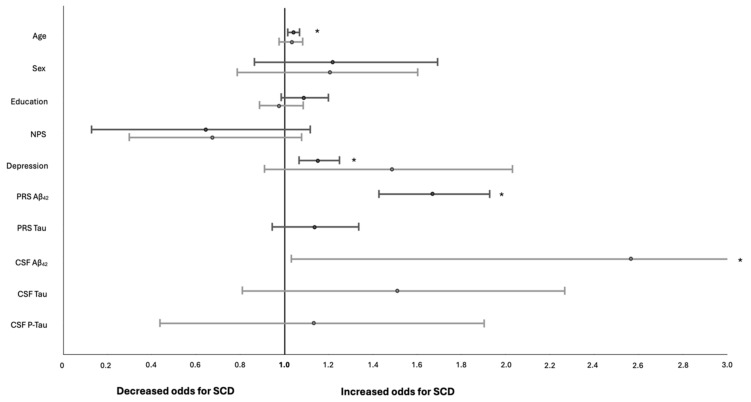 Figure 1
Peer Reviews
No public reviews on file for this paper yet. If you reviewed it on a platform where reviews are public (OpenReview, ICLR, NeurIPS, ICML), you can paste yours below so the community can read it here.
Videos
No videos yet. Explain this paper in a talk, walkthrough, or lecture? Add one.
Taxonomy
TopicsAlzheimer's disease research and treatments · Dementia and Cognitive Impairment Research · Genetic Associations and Epidemiology