A Practical Guide for the Quality Evaluation of Fluobodies/Chromobodies
Urša Štrancar, Claudia D’Ercole, Lucia Cikatricisová, Mirna Nakić, Matteo De March, Ario de Marco

TL;DR
This paper explains common issues in evaluating fluobodies/chromobodies and offers practical advice for improving their quality control.
Contribution
The paper identifies specific artefacts in FP-based immunoreagents and provides actionable guidelines for FP selection and handling.
Findings
Unexpected bands in SDS-PAGE were linked to FP degradation or experimental conditions.
Heating in loading buffer significantly affected FP stability and migration.
N-terminal methionine removal did not prevent FP fragment appearance.
Abstract
Background: Fluorescent proteins (FPs) are pivotal reagents for flow cytometry analysis or fluorescent microscopy. A new generation of immunoreagents (fluobodies/chromobodies) has been developed by fusing recombinant nanobodies to FPs. Methods: We analyzed the quality of such biomolecules by a combination of gel filtration and SDS-PAGE to identify artefacts due to aggregation or material degradation. Results: In the SDS-PAGE run, unexpected bands corresponding to separate fluobodies were evidenced and characterized as either degradation products or artefacts that systematically resulted in the presence of specific FPs and some experimental conditions. The elimination of N-terminal methionine from FPs did not impair the appearance of FP fragments, whereas the stability and migration characteristics of some FP constructs were strongly affected by heating in loading buffer, which is a step…
Click any figure to enlarge with its caption.
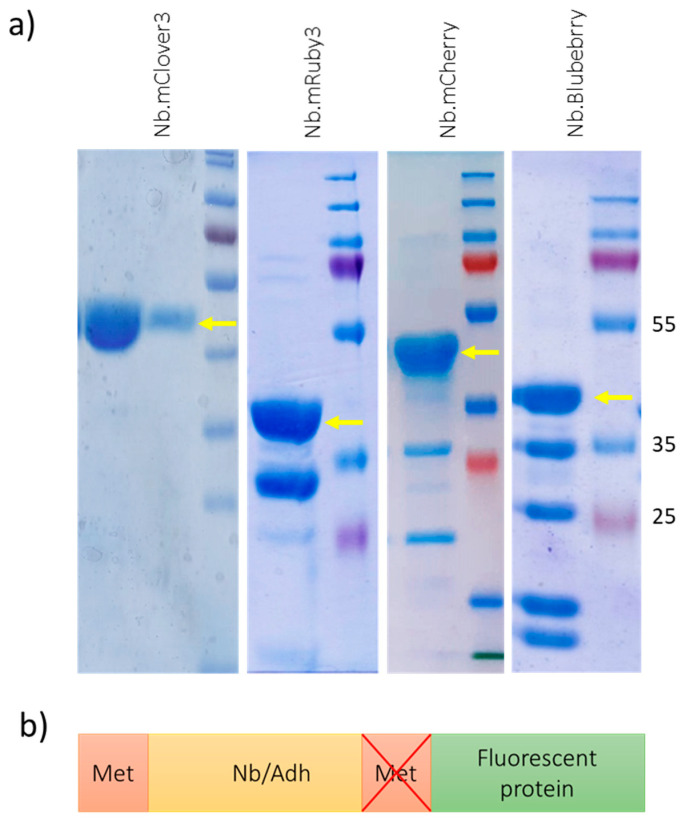 Figure 1
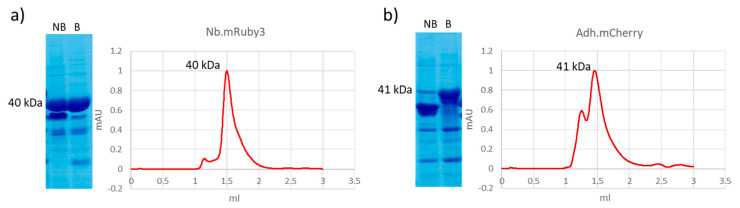 Figure 2
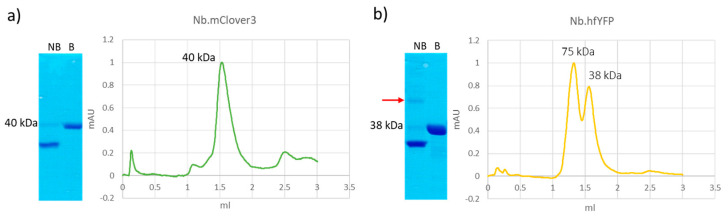 Figure 3
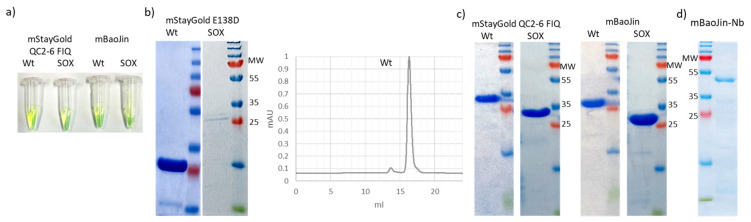 Figure 4
Peer Reviews
No public reviews on file for this paper yet. If you reviewed it on a platform where reviews are public (OpenReview, ICLR, NeurIPS, ICML), you can paste yours below so the community can read it here.
Videos
No videos yet. Explain this paper in a talk, walkthrough, or lecture? Add one.
Taxonomy
TopicsMonoclonal and Polyclonal Antibodies Research · Glycosylation and Glycoproteins Research · Advanced Biosensing Techniques and Applications