A study that redefines the concept of a well-known orchid–pollinator attraction strategy
Hong Liu

Abstract
Genes, proteins, chemicals, diseases, species, mutations and cell lines named across the full text — each resolved to its canonical identifier and authoritative record.
Click any figure to enlarge with its caption.
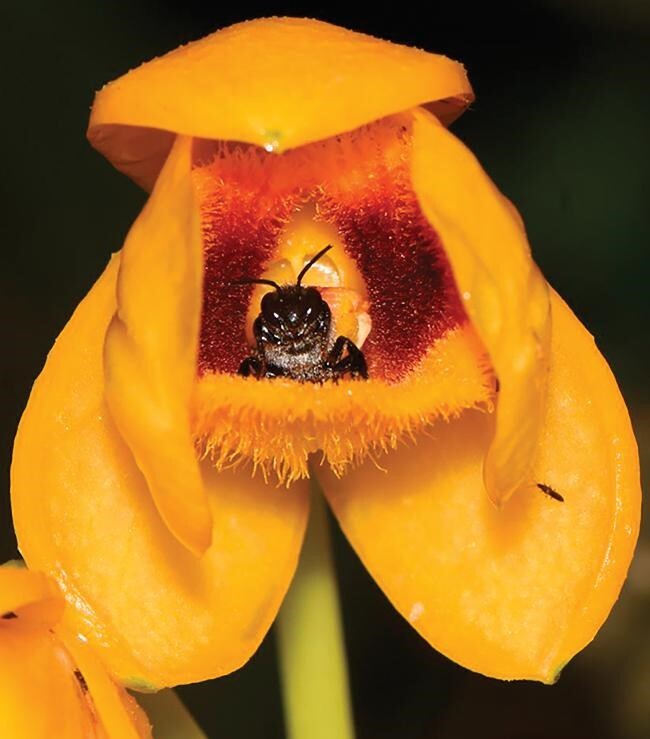 Figure 1
Peer Reviews
No public reviews on file for this paper yet. If you reviewed it on a platform where reviews are public (OpenReview, ICLR, NeurIPS, ICML), you can paste yours below so the community can read it here.
Videos
No videos yet. Explain this paper in a talk, walkthrough, or lecture? Add one.
Taxonomy
TopicsPlant and animal studies · Plant Parasitism and Resistance · Ecology and Vegetation Dynamics Studies
Zhang and collaborators [1] demonstrated that bees of the genus Ctenoplectra collect oil from the newly reported oil-reward orchids of the genera Dendrobium and Galeola in Asia, and that the majority of the bees that carry out this act and pollinate the orchids are male. These are new discoveries with significant implications for biodiversity conservation.
In-depth knowledge on the interaction web of species is critical in formulating effective conservation strategies for species that are in danger of extinction, as is the case for a neotropical oil-reward mimic orchid [2]. While we know that species interactions can be complex, the discovery of Zhang et al. reminds us that we are still far from knowing the true nature of these interaction webs.
Orchid–pollinator interactions are probably one of the best systems for illustrating the complexity and intrigues of nature's interaction web. Globally, orchid pollinators are highly diverse with vastly varied life histories [3]. An example of the most fascinating, specialized orchid–pollinator interactions is the male euglossine bees in tropical America, which collect particular plant chemicals from perfume orchids to be presented to female bees as part of the courtship. Both male and female euglossine bees would collect nectar and pollen from other plants to fulfill their nutritional needs [4]. Conservation of the perfume orchids would demand the protection of the pollinating bees as well as other species in this interaction web.
In another equally specialized and complex orchid–pollinator relationship, oil-reward offering or mimicking orchids in tropical America are visited and pollinated by oil-collecting bees. This pollinator attraction strategy involving floral oil rewards is currently defined based on the most comprehensive global orchid–pollinator database, as ‘(orchids offered floral) lipids (that) are collected by FEMALE bees to construct or provision nest cells’ [3]. The discovery by Zhang et al. [1] that male bees of the genus Ctenoplectra collect oil from oil-offering orchids of the Asian genera Dendrobium and Galeola demands the revision of this well-accepted concept of the lipid-reward pollinator attracting strategy to include male bees!
The purpose of the oils collected by the Ctenoplectra females is assumed to be as food for broods, as are the oils collected by the female Centris bees in tropical America. Zhang et al. [1] showed that the male Ctenoplectra bees would transfer the oil to the females during mating. Therefore, oils collected by the male Ctenoplectra are likely to be copulatory ‘gifts’ for the female bees. If this is proven to be the case (more work is needed here), then Ctenoplectra becomes one of the many insect species that engage in the romantic behavior of copulatory gifting.
The report of oil secretion in nearly 79.5% (n = 39) of the Dendrobium species studied (see Tables S1 and S2 in [1]) is also the first to discover oil-offering orchids that are exclusively pollinated by oil-collecting bees in Asia (also see [5] on oil-offering Cymbidium aloifolium pollinated by a generalist honeybee Apis cerana). These discoveries may indicate that the orchid-oil-reward flower system could involve a large number of orchids in Asia, as there are 1647 species in the genus (https://www.worldfloraonline.org/taxon/wfo-4000011060). Dendrobium has many species of horticultural and medicinal significance, and a more thorough understanding of the ecology of these species would help in the sustainable use and conservation of these valuable biological resources. Zhang et al. [1] represents a major contribution to our knowledge of orchid pollination in tropical Asia and globally (Fig. 1).
The reference list from the paper itself. Each links out to its DOI / PubMed record.
- 1Zhang M, Jia L-B, Renner SS et al. Natl Sci Rev 2024; 11: nwae 072. 10.1093/nsr/nwae 07210.1093/nsr/nwae 072PMC 1112769538798961 · doi ↗ · pubmed ↗
- 2Pemberton RW, Liu H. Biol Conserv 2008; 141: 1758–64.10.1016/j.biocon.2008.04.016 · doi ↗
- 3Ackerman JD, Phillips RD, Tremblay RL et al. Bot J Linn Soc 2023; 202: 295–324. 10.1093/botlinnean/boac 082 10.1093/botlinnean/boac 082 · doi ↗
- 4Pemberton RW. Bot Rev 2010; 76: 275–92.10.1007/s 12229-010-9047-7 · doi ↗
- 5Adit A, Koul M, Choudhary AK et al. Ecol Evol 2022; 12: e 8697. 10.1002/ece 3.869710.1002/ece 3.869735342566 PMC 8928877 · doi ↗ · pubmed ↗